Thursday, 25 November, 2010

A Green Jobs Primer -- by Bracken Hendricks, Andrew Light, Benjamin Goldstein, John Podesta

This analysis originally appeared on the Centre for American Progress website: 6 Apr 2009 and 9 Sep 2008.


Our country faces two immense, interrelated challenges: Charting a course to economic recovery and tackling the threat of global warming. Both are moral imperatives…. Meeting these challenges head on now and into the future is straightforward—begin a robust and aggressive transition towards a clean energy economy. Building the green economy will also create millions of new green jobs, offering hope to many Americans who are out of work or facing possible layoffs.

1. What is a green job?

The short answer: Green jobs enhance environmental quality, build a vibrant clean energy economy, and help to expand the American middle class.

The long answer: Green jobs are today’s jobs but repurposed and expanded to build a sustainable low-carbon economy. Most green jobs will be in occupations that people already work in today. Constructing wind farms creates jobs for sheet metal workers and industrial truck drivers. Energy efficiency retrofits for buildings employ roofers and insulators. And expanding mass transit systems employs electricians and dispatchers. Green jobs are not an entirely new job sector. Akin to more familiar blue collar jobs, this new class of employment refers to certain types of productive activities rather than a specific job classification.

What’s more, green jobs are inherently local and difficult to outsource. Green jobs involve transforming today’s homes, offices and factories and investing in new, low-carbon infrastructure. This work is impossible to push offshore because it must be preformed on site. Making buildings more energy efficient, constructing mass transit lines, installing solar panels and wind turbines, expanding public green space, and growing and refining advanced biofuels all must take place right here in America.

2. Are green jobs only low-paying jobs?

The short answer: No. Green jobs encompass a wide breadth of skill sets and pay scales. The bulk is good-paying, middle-skill jobs accessible to all Americans.

The long answer: Our research [at Center for American Progress] demonstrates that green jobs are broadly distributed across the entire spectrum of the economy. In a side-by-side comparison of job creation from green investments versus investments in the oil industry, we demonstrated that nearly four times more jobs are created overall at every step in the pay scale and across every skill level. Green jobs represent a wide range of points of entry into meaningful, long-term employment, and can provide ladders into the middle class for lower-skilled workers if career advancement and workforce training opportunities are integrated into our larger economic development strategies.

In fact, green jobs are blue collar and white collar alike. Green jobs are not only production-line construction and manufacturing jobs. Green businesses will need secretaries, managers and accountants, too. High-technology endeavors will offer new opportunities in green design, engineering, and finance. Such a diverse spectrum of job creation is precisely what we need in an economy suffering from its worst downturn since the Great Depression.

3. Do gains in green jobs cause losses in other sectors of the economy?

The short answer: No. A clean energy economy will result in net job creation because green investments are domestic, have a large multiplier effect, and create work that is skill and labor intensive.

The long answer: Investments in renewable energy and energy efficiency can create twice as many jobs per unit of energy and per dollar than traditional fossil-fuel investments by redirecting money previously spent on wasted energy, pollution, and imported fuel toward advanced manufacturing, modern infrastructure, and skilled labor. In the beginning stages, green jobs will simply result in the creation of new jobs that did not exist before, putting people to work without displacing existing sectors. In the medium term, some particularly polluting sectors of the economy experience employment downturns, which is why we must devise smart policies to transition affected workers.

But one day all good jobs will be green jobs as we build an economy where productivity and competitiveness are contingent on increased environmental stewardship and efficient use of all resources, including energy. Moreover, initial public investments in green infrastructure will “crowd-in” private capital. This follows a time-tested script that helped build the railroads, the national highway system, and enabled the development of the Internet revolution. In each case, strategic public investment enabled market transformation and the growth of new industries and vast new opportunities for economic growth and wealth generation.

4. Are green jobs the result of picking technological “winners?”

The short answer: No. A clean energy economy will reward efficiency, low-carbon energy and environmental stewardship. Any and all technologies can compete and contribute in this transformed market.

The long answer: Building a clean energy economy means fixing broken markets where the costs of pollution are passed onto future generations. Setting strong market signals with smart policies through a combination of investment and regulation will allow the market to decide the most appropriate technologies without distorting real consumer choices.

These policies will also spur a huge wave of innovation as the private sector steps up to meet the challenges of solving global warming and reducing our dependence on polluting fossil fuels. That’s the ultimate promise of new green jobs in a clean energy economy.

Green recovery -- by John Podesta 9 Sep 2008

Our economy is in trouble. Falling home prices, foreclosures, bank failures, a weaker dollar, rising prices for gas, food, and steel, and layoffs in banking, construction, and manufacturing sectors are all indicators of serious economic strain—following a long period in which the middle class went nowhere even while the economy grew as a whole… the current downturn will continue for at least another year.

At the same time, we face a growing climate crisis that will require us to rapidly invest in new energy infrastructure, cleaner sources of power, and more efficient use of electricity and fuels in order to cut global warming pollution. There is much work to be done in building smart solutions at a scale and speed that is bold enough to meet this gathering challenge.

It is time for a new vision for the economic revitalization of the nation and a restoration of American leadership in the world. We must seize this precious opportunity to mobilize the country and the international community toward a brighter, more prosperous future. At the heart of this opportunity is clean energy, remaking the vast energy systems that power the nation and the world. We must fundamentally change the way we produce and consume energy and dramatically reduce our dependence on oil. The economic opportunities provided by such a transformation are vast, not to mention the national security benefits of reducing oil dependence and the pressing need to fight global warming. The time for action is now.

A report by Dr. Robert Pollin and University of Massachusetts Political Economy Research Institute economists… [shows] how a new Green Recovery program that spends $100 billion over two years would create 2 million new jobs, with a significant proportion in the struggling construction and manufacturing sectors….

Retrofitting buildings to increase energy efficiency

  • Expanding mass transit and freight rail
  • Constructing “smart” electrical grid transmission systems
  • Wind power
  • Solar power
  • Advanced biofuels

This green recovery and infrastructure investment program would:

  • Create 2 million new jobs nationwide over two years
  • Create nearly four times more jobs than spending the same amount of money within the oil industry and 300,000 more jobs than a similar amount of spending directed toward household consumption.
  • Create roughly triple the number of good jobs—paying at least $16 dollars an hour—as spending the same amount of money within the oil industry.
  • Reduce the unemployment rate to 4.4 percent from 5.7 percent (calculated within the framework of U.S. labor market conditions in July 2008).
  • Bolster employment especially in construction and manufacturing. Construction employment has fallen from 8 million to 7.2 million over the past two years due to the housing bubble collapse. The Green Recovery program can, at the least, bring back these lost 800,000 construction jobs.
  • Provide opportunities to rebuild career ladders through training and workforce development that if properly implemented can provide pathways out of poverty to those who need jobs most. (Because green investment not only creates more good jobs with higher wages, but more jobs overall, distributed broadly across the economy, this program can bring more people into good jobs over time.)
  • Help lower oil prices. Moderating domestic energy demand will have greater price effects than modest new domestic supply increases.
  • Begin the reconstruction of local communities and public infrastructure all across America, setting us on a course for a long-term transition to a low-carbon economy that increases our energy independence and helps fight global warming. Currently, about 22 percent of total household expenditures go to imports. With a green infrastructure investment program, only about 9 percent of purchases flow to imports since so much of the investment is rooted in communities and the built environment, keeping more of the resources within the domestic economy.

Our report looked at investments that were funded through near-term government spending...:

  • $50 billion for tax credits. This would assist private businesses and homeowners to finance both commercial and residential building retrofits, as well as investments in renewable energy systems.
  • $46 billion in direct government spending. This would support public building retrofits, the expansion of mass transit, freight rail, smart electrical grid systems, and new investments in renewable energy
  • $4 billion for federal loan guarantees. This would underwrite private credit that would be extended to finance building retrofits and investments in renewable energy.
The plan increases public spending in the short term when a near-recession economy needs greater impetus to growth; but it remains consistent with fiscally responsible long-term plan to reduce the debt as a share of GDP, after the economy recovers....

Friday, 19 November, 2010

Barefoot Economics -- by Manfred Max-Neef

Interview with the Chilean economist by Amy Goodman on Democracy Now! 22 Sep 2010. He won the Right Livelihood Award in 1983, two years after the publication of his book Outside Looking In: Experiences in Barefoot Economics.

Q: . I began by asking him to explain what barefoot economics is.

A: Well, it’s a metaphor, but a metaphor that originated in a concrete experience. I worked for about ten years of my life in areas of extreme poverty in the Sierras, in the jungle, in urban areas in different parts of Latin America. And at the beginning of that period, I was one day in an Indian village in the Sierra in Peru. It was an ugly day. It had been raining all the time. And I was standing in the slum. And across me, another guy also standing in the mud—not in the slum, in the mud. And, well, we looked at each other, and this was a short guy, thin, hungry, jobless, five kids, a wife and a grandmother. And I was the fine economist from Berkeley, teaching in Berkeley, having taught in Berkeley and so on. And we were looking at each other, and then suddenly I realized that I had nothing coherent to say to that man in those circumstances, that my whole language as an economist, you know, was absolutely useless. Should I tell him that he should be happy because the GDP had grown five percent or something? Everything was absurd.


So I discovered that I had no language in that environment and that we had to invent a new language. And that’s the origin of the metaphor of barefoot economics, which concretely means that is the economics that an economist who dares to step into the mud must practice. The point is, you know, that economists study and analyze poverty in their nice offices, have all the statistics, make all the models, and are convinced that they know everything that you can know about poverty. But they don’t understand poverty. And that’s the big problem. And that’s why poverty is still there. And that changed my life as an economist completely. I invented a language that is coherent with those situations and conditions.


Q: And what is that language? How do you apply economics or have those situations explain economics changing?

A: No, the thing is much deeper. I mean, it’s not like a recipe typical of someone in your country, fifteen lessons or satisfaction guaranteed or your money back. That’s not the point. The point is much deeper. You know, I would—let me put it this way. We have reached a point in our evolution in which we know a lot. We know a hell of a lot. But we understand very little. Never in human history has there been such an accumulation of knowledge like in the last 100 years. Look how we are. What was that knowledge for? What did we do with it? And the point is that knowledge alone is not enough, that we lack understanding.


And the difference between knowledge and understanding, I can give it as an example. Let us assume that you have studied everything that you can study, from a theological, sociological, anthropological, biological and even biochemical point of view, of a human phenomenon called love. So the result is that you will know everything that you can know about love. But sooner or later, you will realize that you will never understand love unless you fall in love. What does that mean? That you can only attempt to understand that of which you become a part. If we fall in love, as the Latin song says, we are much more than two. When you belong, you understand. When you’re separated, you can accumulate knowledge. And that is—that’s been the function of science. Now, science is divided into parts, but understanding is holistic.


And that happens with poverty. I understood poverty because I was there. I lived with them. I ate with them. I slept with them, you know, etc. And then you begin to learn that in that environment there are different values, different principles from—compared to those from where you are coming, and that you can learn an enormous amount of fantastic things among poverty. What I have learned from the poor is much more than I learned in the universities. But very few people have that experience, you see? They look at it from the outside, instead of living it from the inside.


And you learn extraordinary things. The first thing you learn, that people who want to work in order to overcome poverty and don’t know, is that in poverty there is an enormous creativity. You cannot be an idiot if you want to survive. Every minute, you have to be thinking, what next? What do I know? What trick can I do here? What’s this and that, that, that, that? And so, your creativity is constant. In addition, I mean, that it’s combined, you know, with networks of cooperation, mutual aid, you know, and all sort of extraordinary things which you’ll no longer find in our dominant society, which is individualistic, greedy, egoistical, etc. It’s just the opposite of what you find there. And it’s sometimes so shocking that you may find people much happier in poverty than what you would find, you know, in your own environment, which also means, you know, that poverty is not just a question of money. It’s a much more complex thing.


Q: What do you think we need to change?

 A: Oh, almost everything. We are simply, dramatically stupid. We act systematically against the evidences we have. We know everything that should not be done. There’s nobody that doesn’t know that. Particularly the big politicians know exactly what should not be done. Yet they do it. After what happened since October 2008, I mean, elementally, you would think what? That now they’re going to change. I mean, they see that the model is not working. The model is even poisonous, you know? Dramatically poisonous. And what is the result, and what happened in the last meeting of the European Union? They are more fundamentalist now than before. So, the only thing you know that you can be sure of, that the next crisis is coming, and it will be twice as much as this one. And for that one, there won’t be enough money anymore. So that will be it. And that is the consequence of systematical human stupidity.


Q: So, to avoid another catastrophe, collision, if you were in charge, what would you say has to happen?

 A: First of all, we need cultured economists again, who know the history, where they come from, how the ideas originated, who did what, and so on and so on; second, an economics now that understands itself very clearly as a subsystem of a larger system that is finite, the biosphere, hence economic growth as an impossibility; and third, a system that understands that it cannot function without the seriousness of ecosystems. And economists know nothing about ecosystems. They don’t know nothing about thermodynamics, you know, nothing about biodiversity or anything. I mean, they are totally ignorant in that respect. And I don’t see what harm it would do, you know, to an economist to know that if the beasts would disappear, he would disappear as well, because there wouldn’t be food anymore. But he doesn’t know that, you know, that we depend absolutely from nature. But for these economists we have, nature is a subsystem of the economy. I mean, it’s absolutely crazy.


And then, in addition, you know, bring consumption closer to production. I live in the south of Chile, in the deep south. And that area is a fantastic area, you know, in milk products and what have you. Top. Technologically, like the maximum, you know? I was, a few months ago, in a hotel, and there in the south, for breakfast, and there are these little butter things, you know? I get one, and it’s butter from New Zealand. I mean, if that isn’t crazy, you know? And why? Because economists don’t know how to calculate really costs, you know? To bring butter from 20,000 kilometers to a place where you make the best butter, under the argument that it was cheaper, is a colossal stupidity, because they don’t take into consideration what is the impact of 20,000 kilometers of transport? What is the impact on the environment of that transportation, you know, and all those things? And in addition, I mean, it’s cheaper because it’s subsidized. So it’s clearly a case in which the prices never tell the truth. It’s all tricks, you know? And those tricks do colossal harms. And if you bring consumption closer to production, you will eat better, you will have better food, you know, and everything. You will know where it comes from. You may even know the person who produces it. You humanize this thing, you know? But the way the economists practice today is totally dehumanized.


Q: You don’t think the earth will force this different way of thinking, that we’re reaching the end?

 A: Oh, well, yes. Yes. I believe, you know, that—well, there are some important scientists that already are saying, I believe. I have not reached that point yet. But some believe, you know, and state that it’s definite: we are finished. We are finished. In a few more decades, I mean, there will be no humanity anymore. I don’t think we have reached that point of it, but I believe that we are pretty close to it. I’ll say that we already crossed one of the three rivers. And if you look at it and what is happening everywhere, I mean, it’s quite frightening how the amount of catastrophes are increasing all over the place, you know, in all manifestations—storms, earthquakes, you know, volcanoes erupting. I mean, the amount of events is growing dramatically. I mean, it’s really frightening. And we continue with the same.


Q: What have you learned that gives you hope in the poor communities that you’ve worked in and lived in?

 A: Solidarity of people. You know, respect for the others. Mutual aid. No greed. I mean, that is a value that is absent in poverty. And you would be inclined to think that there should be more there than elsewhere, you know, that greed should be of people who have nothing. No, quite the contrary. The more you have, the more greedy you become, you know. And all this crisis is the product of greed. Greed is the dominant value today in the world. And as long as that persists, well, we are done.


Q: And if you’re teaching young economists, the principles you would teach them, what they’d be?

 A: The principles, you know, of an economics which should be are based in five postulates and one fundamental value principle.


1. The economy is to serve the people and not the people to serve the economy.


2. Development is about people and not about objects.


3. Growth is not the same as development, and development does not necessarily require growth.


4. No economy is possible in the absence of ecosystem services.


5. The economy is a subsystem of a larger finite system, the biosphere, hence permanent growth is impossible.


Explain that further.

 A: Nothing can be more important than life. And I say life, not human beings, because, for me, the center is the miracle of life in all its manifestations. But if there is an economic interest, I mean, you forget about life, not only of other living beings, but even of human beings. If you go through that list, one after the other, what we have today is exactly the opposite.


Q: Go back to three: growth and development. Explain that further.

 A: Growth is a quantitative accumulation. Development is the liberation of creative possibilities. Every living system in nature grows up to a certain point and stops growing. You are not growing anymore, nor he nor me. But we continue developing ourselves. Otherwise we wouldn’t be dialoguing here now. So development has no limits. Growth has limits. And that is a very big thing, you know, that economists and politicians don’t understand. They are obsessed with the fetish of economic growth.


And I am working, several decades. Many studies have been done. I’m the author of a famous hypothesis, the threshold hypothesis, which says that in every society there is a period in which economic growth, conventionally understood or no, brings about an improvement of the quality of life. But only up to a point, the threshold point, beyond which, if there is more growth, quality of life begins to decline. And that is the situation in which we are now.


I mean, your country is the most dramatic example that you can find. I have gone as far as saying—and this is a chapter of a book of mine that is published next month in England, the title of which is Economics Unmasked. There is a chapter called "The United States, an Underdeveloping Nation," which is a new category. We have developed, underdeveloped and developing. Now you have underdeveloping. And your country is an example, in which the one percent of the Americans, you know, are doing better and better and better, and the 99 percent is going down, in all sorts of manifestations. People living in their cars now and sleeping in their cars, you know, parked in front of the house that used to be their house—thousands of people. Millions of people, you know, have lost everything. But the speculators that brought about the whole mess, oh, they are fantastically well off. No problem. No problem.


Q: So how would you turn that around?

 A: Well, I don’t know how to turn it around. I mean, it will turn around itself, you know, in catastrophic manners. I mean, I don’t understand how there isn’t—millions of people can all of a sudden go out in the streets in the United States and begin destroying things, I don’t know. That may perfectly happen. You know, the situation is absolutely dramatic. Absolutely dramatic. And it is supposed to be the most powerful country in the world, you know, and so on. And even in those conditions, they continue with those stupid wars, you know, and spend more, more, more millions and trillions. Thirteen trillion dollars for the speculators; not one cent for the people who lost their homes! I mean, what kind of logic is that?


Monday, 15 November, 2010

Mystical oneness with nature -- Archbishop William Temple

The treatment of the Earth by man the exploiter is not only imprudent, it is sacrilegious. We are unlikely to correct our hideous mistakes in this realm unless we recover the mystical sense of our oneness with nature. Many people think this is fantastic. I think it is fundamental to our sanity. --
Nature, Man, and God (1934) by Anglican Archbishop William Temple. See his biography in Wikipedia. For other quotations see Malik Imran Awan's 2009 blog post 11 Great Green Minds.

Saturday, 13 November, 2010

300 years of fossil fuel addiction in 5 minutes -- by Post-Carbon Institute


This is just one of many videos from Post Carbon Institute. Founded in 2003 by Julian Darley, PCI is a think tank focusing on climate change, renewable energy and (re-)localization, resource and water depletion, limits to growth, overpopulation, and food. For more of his ideas see Relocalize Now! Getting Ready for Climate Change and the End of Cheap Oil (2005). PCI experts now include Richard Heinberg, Bill McKibben, Majora Carter, Wes Jackson, Joshua Farley, Richard Douthwaite, Rob Hopkins of the international Transition Towns, and many others. Partners are Transition US and Energy Bulletin.net.

Saturday, 6 November, 2010

On being a Quaker and a scientist -- Jocelyn Bell Burnell

Jocelyn Bell Burnell is an active Quaker: former clerk of Britain Yearly Meeting, and current clerk of Friends World Committee for Consultation. She is an astrophysicist who discovered neutron stars and quasars, winner of numerous awards, a role model for women in science, President of the Royal Astronomical Society and the Institute of Physics, mother of an astrophysicist, and grandmother of two. (1) In 2006 Joan Bakewell interviewed her for the BBC program "Belief". This is an excerpt:

Q Today, I talk to someone who comfortably combines distinction in the world of astronomy and physics with a strong religious faith and a belief in God. Scientists with such beliefs hold a fascination for many people who feel that somehow science has ousted religion as an explanation for the world and by logic and deduction, and managed to prove that God does not exist.
pulsar in Crab nebula: combined Xray-optical
Jocelyn Bell Burnell believes resolutely in God. She was born into the Society of Friends - the Quakers - and still regards Quaker worship as central to her life. She's also one of our most distinguished astronomers, having in 1967/68 with her colleague Tony Hewish, discovered 'pulsars', a new kind of star which was until then entirely unknown. She added new knowledge to our understanding of what is 'out there'. And for that discovery, her male colleague was awarded the Nobel Prize. Jocelyn Bell Burnell, what does it mean to be a Quaker? Is it a sect of Christianity?

JBB It came out of the Christian Church... These days it's probably not as firmly Christian... But it is religious, it does believe in a God, and worships that God.


Q But not necessarily a Christian God?


JBB For some Quakers it would be, for some Quakers it would not. We are a denomination that puts a lot of emphasis on the individual's understanding and experience, and therefore doesn't have a strong dogma that one has to believe in.


Q Is there a teaching that is handed on?


JBB There are ways of living that are commended to one I think, rather than a teaching. For example, one of the tenets that you'd find many Quakers hold is the belief that there is that of God in everyone - even in apparently the most heinous person, there's something good in them - and one is encouraged to look for that....


Q So there's no creed, there's no dogma and there's no priesthood. Is there a scripture to which you refer, other than the Bible?


JBB I don't want to give you a whole treatise, Joan. But it's perhaps worth just for a moment thinking about where authority in religion comes from. Holy writings, the scripture is one possible place, another possible place is the tradition, the history of the denominational faith, and a third possible place is God speaking to the current generation - what's called 'continuing revelation'. And Quakers are particularly strong on that third one, and they're lighter on the first two. So we don't place great emphasis on holy writings. What we do look for is what people's understanding is of what's required of us today by God.


Q Let's talk of this personal revelation. That revelation must change from generation to generation simply because people's mindset is so different... so God Himself must change from generation to generation. (2)


JBB Mm yes, our understanding of what is required of us does change. Indeed, it can change within one's lifetime. But for example Quakers will revise their book of discipline once a generation, every thirty years or so, partly because our articulation of things changes. But it can also change within one's lifetime, one's understanding can grow. And just as when one's a research scientist, you have to hold lightly to what you believe as a Quaker or what as a research scientist you understand about the star you're studying. And as the Quaker gets more experience, and as the research scientist gets more experimental data you are supposed to revise your picture in the light of that new data. So nothing's fixed....


Q What was your earliest interest in astronomy?


JBB My earliest interest came through some of my father's library books. He was very widely read, used to bring home all sorts of interesting books from the library, and I would scan them. The astronomy ones caught my attention. I didn't just scan them, I purloined them - they went up to my bedroom until I'd finished reading them. (Laughs).... it just seemed so amazing... I particularly remember Fred Hoyle's book 'Frontiers of Astronomy', which was very well written, very exciting, and showing the areas of the unknown...


Q How much unknown do you think there is?


JBB Oh, an awful lot. At the moment we're trying to nail some stuff called 'dark matter', which seems to make up about ninety five percent of the universe. We don't know what it is yet (laughs).


Q Now when you looked through the first telescope in your life and saw what was 'out there'...


JBB ... I don't think it rocked my faith in my religion. It's obviously a very awesome experience, coming to appreciate how big the universe is, how myriad it is - how beautiful it is as well - and to realise that we are on a very small planet in a universe that beyond our planet is quite inhospitable for humankind. Mm, sobering.


Q And what effect does that have on you? Did you feel despair ever, or depression, or panic?


JBB I don't think so. I think I was more thrilled. And to think that one could understand how stars were born, lived and died, how galaxies came about, how they evolved...it was intellectually stimulating and thrilling.


Q But did [that] ...make you feel that the meaning we ascribe to our own lives is really rather insignificant and unimportant?


JBB I don't think as a teenager I had a very strong feeling of the significance of my life. I think a lot of the time as a teenager, I suffered from an inferiority complex and confidence has only grown as I've got older. So I don't think I thought I was particularly important to begin with (laughs).


Q Now you went to Cambridge, and you were a research scientist. You built your own telescope!


JBB Yes. I actually went there as a research student, working for my doctorate, and traditionally research students are used for all sorts of fairly menial tasks. So I was involved in building a radio telescope which looks like four acres of hop field. Thousands of wooden posts, with wire strung between them. The wires are the operative bit. I bit like early type of television aerial, y'know those old H shaped TV aerials. If you could imagine about two thousand of those strung up between wooden posts, you'd sort of have the picture.... I and four or five others. I did all the cabling, put plugs on cables. It was a hundred and twenty five miles of wire and cable in that radio telescope.

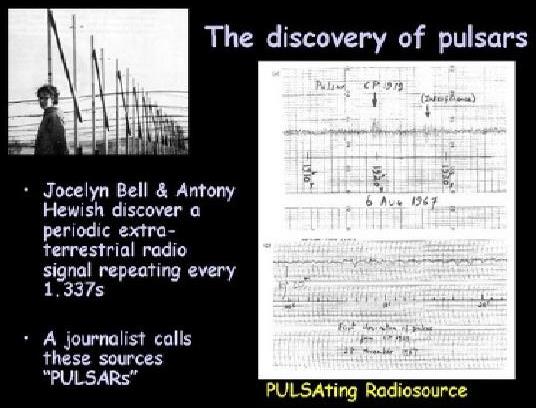
slide by Giampaolo Pisano, Pulsars

Q Now this was moving towards the discovery of 'pulsars'.

JBB Yes that was one of the things that kind of rolled in when we started operating the telescope. Were about half a dozen of us building it, and then when it was built the rest of the group disappeared onto other projects and I was left to run the telescope. And we were doing a regular survey of the sky and up popped, at a rather low level, this strange signal. The analogy I use is imagine you're at a viewpoint making a video of a nice sunset. And somebody comes along and parks their car in the foreground and leaves those double flashers, the hazard warning lights going, which spoils your video. I was focusing on some of the very distant things in the universe, and something kind of popped up in the foreground and went 'Yoohoo!'


Q And that was it?


JBB And that turned out to be this totally unimagined kind of star.... [but] Scientists always have to be very cautious, and when you come across something really unexpected, you start by saying 'Right, what's wrong with the equipment, or what's wrong with our method?' And I spent a very anxious week or two while they checked out the wiring which I had been responsible for, 'cos I was afraid I had literally got some wires crossed, and that I was about to be discovered as an incompetent, untrained scientist and kicked out of Cambridge.


Q But no, it was something you called a 'pulsar'. Was it your name?


JBB The name was given by the science correspondent of the Daily Telegraph, who came to interview us, and said 'What are you going to call these things?' And we had more serious issues on our minds, and hadn't addressed that question. And he suggested 'pulsar', because it was a pulsating radio star.... We didn't have many computers in those days and my project did not have a computer. So the signal from the radio telescope was a squiggly, red line on moving chart paper, a pen recording. And as the student, I was responsible for analysing this squiggly, red line. And some of the squiggles were what I were looking for, and some of the squiggles were radio interference. you'll be aware you're listening to the radio and suddenly it goes 'Tsss!' That's interference. And radio telescopes pick that up as well as your radio at home. So some of it was interference. But there was another bit of squiggle that didn't make sense. It took up about a quarter inch on this chart paper out of the four hundred feet that it took to do a complete sky survey. And it wasn't always there, but it was there sufficiently often that my brain clicked and said 'You've seen this unclassifiable squiggle somewhere before haven't you?' And I found it on previous recordings and er, it turned out to be a source that was going 'Blip, blip, blip, blip, blip, blip...' Very, very regular beat, at a rate of about once every one and a third seconds.


Q Now you, you say a star, but this isn't 'Twinkle, twinkle little star,' is it?


JBB This isn't a star that gives out light. But alongside light there's a whole family of other kinds of radiations, like radio waves, X-rays, ultraviolet, infra-red. Our human eyes actually respond to a tiny, tiny fraction of this family of radiations. We're really quite disabled in that respect. But astronomers have learnt that the stars and the galaxies, besides sending out light, send out radio waves and X-rays and gamma rays and infra-red and what have you. And these are objects that send out radio waves. So if you're listening with a very good radio telescope and radio receiver, you can hear the 'Psst, psst, psst, psst, psst, psst!' as the pulses come in.


Q Was it a great moment?


JBB The - finding the first one was disturbing, scary, because we weren't sure what it was. Worrying perhaps, more than anything. After about a month when we had sorted out that it wasn't crossed wires and it wasn't interference and it wasn't this, and it wasn't that - so what was it - I found the second one. And that was a marvellous moment - that was sweet. That was y'know, the 'Eureka' point, because that showed that it had to be some new family of stars, some new type of stars that we'd never seen before. And I'd stumbled over the first and the second of them, and in fact I found the third and the fourth as well.


Q Amazing, amazing story. But it was your colleague who got the Nobel Prize...did it hurt?


JBB My colleague was in fact my supervisor. I was a research student, working for my doctorate. And in those days, it was believed, felt, held that science was done, driven by great men... the leaders of research groups got both the prizes and the blame, if there was blame.... Our picture of science has changed since then - we now see it much more as a team effort with different people contributing different aspects of the work.


Q But did it hurt at the time?


JBB ... this was the very first time that a Nobel Prize had gone on any astronomical topic, and therefore politically that was very, very important. And there have been a number of astronomical prize winners since then. But it also came at the stage where I had a small child. He must've been about a year old then, a year and a half. And I was struggling with how to find proper childminding, combine a career - all these things that my generation struggled with before there were nurseries and crèches in the workplace, and before it was acceptable for women to work. And so I think at one level it said to me 'Well men win prizes and young women look after babies'....


Q Let me just ask you a more general question. I mean what events in your scientific career, apart from this discovery, stand out as moments of real significance for you?

Uhuru Xray astronomy satellite, 1970
JBB I'm not sure that there are anything that can come within a mile of the pulsar stuff, and I think it's probably not reasonable that there should be. People don't often get the chance to make mega discoveries like that. But I've certainly had some very exciting times. The Nobel Prize that we've just been talking about was awarded the same day as a satellite with which I was working was launched. If I put this in a novel, nobody would believe it. But we all went into work eight o'clock one morning, to hear the transmission from off the East Coast of Kenya from the control centre where our X-ray astronomy satellite was launching. And it launched, and by ten o'clock, eleven o'clock in the morning, we drifted off back to our desks. And on the twelve o'clock news was the Nobel Prize (laughing) announcement. (Laughs)....That X-ray astronomy satellite was incredibly successful. I was responsible for running it for the laboratory. And you'd get to the stage when you'd say 'Satellite, for God's sake stop making discoveries till we've processed the last three!' (Laughs) It was frantic, but it was hugely exciting....
a modern VLA radiotelescope
Q Let's talk about the interface between this science and, and your God. Because science - and I frequently get this wrong. Science works by a hypothesis which requires...verification... God is a hypothesis. Does He require evidence?

JBB Well for me, God is a hypothesis. But I'm not sure that everybody would agree with me on that one. I think for some God is much more...present (laughs). It's definite, (laughing) it's er...


Q But you see, people would say 'That's not a scientific statement.'


JBB No. I would agree with that. I as a teenager was looking for proof of the existence of God, and of course didn't find it. And gradually came to the realisation that I suspect we're not meant to have proof of the existence of God. I suspect we are meant to act without proof, on probabilities - but ultimately with 'I don't know' as the bottom line. And I made the conscious decision to adopt the hypothesis that there is a God, and to run with that hypothesis and see what happened. And I haven't felt the need to abandon that hypothesis yet. But it could happen - who knows?


Q And are you vigilant in your scrutiny? Do you constantly examine this hypothesis?


JBB Yes I do. The proof - that's not really the right word - the data, the evidence is sufficient to convince me. Would not convince anybody else, I don't expect - and I don't know that it's meant to convince anybody else. But I have enough evidence that there is a God from experiences in Quaker worship, for example. I'm also aware that quite a lot of my experience of God comes in a Quaker meeting for worship when a number of other people in the same room at the same time will have similar experiences in so far as one can describe these experiences to one another.


Q ,,,can you try and describe it to me?


JBB It's difficult because it is a very deep and intimate experience. It is at the level of sense, nudging, prompting is a word that, that Quakers will use.... if there is a strong sense of the presence of God, I find that intellectual questions float away as being irrelevant, and one is just wanting to be there.


Q What then do you say to your scientist colleagues, who denounce religion...and say 'Superstition is on the way out...


JBB ... in taking that position they are denying even part of their own discipline, science. Intuition and imagination play quite a large part in science. It's not always taught, this, but I believe it to be true. We talked earlier about developing a hypothesis which we then tested. How do we develop a hypothesis? We imagine, we dream. Some of it literally comes from dreams, the shape of the benzene ring came to a chemist who had a dream about a snake swallowing its own tail, which I think is a Jewish Kabbalistic symbol, so it's not unusual. But that was the first ring molecule, and suddenly he understood from this dream - intuition and imagination matter a lot. Also having been involved in a significant discovery, I know that in the discovery process, things are not straightforward. It's not a linear process. You dart backwards and forwards, you develop pictures which will take account of some of the data you have, but maybe not all of it, and then you try a different picture, and so on.


Q So for you, science, the imagination and religious insight are all part of one great mystery?


JBB And a different kind of mystery too.... The God that I experience is a loving, caring, enabling God. A God who helps one see things, one's own action, or the world, or whatever, in a particularly true light. A God who acts through people, inspires in that sense. But as an astronomer, I do not believe in a God who was the prime creator of the universe. So I get quite twitchy when people talk about 'God the Creator' and how God made that beautiful sunset, that kind of thing.


Q (Laughs) As an astronomer, what d'you think brought the world into existence?


JBB As far as I can see, it did it itself. It didn't need a God to do it. And it runs itself as well, and here we're getting close to some of the problems of suffering, because suffering doesn't make sense if you've got a loving God and a God who's in control of the world.... The explanations that we have around in the Christian Church for suffering I think, are nonsensical. They cast God as somebody for whom the means justify the ends, for example, and I don't buy into that I'm, I'm afraid. It just doesn't work for me.


Q But for you, God is an authority...


JBB Guide perhaps, more than authority, because one can ignore or deny.


Q Are you allowed to be angry with whoever He is?


JBB Yes, oh yes. Yes. I, I think (laughing) that's quite important (laughs).... God as I understand it chooses not to intervene in the world. So it's no good praying to God for good weather tomorrow, for example - God just doesn't play that game....


Q What's the future? What, do we have a future as the human race? Is the end of the world on the way?

Hubble image: star birth in M16
JBB As we understand what's happening in the universe at the moment, the galaxies are still flying apart, following the Big Bang. In these galaxies there are stars being born and living and die. And at the same time, because of those stars being born and living and dying, there are changes in the chemical balance in the universe. Some of the hydrogen is being used up and the materials that we need for life, like carbon, oxygen, calcium, iron, are being created out of that hydrogen by the stars. And that's fine. But if you carry this on to its logical end, there will come a time when new stars get formed, or try to get formed, but can't light, because there's no longer enough hydrogen around. And hydrogen is basically the fire lighter. So in about a million, million years' time in galaxies all over the universe, old stars will go out and new stars will not be able to light. So the galaxies will go out. Now we depend on starlight - sunlight in our particular case - for our very existence, for energy, for growth, for food ultimately - everything. And so in that dark, dark universe, the black holes will have a field day. But everything else - us included, will be dead.

Q How do you feel about that?


JBB Well it is a bit bleak, and I have found that quite difficult to reconcile with a sense of hope. And it's actually led me to think quite hard about what we mean when we hope about something. And I think I've got to the position where I no longer believe that hope means that everything'll come out OK in the end. I don't think that's what hope is actually about. I think hope is about recognising that there are things in this world that have worth, that are good, and that it is worth putting effort into them, working at them, helping them along.

*****
Notes
1. see Wikipedia biography of Burnell; BBC video interview and podcasts about her discovery of quasars. Astronomer Marcia Rieke explains Xray and radiotelescopes.
2. cf. a recent book by a lay author, Robert Wright, The Evolution of God (2009).

Thursday, 4 November, 2010

Biodiversity: connections become obvious when we destroy them -- by Winifred Bird

Reprinted from the blog 10,000 things, founded (original site) by Jean Miyake Downey, Kimberley Hughes and Jen Teeter, as part of Kyoto Journal.

Winifred Bird at the launch of KJ's special issue for COP-10 of the Convention on Biological Diversity, behind her the gardens of Kyoto's 835-year-old Eiun-in Temple (aka Kurodani, Konkai-Komyoji)

I’ve been thinking a lot about biodiversity lately. Actually, since last summer, biodiversity has pretty much taken over my life. Partly that’s because I’ve been lucky enough to be working on this great special issue of Kyoto Journal, and partly for a couple of other projects. I guess you could say I’ve hopped on the COP-10 media bandwagon, but the funny thing is, I sometimes still don’t feel like I have a firm grasp on what biodiversity actually is and why it matters. This could have something to do with the fact that I haven’t formally studied biology since tenth grade, but I think a lot of the general public is also pretty hazy on the term, if they’ve heard it at all. It’s not one of those easy-access words like “nature” or “open space” or even “extinction,” that you hear and just immediately visualize. It’s not even really about individual species – a panda here, a tiger there - it’s about the whole picture, how everything works together and is connected, and for me, that’s been a hard thing to get my head around because it’s just so huge.

But I had a bit of a biodiversity breakthrough earlier this summer that I’d like to share with you.
Around July I had a lull in my writing work, so I went up to Gifu to help my husband out with a project he was doing there. He’s a carpenter, and he was building a cabin up in this vacation development way out in the mountains near Gujo Hachiman, and to cut costs we were camping at the worksite. It’s a vacation area, so during the week the place is a real ghost town, and it became our own little world. One morning, we’d set up our breakfast table, which was actually a plank balanced on top of some boxes, and we were sitting across from each other drinking our tea, and suddenly it was just like I had fallen inside a cheesy love song. It just struck me that we were made for each other. Not just on a personal level, but on a biological one, the level of elemental man and woman. We fit together perfectly and we literally can’t live without each other, in the sense that we need each other in order to procreate our species.

And the amazing thing is that this not only works on a utilitarian level, but this interdependence is also incredibly beautiful. It’s not only procreation, but also love. And then it hit me really strong that the same thing is true for the whole world – that the fox and the rabbit, the flower and the bee, everything, is made for each other, everything fits together in the most immense and beautiful pattern.
Of course, it’s the most obvious of clichés to say that we’re all connected and that that every piece of the puzzle matters. These are things that I know on an intellectual level, as I’m sure you all do, but how often is it that we really feel that connection? How often does the pattern flash before our eyes in all its Technicolor complexity? I said a second ago that it’s completely obvious that everything is connected, but in another sense it’s not obvious at all. It’s not like the connections are visible, like a giant string net tying me to that tree to that cat to that mosquito. My basic instinct, admittedly as an American and someone who’s neither a biologist nor a Buddhist, is to think of myself as an independent unit, rather than as part of something larger, a part that doesn’t work when it’s isolated from that larger picture.

The connections become obvious, of course, when we destroy them. When we hunt all the
sea otters and then the urchins that they used to feed on explode out of control and eat the kelp forests where they live down to the nub, and then the fish that breed in these kelp beds decline and we go fishing and there aren’t any fish out there, then we understand that nature is a network where every piece matters. The trick is to see it before we’ve destroyed it, to somehow raise our awareness enough to protect what we’re used to taking for granted.

I was talking to a scientist recently who gave me another example of how we often don’t become aware of the value of biodiversity until a disaster strikes. His name is Thomas Elmqvist, and he teaches natural resource management at the
Stockholm Resilience Center at Stockholm University, and he’ll also be in Nagoya for COP-10 as part of the Swedish delegation. For about twenty years, Elmqvist has been studying a forest in Samoa where two different types of flying fox play a key role in dispersing seeds. Basically they eat tree fruit then drop the seeds throughout the forest. One species, the dominant one, did most of this work while the other was less abundant and played a fairly minor role in the forest.
flying fox bat: photo Tavita Togia, NPS
In the early nineties, a major hurricane hit the forest and knocked down a lot of trees. What happened afterwards with the flying foxes is really fascinating. The dominant species went down to the forest floor to search for fallen fruit, and when these animals are on the ground they’re very slow, they kind of creep along, so this species was essentially wiped out by predators. Meanwhile, the subdominant species stayed up in the trees and survived by eating young leaves. When flowers and fruits started to appear in the remaining trees again, this formerly inconsequential flying fox was the one that was still around to carry on seed dispersal. Elmqvist says he suspects that if there hadn’t been this diversity in the flying fox species – he calls it “response diversity within functional groups” – it’s quite likely many of the plant species in the forest would not have been propagated, and alien plant seeds would have blow in on the wind and been able to gain a foothold in the forest, possibly causing it to flip to a very different kind of environment. His point in telling this story was that diversity is what gives ecosystems their resilience when disaster inevitably strikes. It’s kind of like biodiversity is the ultimate life insurance policy: it ensures that in one form or another, life will go on.

But on a more basic level, what this story illustrates for me is that there is a whole lot of stuff going on in the natural world that I’m unaware of, yet completely dependent on for all sorts of goods and services. We don’t want to mess around out there too much. We don’t want to start saying, why do we need two kinds of flying fox? One is doing the job just fine. We’ve got to keep reminding ourselves of the limits to our own knowledge. At the same time we’ve got to keep trying to learn more and become more aware of how everything, including ourselves, is interrelated. Hopefully
this issue of Kyoto Journal can be a part of that.
*****
See also reports on current UN negotiations at CBD and CSD in QEWnet.
The flying fox of Samoa is in the IUCN red list of threatened species.

Wednesday, 3 November, 2010

Environmental theater

Here is one example: Sarah Moon's Light Comes interweaves themes of mountaintop removal, the invention of the lightbulb, and the sacredness of earth.

See this script excerpt. Others of her Moon Plays show strong influences from Berthold Brecht's agitprop and Augusto Boal's "theatre of the oppressed" inspired by Paulo Freire. Boal has also influenced Montreal's Engrenage Noir.

The "environmental theatre" of natural or found settings was explored by Richard Schechner's Performance Group in New York, and in his book Environmental Theater (1994). See discussions in Helium.com and Wikipedia on site-specific theatre. Some recent examples are Times Up, the Church of Earthalujah (formerly Church of Stop Shopping), and New York Loves Mountains.

Eco-theatre draws on many other traditions: Butoh, Kabuki's hanamichi, Christian miracle plays, Hindu Ramlila, the Black Mountain festivals, happenings, Jerzy Grotowski, Jacques Lecoq and Ariane Mnouchkine, Tadeusz Kantor, Vselovod Meyerhold, Nikolai Okhlopkov, Eugenio Barba, Dario Fo, Peter Schumann's Bread and Puppet Theater, En Garde Arts, Forced Entertainment, James Slowiak and Jairo Cuesta's New World Performance Laboratory (NWPL), Mike Lawler's eco-theater, Jeff Burroughs' 9Thirty Theater, Restless Natives in Totnes, England (see their website and its links), Climate Change North, Confluence Theatre Co's (re)CYCLE plays, and numerous plans for greening theatre buildings. Dancer Tevyn East has created an eco-liturgy of movement and questions, Affording Hope.

Therapeutic theater and dance has blazed its own trails. A landmark is choreographer Bill T. Jones' moving, musical, marvellous Still/Here (1994) with real people facing life-threatening illnesses; a 60 min video/DVD shot in 1997 is available; see this online excerpt from Bill Moyers' PBS program. Some other notable artists in this genre are: Margie Gillis -- especially her M.Body.7 (2008) for dancers ranging in age from 12 to 73; Vida Simon; Petra Kuppers; Epiphany Productions in San Francisco -- see its video Fears of Your Life (2007); a group in a Calcutta jail; and many groups in Boston -- see also the Lesley University dance therapy website and its links.