Showing posts with label Kenya. Show all posts

Tuesday, 1 May 2012

Global Climate Change -- by Cornelius Ambiah

Leaving today, saving the future
Is our responsive ability to planet earth
As we partake of this crisis, our contribution
Though in minute countless effort,
We are blessing not cursing the future
The world is a sinking planet
Faced with a spiritual crisis,
Our future is at stake

We are living in unfamiliar territory
Not like in our childhood,
Depending on weathermen;
Unreliable sometimes and we accuse,
The true weatherman gave us knowledge;
To look after planet and endowed beauty,
How you and I practice it counts a deal!

New technology, advanced adoption
Creates huge gases limiting productivity:
Less gas emissions; cost effective ways
Will be realized if we take actions
Actions as friends with great concern for nature
For good environment nurtures us into naturally,
Nurturing life as God intended before

Global environment care,
Is all we can practice to protect climate
Living as Christians, combating desertification,
Though limited to individual interest,
We can be source of global benefit
As the planet sinks,
What is our contribution?

This was the opening prayer at the 6th World Conference of Friends
17th-25th April, 2012 at Kabarak University, Nakuru, Kenya

Tuesday, 24 April 2012

The Kabarak call for peace and ecojustice


The Kabarak call for peace and ecojustice was approved today at Friends World Conference, Kabarak University, Nakuru, Kenya.

from the FWCC World Consultation on Global Change 2010-11
and participants’ witness in the GC thread at the Friends World Conference 2012


In past times God’s Creation restored itself. Now humanity dominates, our growing population consuming more resources than nature can replce. We must change, we must become careful stewards of all life. Earthcare unites traditional Quaker testimonies: peace, equality, simplicity, love, integrity, and justice. Jesus said “As you have done unto the least… you have done unto me”. We are called to work for the peaceable Kingdom of God on the whole earth, in right sharing with all peoples. However few our numbers, we are called to be the salt that flavors and preserves, to be a light in the darkness of greed and destruction.

We have heard of the disappearing snows of Kilimanjaro and glaciers of Bolivia, from which come life-giving waters. We have heard appeals from peoples of the Arctic, Asia and Pacific. We have heard of forests cut down, seasons disrupted, wildlife dying, of land hunger in Africa, of new diseases, droughts, floods, fires, famine and desperate migrations – this climatic chaos is now worsening. There are wars and rumors of war, job loss, inequality and violence. We fear our neighbors. We waste our children’s heritage.

All of these are driven by our dominant economic systems – by greed not need, by worship of the market, by Mammon and Caesar.

Is this how Jesus showed us to live?

•       We are called to see what love can do:
to love our neighbor as ourselves, to aid the widow and orphan, to comfort the afflicted and afflict the comfortable, to appeal to consciences and bind the wounds.

•       We are called to teach our children right relationship, to live in harmony with each other and all living beings in the earth, waters and sky of our Creator, who asks, “Where were you when I laid the foundations of the world?” (Job 38.4)

•       We are called to do justice to all and walk humbly with our God, to cooperate lovingly with all who share our hopes for the future of the earth.

•       We are called to be patterns and examples, in a 21st century campaign for peace and ecojustice, as difficult and decisive as the 19th century abolition of slavery

We dedicate ourselves to let the living waters flow through us -- where we live, regionally, and in wider world fellowship. We dedicate ourselves to building the peace that passeth all understanding, to the repair of the world, opening our lives to the Light to guide us in each small step.

Bwana asifiwe.  Apu Dios Awqui.  Gracias Jesύs.   Jubilé.   Salaam aleikum.  Migwetch.  Tikkun olam.  Alleluia!

Kenya 4 - Worship and reflection


I have not had time to write about the actual conference. So you can taste its flavor, I append short excerpts from our Morning Reflections in plenary. More links are being added on saltandlight2012.org along with photos and videos.
  • Esther Mombo  of FWCC Africa, 18 Apr 23Apr
Being Salt and Light: Friends living the Kingdom of God in a broken world
In the metaphor of Jesus(Matthew 5: 13-16 ) if the salt has lost its taste it has no use but to be trampled upon by our feet. Or the light is lit and hidden under a bushel….This is what I call the challenge of preaching and living what we preach. In these days of statistics, Christians may pride themselves on numbers... The issue is not the numbers but the influence.
[At a hotel restaurant in Guatemala City] there came a group of men dressed in black, with high caliber guns and ski masks. They shouted at us: "Where is (the owner several times, shooting everywhere… two men who were in front of me fell to the floor, spilling blood. I don't know how I did it, but I put myself underneath the table and covered myself with the tablecloth which hung down to the floor… they killed the hotel's owner, her daughter and a medical visitor who was a guest. Then, they came back to shoot, again, two men lying three to five steps away… to make sure that there were no witnesses at all… God made them blind and saved my life and I still can't understand how it was. I am very weak in such circumstances, very expressive when things happen. I am very enthusiastic... I am a weeper in affliction…I do not repress my feelings. How could I stay so calm? … For what purpose did God keep me?
In 1696 Samuel Bownas went to Meeting. A woman he had never met rose and pointed at him, "A typical Quaker, thou comest to meeting as thou went from it the last time, and goes from it as thou came to it, but art no better for thy coming - What wilt thou do in the end?"
  • Jocelyn Burnell of Britain, FWCC Europe Middle East Section (EMES) 19 Apr
…if our community (the world body of Friends) is saved, what does it mean? And what are the marks of a community that is saved? I think it means:
-          We are united with God – we work in God’s strength
-          We listen to God – follow God’s promptings.
-          We listen to each other, for God’s promptings may come through other people.
-          We respect the diversity amongst us – not everyone has the same gifts or the same callings and we know there are many ways to God.
I mentioned earlier that I am a scientist; I am also a woman, and there aren’t so many women scientists. A lot of my life is trying to make things easier for women to be scientists and to encourage those who already are. It has become clear that businesses, research groups, all sorts of organisations that have women as well as men in their senior positions are more flexible, more robust and more successful…. I celebrate diversity in the Religious Society of Friends.

  • Pradip Kumar Lamichhane of Nepal, FWCC Asia West Pacific Section (AWPS) 20 Apr
During my childhood and teenage years, I experienced poverty, crying every day for food, so I understand what a small help can change the life of people and bring peace and joy…. we must also avoid the error of being one with the world and embracing its values and ways…. My friends ask why I am still in Nepal as I have valid visa for the US and UK. I tried to answer them that I am really OK here. They think I am a fool and I think they are mistaken. I am happy as I am, I will try to make a difference from where I am and what I have. I am happy to support my church as I can. I am happy I am able to send a few poor children to school. I am happy I am able to run small NGO to support poor people. I am happy I am able to feed my old parents. Others helped me to be an “green IT” guy, so I help others so they could help more people. It is like a gospel which keeps on spreading. I share this experience with others and encourage them to do the same - help others as you have been helped.
I was tasked to give a presentation about the Kingdom of God. You may notice that Filipinos are happy despite the raging price hikes, … lack of employment … recent [tsunamis, storms and floods] … separation of family members caused by emigration for job opportunities—these are just VERY FEW examples of the problems a typical Filipino is facing. But regardless of all these, the joy of the fact that we are still breathing, that we are still able to wake up in the morning to experience God's grace in our lives….  the Kingdom is inside us,.. God is reigning in our hearts… He is in full control of our lives. This is because Jesus Christ has come into our lives when we accepted Him as our personal Lord and Savior. …living out the kingdom within us.
E oku tuakana, e oku tuahine, kua tae mae nei I tenei ra – nga mihi nui ki a
koutou katoa. Ngā mihi nui ki a Io, nāna te kore, nāna te pō, nāna hoki te ao i whakatinana.
E mihi ana, e mihi ana. Ngā mihi nui ki te mana whenua o te rohe nei. E mihi ana, e mihi ana. Ko Te Haahi Tuuhauwiri te iwi.Tēnā koutou, tēnā koutou, tēnā tātou katoa.
To translate, I began by giving praise to God the Creator – “from you came potential, the night, and this world you have populated”. I then greeted our hosts, the Kenyans, the peoples who nurture the Spirit of this land.
I also greeted all of us gathered here today as one tribe, what I called Te Haahi Tuuhauwiri. This is the Māori name for Quakers in Aotearoa. It translates literally as “the faith community that stands shaking in the wind of the Spirit.”
  • retiring General Secretary, Nancy Irving  23Apr
Are  you the same as when we arrived here last week? How has God been working through you and within you? It is not always pleasant or pretty. Sometimes it takes some pain or some anger to crack us open like an egg, so that the work God has been doing inside of us can come out. Much as I am grateful for the changes and depth of my spiritual life, I still resist it. I want God to have me come to a nice place of comfort where I can stay awhile. I get scared of how I might be led to change. I get scared that God will ask me to do something I really don't want to do. I sometimes turn off my ears to God's voice – I go to Meeting on Sunday and think about some committee work or how nice the weather is. I don't want to be changed. I am often like Samuel Bownas from Noah's story. So here we are – a people in the midst of change as we deepen our faith – we will always be changing if we are faithful to that Voice within us….

In our Home Group after each day’s Worship and Reflections each day, we exchanged personal stories – some extremely moving ones by those who have experienced genocide and reconciliation – which we agreed to keep confidential. However, you can read the stories of Quaker Peace Teams throughout central Africa using HROC-AVP, in David Zarembka’s new book A Peace of Africa.

We had daily thread groups (later, I will report on the Global Change one) and interest groups. Some examples from over 50 workshops: climate, food security and deadly conflict in Africa; prison visits; HROC -- healing and reconciliation in our communities; AVP -- alternatives to violence; socially responsible banking; Bio-Sand water filters; Beyond us and them -- working among different kinds of Quakers,  and interfaith; the message of early Friends; faith in action worldwide; peacebuilding; youth ministries in Latin America; eschatology and utopia; Quaker women sharing our gifts; Being salt and light; FCNL, QUNO and QCEA; interfaith community building.

And always, intense discussions in every corner – at meals – in the dorms and quads – weaving the threads together – worship sharing and the sound of singing-dancing-praise songs from Kenyan Friends. At points the dance-worship involved everyone in the immense auditorium. See the videos.

Friday, 20 April 2012

Kenya 3 -- by David Millar

I am short of time, have little internet access and am unable to upload my own photos. You can see news, photos and videos of the Quaker world conference here: http://saltandlight2012.org/followtheconference
Today Apr 20 we are finishing the three-day thread on Global Change – which I call ecojustice -- adding African, Asian and Latin American testimonies to those already gathered over the past three years. We hope to take a recommendation to the plenary on Sunday that Friends worldwide take a stand affirming the spiritual basis of our work in earthcare, peace and justice. If approved, I will post that Declaration here.
Tomorrow, on our one free day (assuming other responsibilities do not preclude) I will be on a 100 mile excursion from Nakuru (where the conference is held) north in the Rift Valley to Lake Baringo (see wildlife pix here).
As soon as I do have time, I will post the story of my homestay in several villages in Western Kenya, with photos and descriptions of the people I met.

Wednesday, 11 April 2012

In Kenya, part 2 -- David Millar


See also the illustrated blog of Judy Lumb who has been in W. Kenya for several months observing the peace process, the Quaker role in peacemaking and resettling of 600,000 IDP refugees from the 2007-08 violence, rural and urban life, the old-growth Kakamega Forest, house-building and community development. Her forthcoming book Ending Cycles of Violence is based on extensive interviews and tells of the HROC/AVP process.
My experiences April 8-11 in Nairobi
The ACK (Anglican Church of Kenya)  guest house is a wonderful introduction to Church and aid work, as locals and wa-mzungu (whites) come from all parts of East Africa for training, staff meetings and postings. You get an earful every time you take a meal, is you invite others to share your table. Which, insatiably curious, I always do. It has been quite an education. And ridiculously cheap: 5 days and 10 meals for US$40. Tomorrow I fly out to Kusumi for a day and then homestay in Bwere, so small it is not on the map.
Brief glimpses of local headlines: the political Truth and Reconciliation process has broken down because genocidal leaders hang on to posts in the coalition and want immunity from ICC prosecution, while ambitious underlings try to unseat them. Patronage is being showered down by the old guard of both UCC and ODM parties, using World Bank money (much of it ill-spent and ecologically dangerous). Youth leaders demand that older “menopausal” male leaders step aside. Cries of “forgery” as a British Embassy file naming the abettors of genocide is leaked. Kenya Airport union strikes, threatening tourism  – the Minister sacks them all – they vow to continue striking. I imagine there are planeloads of red-faced shrieking mzungus shouting at some hapless airlines rep; they always do. One aid worker described seeing a mzungu meltdown on the coast as a mechanical fault delayed takeoff; he tried to explain to his compatriots that they were therefore safer on the ground; but they preferred to shout about their “entitlement” to be in the air, demanding a plane, any plane, immediately. It is best to be cool: nzuri. 
Traffic jams paralyze the city, nothing new; what is new is that there is road construction everywhere though this is the rainy season. Not much rain in Nairobi so far, just brief downpours. This is a city built around trade: city districts and new main roads are all named for malls (mostly vertical, not horizontal: immense echoing concrete halls), FIC for example being at Nakumatt Prestige (not to be confused with Nakumat Junction or Nakumatt City Hall, which are miles apart and often misspelled). No one is quite sure where anything is – especially as they are probably trying to use their second or third language.  Even taxis get lost. And the real estate promoters must make a pile of money, as they sit uneasily atop the squirming heap of getting-rich-quickers. And, I presume, occasionally fall.
To prevent that fall, they bankroll the politicians – with millions. For those at the bottom of the squirming heap, there is “holy oil” (olive, from Israel, at 10 times the shelf price) peddled by unscrupulous pastors to the poor. It will heal the sick, avert the Devil or the jealous neighbor, assure promotion – so much so, that some businesses have put up signs forbidding “anointing” of office doors and walls: a messy business. A Christian paper The Shepherd denounces this widespread “idolatry” but does not question the gospel of prosperity. God will bless, Jesus saves, your children must go to Christian school and succeed. There is a praiseworthy aid industry to pay school fees and board for HIV orphans throughout East Africa (I have met several NGO workers, and some individual sponsors). One girl learned enough in a few years to bring her granny (who had taken care of her and her orphan sisters) back from the hospital, administer her daily intravenous, cook for her sibs and continue school! Not untypical of Kenyan country character. This is a country where individual responsibility, shrewd choices and getting ahead mean survival for the whole family. Telling this nation of small traders and hard workers that “development” or “capitalism” are wrong would be a hard sell indeed. But they are revolted by malpractice, corruption, monopolies and foreign dictation.
Missed seeing people at All Africa Council of Churches (AACC), PACJA, and PROCMURA because they went home for Easter. But made other contacts, saw Westlands subdivision and its seething mall, and gathered some info on what they are doing: eco-justice work, climate caravans and democratizing development, building Christian-Muslim peace. Didn’t get to UNEP. Did get to CAPI, a Quaker-backed peace and development agency which is arranging West Kenya homestays for pre-World Conference arrivals. I think now that email and Skype may be far more efficient ways of communicating once an initial contact is made. Getting a few miles across town can take an hour, amidst black clouds of pollution and dangerously driven mutatas. Mutatu mutata: jitney bus = trouble. One of my taxi drivers showed me his injured leg; when I came to the city, I used to walk and take mutates, he said; no more.
At ACK, most of the aid workers say the same thing: encourage mutual aid at the grassroots, emphasize community self-help, strict reporting or no more donations, support women and local leaders, listen to their wants (which almost always  include good education). Wells, latrines, solar panels, organic food plots, tree planting – all do fine if, and only if, the local partners are listened to, respected, and have a stake. Workers in refugee camps, Kenya, Ethiopia, Tanzania, Zambia, Rwanda, Uganda, etc. say pretty much the same thing. And some of the most effective work is being done by the native-born who are “paying back” the chances they got. There is much to be learned and done, not least in interfaith and intertribal efforts to prevent, mediate and reconcile murderous conflict – often over water, land, and resources. This requires open hearts and open ears. What doesn’t work: almost any mega-project imposed from above.
Example: at the Kenya National Museum (a great way of getting the whole picture of human evolution – and the digs that discovered it -- flora, fauna, colonial history and independence) there was a photo exhibition of top-down mega-development in the Tana River delta in the northeast. How not to do it. Huge areas irrigated for biofuel monocrops (jatropha) the so-called “green” fuel to keep our gasguzzlers on the road. The seasonal floods that guarantee fertility dwindled, cattle and crops died, mangroves were cut down, indigenous knowledge ignored, people are starving and digging 10’ to find water. Mzungu hydraulic ‘experts’ (paid by World Bank, thereby increasing the Kenyan debt load: there is almost no “direct aid” anymore) came up with million-dollar “solutions” that were abysmal failures. A belated attempt is being made to do community mapping with local participants.
One noon at FIC -- Hezron Matitsa of CAPI  introduced me to a trio of powerful women: Kristen Eskeland of Norway’s Quaker Aid, Jacinta Makokha chair of CAPI, and recently elected South Sudan MP Susan Wasuk Sokiri, who quietly observed that it was women’s networks that brought peace, elected a woman governor, and actively (including their men) do self-help village improvement -- see second para above. The peace is still fragile. All across the Sahel, drought, land hunger, religion (of the crazy kind) and guns fuel tribal conflict. See the avril 2012 Monde Diplomatique, pp.8-9, for a superb analysis. For instance, Boko Haram is really gang violence by desperately poor, uneducated (95%), and jobless young men. Jobless because their land is dwindling and their opportunities nil; scapegoats are their Christian neighbour, reader of “unholy books”; brutal armies working for corrupt (but educated) city elites; the mzungu corporations.  Boko Haram burn churches, run protection and smuggling rackets, recruit mercenaries returning from Gaddafi’s Libya, share the old Bedouin dream of freedom / lawlessness / independence. Mali has just fallen. More burning, bombs, violence, refugees will surely follow.
Supper with Rosemary Burke, who does UK Protestant aid in Ethiopia. Her villages include dismal dumps of Sudanese refugees. Whose women are gradually taking responsibility for their part in intertribal wars – vengeance for the fallen – and trying to make peace. Breakfast with Joel Chacha, a Kenya-born mediator in Ontario’s Rent Board, who has spent every holiday since 1977 setting up orphanages and good schools for HIV orphans. Met a Dutch gang of Translators without Borders who are helping local health workers develop their Swahili translation skills, brief hands-on workshops – apparently great fun for all -- whose work is then corrected by a native Swahili speaker from the University.

At less than $45 for 5 days at the ACK-GH, this has been my most intensive and effective education, ever. Tomorrow at 5 am, I head to the airport and Kumaru.

Monday, 9 April 2012

Under the flame trees, in Kenya -- David Millar

Enroute to the Friends World Conference, in Kusumi, Kenya. I’m unable currently to post my photos, but will add them when I can.

Apr 5-6 in the air, Montreal-Amman-Nairobi

Followed the Great Circle route from N.Ireland to France, Germany, Austria, Slovenia, Serbia, Bulgaria, Greece, Turkey, and the crowded neighbourhood of Lebanon / Palestine /Israel / Jordan. Overcast Couldn’t help thinking of the mountains of corpses, rivers of blood that soaked all those grounds over the centuries: tribes, clans, mercenaries, creeds vs ‘heretics’, nations, world wars, ideologies. The forgotten Bogomils (people of God, aka Cathars, known only by their enemies’ propaganda in the First Crusade). The sky cleared over the Aegean as we passed Miletos (slaughtered by Athenians to the last man woman and child), Rhodes, Cyprus. Spring greening the hills of the Holy Land (to many religions, all busy killing themselves and each other, Jesus wept). A Sunni lady from Baghdad on the plane said, all my family in danger, can’t go back, scattered – touching her heart – but I tell my children God speaks to you here, the greater jihad is with yourself. Temperature -71 C at 35000 feet, almost out of the thin skin of atmosphere that lets us live, precariously.

Amman, the white city. Spring ploughing in the fields, olive orchards, vine & fig trees, purple desert flowers blowing in the wind. Browsing photos of Jordanian folk festivals, I see Cossacks (no, Circassians) a whole people displaced from the Caucasus. Empires like to do that, shift the troublesome mountaineers around so they can fight on other borders. Picts, Franks, Vandals, for instance. Canadians in Afghanistan. Scots-Irish in the British Empire (devils in skirts, the Germans called them). Isn’t it nice that so much of the map is red? said Victoria.

Queen Alia airport (Queen Noor is now history?). Indiscreet luxury everywhere, cheap booze, gold watches and Dior. Saw a tall black with a full Islamic beard, black dish dash to his polished toes, enroute to Mecca; salaam aleykum, says I, do you speak English? Albert from Augusta GA, says he; converted to Islam after reading Malcolm X’s autobiography. All men are really brothers, Allah Akbar. It changed his life. Introduced to his friend Ali from NYC, a prevent proselytizer who asked if I was a Unitarian Christian. Many names for God, many roads, say I. You are asking an ant to describe the earth’s Creator , a speck to explain the maker of the Universe? Without charity (sadaqah) we are nothing, says the Prophet (PBUH). We talked of Sunni, Shia, Sufi ways and parted friends. Though Ali hopes I will convert, enter the Dimma and avoid the eternal fire.

Night flight to Kenyatta airport – I talk to two Kenya-born aid workers, James of UNICEF who tries to improve child nutrition and life expectancy in the Maghreb, and Dr Paul who works with torture and trauma victims in the refugee camps. Paul has to exchange a ‘nzuri’ (fine, cool, awful, you on’t wanna know) before starting each trauma interview – now we can talk truth. Dadaab refugee population is half a million, now in its 2nd generation. Also from the 2007 violence, 600,000 IDPs, no one knows how many were burned alive in W Kenya and Kigeri. Corruption, political gangs, religion, ‘tribal’ violence – but any excuse serves land hunger. I learn some Swahili: jambo! Nzuri! Asante! Tutaonana… We alight in torrential rain. (0200 in Nairobi, it is now 8 am in Canada and I don’t feel very sleepy). Fortunately Anglican Guest House did send a driver (without telling me) so I offer Paul a ride. On the right, in the British tradition. The driver gets an extra fare. Nzuri sana. Streets unusually empty. When dawn breaks, I am on the Bishop Street hill, amid tropical flowers and birds. The million strong Kigeri slum is a mile away. I get a good breakfast, walk across Uhuru Park (safe in daylight) into downtown, get money (after 3 ATMs fail me), local cellphone $20, airtime, stamps, postcards. Lots of heavily armed security around, to protect the money, the suits and the mzunga (me). At breakfast an aid worker tells me, if the politicians don’t cause civil war again, the middle class is exploding. Kansas in 1870? Food, land, the dangerous poor fenced in, money to be made, praise Jesus, and may God keep us healthy and safe. I later hear there are lots of orphans. Some get cared for. The rest must beg. Religion, education, professional status, business and connections are the way up. The gospel of prosperity, as South Africa calls it. Every little biz dreams bigger biz. This place is not going to reject capitalism.

In the Guest House, Christian Professional magazines; one article says, if you’re jobless, emigrate and burn your boat; you will have to succeed. Christian music with a reggae beat, Pentecostals rub shoulders with Anglican bishops and Lutheran aid workers. Everybody is saved, saving or about to be – very American evangelical, there is always English in the prayers, hymns and Godly injunctions. The Christian university in Kabarak tells of four grads hired by a big businessman, who overpaid their salary the first time: only the Christian KU grad reported it. Whom to trust? seems to be a question everyone asks. By their fruits you know them. Lots of good guys and selfless women (like the nurse, wife of local Quaker Church clerk, who trains women volunteers for healthcare in Kiberi), lots of conmen, thieves and carjackers. Leave your computer at home, don’t flash jewelry, keep windows closed, don’t walk at night (except on Bishop Road). Trust, credit, godliness, blessings – and some fear. That’s what the razor wire is for. Nature is abundant here, amazing flowers, trees spring up, birds, where the land is not rubbed raw by man. Greenbelt Movement plants more trees in Uhuru Park and all over. Little left of the ancient forests – the poorest of the poor are charcoal burners, everyone uses charcoal to cook. Ngama choma, grilled meat, the national dish. Food is abundant. If you can afford it. Schooling is excellent. If you can afford it. A Scots couple, sunburned from climbing the Rift escarpment, tell me about the little boys, still in school uniform, carrying huge wood loads home at noon in the blinding sun, smiling and speaking excellent English (and Swahili, and several other of the 42 recognized languages – an aid worker tells me more like 100 but colonial bureaucrats ‘simplified’ the tribal map while eradicating ancient cultures and taxing huts to force migrant labour for the plantations). And several varieties (Allah’s or Siva’s own plenty) of Levanters, Ismailis, ‘Indians’ for shops and railway building. That’s how Gandhi started in Durban. Brought great cuisine, charities, sharp business, mosques, temples, some Christian-Muslim-Bahai etc interfaith efforts I hope to find out about.

Kenyans don’t need to be told what to do. All the talents are here, says Ken, a 20 year aidworker from the coast. They don’t need fly-in experts or white teenage volunteers, they need respectful partners for small home-grown local initiatives. It takes years to know whom to trust. On both sides.

UNCD Sustainability and Equity report (Mar 2012) takes issue with the neolib Washington Consensus: what the world needs to stop climate chaos and advance Millenium Goals (now renamed SDGs) is educate girls (they will plan their families, thank you) and raise minimum wage (a social floor for quality of life, instead of a desperate struggle to survive). Both measures would improve things for the 99% in the rich world, whose floor is being chopped up and thrown away.

We see o clearly here the insecurity of ‘security’: the private guards with Kalashnikovs, the wands searching for Al Qaeda (or Shabab) explosives and guns, the razorwire scrolls on the fences. All this means here must be a Dickension subclass, diseased, dirty and depraved, ready for anything from armed robbery to truckstop prostitution (thus spreading AIDs – maybe to 75% of men?). By contrast the conmen and schemers seem almost beneficent. And here am I, a pinko-grey child (ill-trained and ill-spoken, by local standards) in need of constant protection. There is even a law, I hear, against hassling wa-mzunga.

Day 2: Wake again at 0630 to the songs, jokes, banter of young men in the parking garage next door. Why are men so noisy? Boys at soccer. Businessmen in the bars. TVs blaring everywhere (you turn them up when guests arrive). Then – despite a taxi driver who lost his way -- celebrated Easter with the singing, dancing, hot-gospel (5 preachers) Quakers of Friends Church at Nakumat Prestige bus stop on Ngongo Rd (meeting has 11,000 members). Christ is risen! Jesus will bless, protect and prosper us all! Beat the Devil! Men in shiny suits. Women in amazing hairstyles, bangs, braids, squiggles, frizzles, feathers and headbands. A 3 hour lollapalooza of a worship service, complete with a whole section getting the Word by sign language. I make lots of new friends, get invited to the clerk’s home, get taken care of. Hospitality plus. Asante, wewe rafiki.

More to come...

Wednesday, 14 March 2012

Poverty and population in Uganda

Children of Peace vocational training, Bududa - Allison Godwin
In 2007, the Canadian Friends Service Committee entered into a partnership with the African Great Lakes Initiative. AGLI is an offshoot of the US Friends Peace Teams and it is best known for its outstanding peacebuilding activities in East Africa. In Uganda, AGLI helped establish the Bududa Vocational Institute, now called the Bududa Learning Centre. In 2010 CFSC began a partnership directly with the Bududa Learning Centre, which now has its own board and official registration in Uganda.

Nestled in the foothills of Mount Elgon, which straddles the Kenyan border in the far east of Uganda, Bududa District is both stunningly beautiful and lush, with its annual 180 to 200 centimetres of rain, and isolated and impoverished. There are several branches of Friends Churches there, which is how Quaker organizations like AGLI and CFSC began to know the community.

The birth rate is as striking as the luxuriant vegetation and the mountains. Uganda has one of the highest fertility rates in the world and fertility amongst the Bugisu tribe is high even by Ugandan standards. Families of eight are common and there is relentless pressure to extend the cultivated area. In two generations, crops have crept up to the very summits of the volcanic peaks, and farmers are even encroaching on Mount Elgon National Park. Unemployment and underemployment are rife. Villagers are keenly aware that the only escape for their children is education.

Sheila Havard, a Coldstream Friend who often visits Bududa, was solicited for money by one local Friend, who sought funds not to treat the oozing sore on his leg, but to pay his children’s school fees.

The Bududa Learning Centre, by offering training in vocations that are in demand, such as brick laying, carpentry, computer use, dressmaking and tailoring, and nursery teacher training, makes self-improvement accessible in this remote area. Since it opened its doors in early 2008, there have been three graduating classes and many graduates have found employment. Enrolment has increased from 30 to 65.

The Institute contends with obstacles inconceivable in the West, one being its remoteness.  Visitors to Bududa jolt along a tortuous red murram (mud) road winding around shambas (small holdings) of plantains and bananas and so deeply potholed that vehicles are often forced almost to a halt and dodge this way and that around the obstacles. The only means of transport to town is a matatu or communal taxi, invariably a decrepit second-hand Toyota minivan. Electricity is coming but not very affordable.  The lack of night-time lighting makes the unmarred star-studded sky a wonder to behold. A reasonably reliable Internet connection exists for those who rise at 5 a.m. These communication problems are just some examples of the challenges facing the school. One might also mention cultural factors, the primary one being the clash between Western concepts of efficiency and punctuality and local values.
In tandem with the vocational training, the Bududa Vocational Institute runs a project for 200 local orphans.  In many cases one or more of these impoverished children’s parents are dead. Where one parent is still alive, the families may be dysfunctional. The caregiver may be unable to support the family due to alcoholism or mental health issues or the father may have deserted the family for a second wife, etc.

In some cases, the head of the household is a young teenager. In short these are needy children. There are thousands of such children just in Bududa District. The Children of Peace program provides supplementary education and enrichment. The children attend Saturday school at the Vocational Institute, where schoolwork is reviewed and they get a chance to enjoy art and sports activities sorely lacking from their everyday lives. Medical problems that might otherwise go undetected come to light and teachers can arrange for treatment. Basics, such as school uniforms, pencils, soap, vaseline and the like are distributed periodically. Such supplies are essential in an area where students are often kept home from “free” government schools because their parents cannot afford the required scholastic materials. Lastly, two much appreciated hearty meals are cooked for the children: porridge in the morning and rice, beans, and cabbage for lunch, providing a valuable supplement to an otherwise meagre diet.

The women’s microlending program began in 2011. There have been twenty women participants in each of three sessions so far.
 *****
This article was reprinted from the CFSC's webpages. See also the recent report in Quaker Concern and Sheila Havard’s diary of her visit in November 201, Allison Godwin's blog, AGLI's PeaceWays bulletins, and David Zarembka's new book.

Monday, 5 March 2012

A Kenyan woman's story -- by Geeta Jyothi McGahey

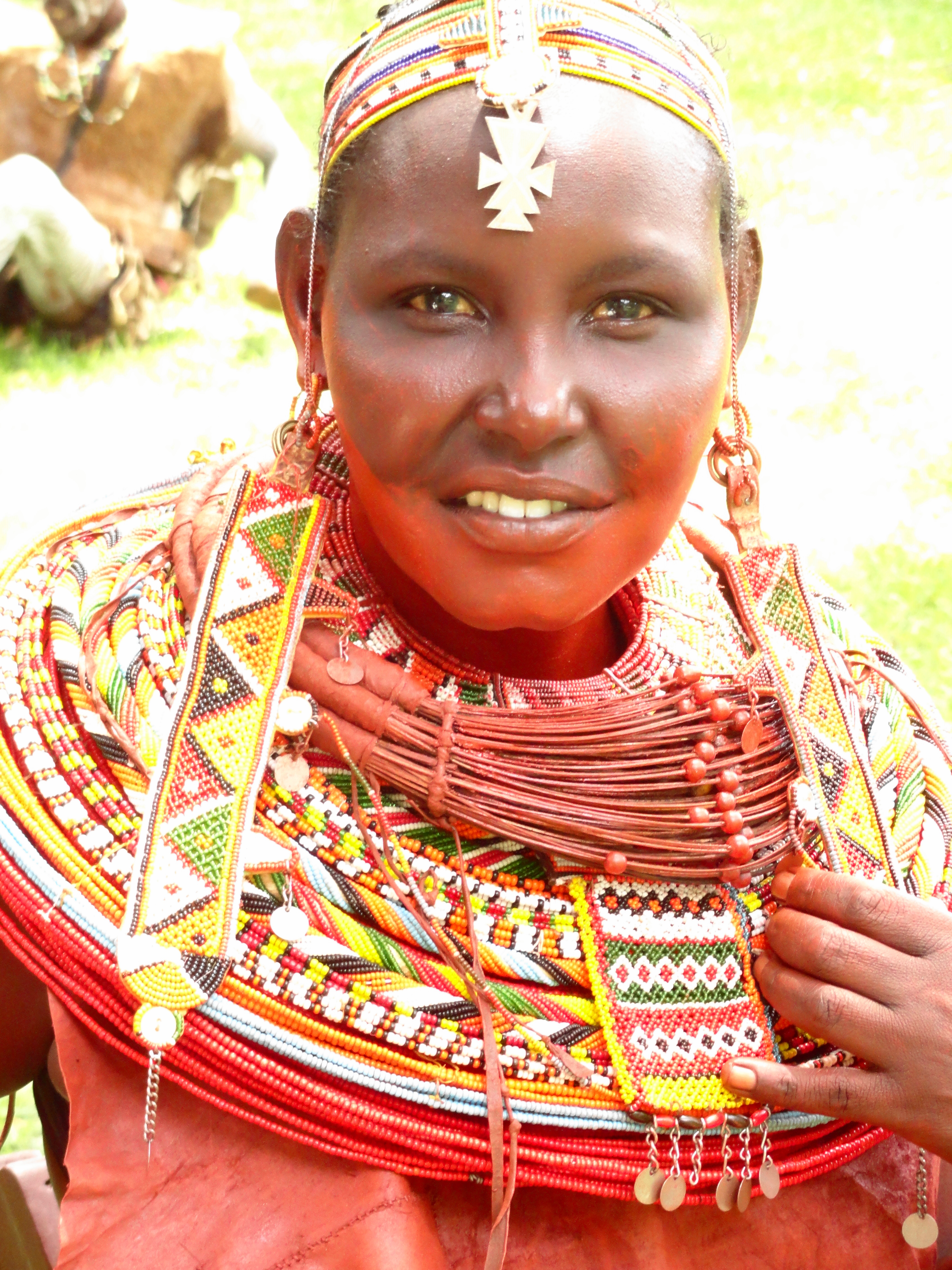
Susan Lentare in Samburu clothes, her own beadwork
Geeta describes herself as a "slightly over the hill American Quaker physician volunteering in Kenya". This story is cross-posted with her permission from her blog Change Insights. Write her with any offers of help for Susan Lentare's work with Samburu women in Kenya.
*****
I met Susan when we went to tryouts for the Kenyan participants to the British Queen’s jubilee.  She was wearing typical Samburu dress and very self-possessed radiating a simple serene presence. My last trip to the bush, I went with her as she mobilized women for family planning.  Since we were walking distances, I had the chance to hear her story and her aspirations.

At age 12, Susan was first circumcised, removing her clitoris and labia and sewing her closed except for a hole from which to urinate, married the same day, and sent off to live with her husband’s family.  She had just finished primary school, best in her class, and was supported by her teachers to go to secondary school.  Her husband, who was 40 years old, had promised her parents that he would send her.  It never happened.  The bride price to her parents was eight cows and one camel.

She had five children, the first at age 14.  The youngest 7 years later.  She said enough children.  
She said, "enough children".  
She knew in her heart that she didn’t want them to lead the life that she did. She wanted them to finish school. She began raising and selling chickens and making necklaces and beaded items to sell. With that money she was able to buy goats and start a small shop. From selling goats, she is able to pay for school fees and buy an occasional cow.

While working in her small shop, she met John Wreford Smith, father of the organizer of CHAT, who was on camel safari.  He came every day to buy a hen from her.  He was very impressed with this enterprising young women and recommended her to Shanni, his daughter and program director.  It took a year for Shanni to get her away from her shop to join CHAT as a community HIV/AIDs and Family Planning mobilizer.
She talked and he understood. "Whatever my wife wants, she can do it."


Her husband, now in his 60s, manages the shop, while she is gone and and looks after the livestock. What impressed Shanni and her dad was that she was already a village organizer.  She was part of a Women’s Group of 12 women who had a Merry-Go-Round.  Each month, each woman puts in 1000 KSH ( about $12.50) a month and every month a different woman gets the pot, about $125 to use as capital.  She also began educating family and neighbors about keeping their daughters healthy by avoiding both female genital mutilation and early marriage, which cut short her own childhood.  These are still very common practices in her area.  Her goal is to send out mobilizers all over her region to stop these practices.

As Susan continues her mission 
no girl will suffer mutilation 
and early marriage 
Her beautiful household, water is far, 
getting charcoal is not enough to support 7 children (2 sets of twins)

Friday, 13 January 2012

REDD vs green -- in Brazil and Kenya

In Brazil, Kenya, and other parts of the global South, opposition is mounting toward the UN "green economy" proposed for Rio+20, with its reliance on corporate lobbies and carbon marketers. Here is a trailer of a 28 min documentary made with indigenous peoples in Brazil:


from climate-connections, A Darker Shade of Green, by Global Justice Ecology Project and Global Forest Coalition, who are also working with indigenous peoples in Cancún and Chiapas, Mexico.

Kenyan views in The Green Belt Movement's Community Forest Climate Initiatives (Dec 2011):

Natural forests provide benefits such as water catchment, climate regulation, biodiversity... medicine and food.

[Kyoto CDM-AR as a model for REDD] Afforestation and reforestation (AR) can have positive or negative impacts on biodiversity depending on the ecosystem being rehabilitated and the management options being applied. AR activities that emphasize species selection and site location can promote the return, survival, and expansion of indigenous fauna and flora population. In contrast, clearing native forests and replacing them with a monoculture plantation of exotic species would have a highly negative impact on biodiversity.

GBM experience has shown that uncontrolled pressure to start and scale up forest carbon projects can be disastrous to biodiversity, water resources, food security and rural community livelihoods. Lack of clear laws and national policies, zoning maps, and institutional infrastructure often lead to unfavourable competition from logging and paper industry for ‘forest land’ at the expense of highly threatened biodiversity and watershed restoration.

An increased emphasis on carbon projects can encourage the planting of exotic trees which are fast growing and give quick return on carbon credits compared to indigenous trees that grow much slower, hence have a low return on carbon credits.... A plantation is a monoculture farm of exotic trees. We cannot afford to reduce natural forests.

GBM wants to see an equitable, ethical climate finance system. Carbon offsetting does not address the issue of climate change at its root cause; behavioural change is needed so fewer GHS [green house gases]  are produced.... 

In addition, some of the rules in these carbon projects, such as the 1990 eligibility criteria for degraded forest for AR CDM projects, further discourages conservation efforts and biodiversity restoration in rural areas. This is because only sites that were deforested before 1990 are eligible for rehabilitation without any regard to the general health of the ecosystem as a whole. Such rules have been forcing the communities to prioritize sites based on year of deforestation at the expense of the prevailing biodiversity threats and watershed restoration needs in the critical water catchment areas therefore undermining the goals of livelihoods improvement.

Local community participation: Projects should respect communities rights, culture and livelihoods. GBM experience has been that this can be achieved if the project allows for full and effective participation of rural communities. This requires sufficient investments in education and empowering communities, and developing grassroots governance structures so as to ensure free prior informed consent, enforcement of agreements, safeguards, clear and equitable benefit sharing and conflict resolution guidelines. In the absence of these, the project can fuel community conflict.

Until governments put in places strong national forest authorities, these AR carbon projects and REDD projects cannot work in Africa.

See also reports from other countries in REDD-Monitor, Global Witness, CBD Alliance's Top 10 issues for biodiversity justice, and Third World Network's backgrounder on Forests. On safeguards, see Oxfam, Guide to Free Prior and Informed Consent.

Tuesday, 26 April 2011

When the Water Ends: tribal conflicts in Kenya

This story is reprinted from Yale Environment 360, an online publication of the Yale School of Forestry and Environmental Studies. See also the UNCHR debate on incitements to hatred in Africa.

To view this content, you must have Javascript enabled in your browser preferences. You will also need to download the latest Flash Player.

For thousands of years, nomadic herdsmen have roamed the harsh, semi-arid lowlands that stretch across 80 percent of Kenya and 60 percent of Ethiopia. Descendants of the oldest tribal societies in the world, they survive thanks to the animals they raise and the crops they grow, their travels determined by the search for water and grazing lands.

These herdsmen have long been accustomed to adapting to a changing environment. But in recent years, they have faced challenges unlike any in living memory: As temperatures in the region have risen and water supplies have dwindled, the pastoralists have had to range more widely in search of suitable water and land. That search has brought tribal groups in Ethiopia and Kenya in increasing conflict, as pastoral communities kill each other over water and grass.

“When the Water Ends,” a 16-minute video produced by Yale Environment 360 in collaboration with MediaStorm, tells the story of this conflict and of the increasingly dire drought conditions facing parts of East Africa. To report this video, Evan Abramson, a 32-year-old photographer (see his slideshow and intervew) and videographer, spent two months in the region early this year, living among the herding communities. He returned with a tale that many climate scientists say will be increasingly common in the 21st century and beyond — how worsening drought in parts of Africa, the Middle East, and elsewhere will pit group against group, nation against nation. As one UN official told Abramson, the clashes between Kenyan and Ethiopian pastoralists represent “some of the world’s first climate-change conflicts.”

But the story recounted in “When the Water Ends” is not only about climate change. It’s also about how deforestation and land degradation — due in large part to population pressures — are exacting a toll on impoverished farmers and nomads as the earth grows ever more barren.

The video focuses on four groups of pastoralists — the Turkana of Kenya and the Dassanech, Nyangatom, and Mursi of Ethiopia — who are among the more than two dozen tribes whose lives and culture depend on the waters of the Omo River and the body of water into which it flows, Lake Turkana. For the past 40 years at least, Lake Turkana has steadily shrunk because of increased evaporation from higher temperatures and a steady reduction in the flow of the Omo due to less rainfall, increased diversion of water for irrigation, and upstream dam projects. As the lake has diminished, it has disappeared altogether from Ethiopian territory and retreated south into Kenya. The Dassanech people have followed the water, and in doing so have come into direct conflict with the Turkana of Kenya.

The result has been cross-border raids in which members of both groups kill each other, raid livestock, and torch huts. Many people in both tribes have been left without their traditional livelihoods and survive thanks to food aid from nonprofit organizations and the UN.

The future for the tribes of the Omo-Turkana basin looks bleak. Temperatures in the region have risen by about 2 degrees F since 1960. Droughts are occurring with a frequency and intensity not seen in recent memory. Areas once prone to drought every ten or eleven years are now experiencing a drought every two or three. Scientists say temperatures could well rise an additional 2 to 5 degrees F by 2060, which will almost certainly lead to even drier conditions in large parts of East Africa.

In addition, the Ethiopian government is building a dam on the upper Omo River — the largest hydropower project in sub-Saharan Africa — that will hold back water and prevent the river’s annual flood cycles, upon which more than 500,000 tribesmen in Ethiopia and 300,000 in Kenya depend for cultivation, grazing, and fishing.

The herdsmen who speak in this video are caught up in forces over which they have no real control. Although they have done almost nothing to generate the greenhouse gas emissions that cause global warming, they may already be among its first casualties. “I am really beaten by hunger,” says one elderly, rail-thin Nyangatom tribesman. “There is famine — people are dying here. This happened since the Turkana and the Kenyans started fighting with us. We fight over grazing lands. There is no peace at all.”

Friday, 10 December 2010

Kenya churches urge action on climate change,

Kenyan churches call for action on climate change, threats to the Mau forest in the Rift Valley, drying up of rivers in the Mt Kenya area, increasing desertification, political reform and resettlement of refugees from the violence of 2007. All are contributing causes of tribal violence. They support the new constitution, an end to corruption and violence, and reforestation. Susie Ibutu is NCCK Director of Governance and Social Service Programs:

On Youtube you will find a number of other videos from the National Council of Churches of Kenya and climate change in East Africa. The General Assembly of the NCCK, which includes Friends Church in Kenya (Quakers), met 29 Nov-3 Dec 2010. Themes included Christian unity and peace, the new Kenyan constitution, ending ethnic strife and corruption, resettling internally displaced persons (IDP). See the NCCK final statement.
***
See our previous posts from Kenya on the genocidal battles of 2007 and their underlying causes. Also: Kenya government's appeal for international aid to save the Mau forest, land grabs by KANU party members, evictions of squatters and ethnic disputes. Water and food shortages in "Shalom City" IDP camp in the Rift Valley. Police brutality against refugees from drought-stricken, war-torn Somalia. Leaked US diplomatic note warns of lack of reform and further violence. Jul-Aug 2010 Kenya church leaders oppose the new constitution allowing abortions, sharia. Dec 2010 National Dialogue and Reconciliation conference has just begun. Citizen journalism and videos from Nairobi in Global Voices Online.

Saturday, 25 July 2009

Climate change around the globe

Kii'iljuus of Haida Gwaii (aka Queen Charlotte Islands, BC): This year our berries and fish are later than usual -- at least one month behind the time when they usually are ready to eat. The coastline has suffered erosion along the eastern shores. This year the herring and whales did not show up in our inlet as they usually do. A few gray whales came into the inlet but left shortly after. In the past we could count on enjoying their visit for anywhere up to a couple of months.Andrew Casebow of Guernsey in the English Channel: Every one of the past 16 years was warmer than the average of the past 30...[with] marked changes in dates of wildflower bloom and migrating birds. Many birds are nesting more than a week earlier and birds that used to be rare are thriving: e.g. white egrets. Many fish species are moving north...others are in decline.... An unforeseen spring tide flooded St Peter Port... overwhelmed sea defences and damaged large sections of sea wall in the west of the island. This is a foretaste of what climate change could bring as a normal occurrence in 50 years time.
photo: secheresse, Tana par O mon héros on Flickr.
The drying of the Tana River Delta, Kenya: At risk are the subsistence farmers from the Boni, Bajuni, Wakone and Wasanya people and the fishers from the Malakote minority communities who depend on river waters for irrigation and fishing, respectively. Currently, as the Tana River bed dries completely, communities living downstream face severe hunger and lack of clean water for domestic use... wild animals invade the villages as they hunt for water and food. Farmers who turn to hunting and gathering... put extreme pressure on wild fauna and flora. Carbon trading projects (ecotourism facilities, sugar and jatropha plantations for ethanol) threaten indigenous lands.
photo: Samoa sky by ming mong on Flickr.
Iteli Tiatia of Samoa: Our old people know what wind is blowing just by feeling the wind or looking up at the tree tops. They have names for winds from any direction, like the to'elau, la'i, la'ilua, tua'oloa and many others. But wind patterns have dramatically changed, [not only] the direction but also the timing. For example, the old folks know in which months hurricanes are possible: late January, February and March were the worst months; November and December used to be the best. But Hurricane Valerie, one of the most destructive in Samoa, came in December 1991... a hurricane used to come from one direction and eventually fade out once you heard strong lightning and loud thunder... old folks would say in Samoan Ua taliligia le matagi (the hurricane is being shaken). But Valerie did not end despite strong lightning and heavy thunder at its most destructive, until hours later when it covered all four directions.
ice fishing by a Madison Guy on Flickr.
Doug Kiel, an Oneida of Wisconsin: Our 15,000 lakes are a tremendously important natural resource and we usually fish them year-round, even after they freeze over in the winter. But the winters are getting warmer, and in recent years this has not always been possible. When I was a child, the lakes froze over in December and did not thaw until nearly April. Now, the lakes do not freeze until much later into the winter, if at all, and the ice is often dangerously thin. And now when the lakes do freeze, they don't stay frozen. The water is getting warmer during the summer months as well, and this threatens the walleye and trout, two of our most important cold-water fish species.
Simon Qamaniq: photo courtesy Will Steger Foundation
Inuit in Nunavut, Canada: We need to be more careful when pursuing animals because of thinner ice... The water from some rivers and ponds smells and tastes bad, particularly when it does not rain for quite some time. We do not want to drink this water. Caribou are a lot skinnier, and the caribou don’t look as healthy as they used to.”
******
The excerpts above are from a new UNESCO group blog, Climate Front Lines "for indigenous peoples, small islands and vulnerable communities"; and Inuit culture in a warming Arctic interviews by Lisa Gardiner, © U Michigan, Windows to the Universe. See also Inuit leader Sheila Watt-Cloutier on "the right to be cold".

Saturday, 31 January 2009

There is nothing I can do but search for love

...closing words from a survivor of the Rwanda genocide, in the video Icyizere : Hope from the African Great Lakes Initiative of Friends Peace Teams:

AGLI workshops on Healing and Rebuilding Our Communities (HROC) take 10 people from one side of a conflict and 10 people from the other side for intensive encounters lasting three days, seeking
something good in every person, a radical notion where neighbors and even family members have committed gruesome act. In Rwanda, this means Tutsi survivors of the genocide and the families of the Hutu perpetrators of the genocide. AGLI is now working in Burundi, Congo, and Kenya.

“Sense of Safety” is the first stage.
It is common for participants to be wary of attending workshops fearing they might be a trap where they will be attacked, sent back to prison, or killed. Through experiential activities and cooperative exercises, participants begin to relax.
The second stage is “Remembrance and Mourning.” There are two Rwandan proverbs that emphasize the importance of speaking out about one’s pain: “The family that does not talk, dies” and “The man who is sick must tell the whole world.” Traditionally Rwandans and Burundians talk about their losses and talk through their grief with family and neighbors. Broken trust and dismantled families have impeded that intuitive process of healing, but it is widely accepted in the cultures here as an important step in the journey toward healing.
In the workshops a forum is created for participants to pay tribute to their losses and to share their grief with others. This process helps to humanize the “other” thereby laying the foundation for the third and final stage, “Reconnection.”

See also: other videos by Patrick Mureithi, the origin of Alternative to Violence (AVP) in prison work in the USA and Canada. "Peace cannot stay in small places", the story of its application by Friends in Rwanda since 1999. "Now, I am Human" testimonies from Rwanda and Burundi; Andrew Petersen's blog about environmental and peace work in Burundi, All Quiet on the Quaker Front. David Zarembka's Kenya Update and previous Kenya posts tagged in this blog.

Tuesday, 11 November 2008

A culture of peace built around trees -- Wangari Maathai

Excerpts from an interview by Geoffrey Lean in UNEP's Our Planet with Wanagari Maathai, creator of the Green Belt Movement and winner of the 2004 Nobel Peace Prize.
Photo by Banson, courtesy of UNEP
African culture was a culture of peace built around trees. Many communities in Kenya, and I am sure throughout Africa, had the concept of peace trees. When elders were seeking reconciliation among communities and individuals they would sit around specific trees. Indeed the Luhya people of western Kenya would even greet each other, when they met, with the name of the species they used as a peace tree, murembe.

Among the Kikuyu the peace tree was a shrub called thigi, with many shoots. Sticks were cut from the shoots and given to elders as a symbol of authority. The elders carried the staffs everywhere they went. If they found people quarrelling, they would first try to dialogue with them, and – if they then made a judgement that there was no reason why they should be at odds – they would put the stick between them. Once an elder had done that the protagonists were supposed to separate and go and reconcile. Thigi were protected. They could not be cut for anything else, or used for building or firewood. But now they have vanished so completely that I myself have never seen one.

They disappeared because they were no longer valued and their importance was no longer an issue. People were no longer being made to reconcile by elders in the community. With colonialism that whole structure was destroyed. Now when people collide they are arrested and put in jail. There are no more thigi trees and there’s a lot more conflict.

As a child, I always used to see vegetation all around me: the land was covered with forests and trees. We did not have a word for desert, because we never saw it.’ I remember drawing water from a spring fascinated by the way the clean cool water pushed its way through the soft red clay so gently that even the individual grains of the soil were left undisturbed, and streams, beautiful streams. The trees were cut down for tea plantations and the streams and springs dried out. I feel the tragedy under my feet, Gullies tell of soil erosion, unknown before. Hunger is on the faces of the people.

When resources are degraded or overexploited, people fight over them. Little of Kenya’s original tree cover remains, and the overexploitation of the land has already led to conflict. Pastoralists and settled farmers have clashed over use of the remaining healthy areas. The same process is behind the conflict in Darfur. 

Professor Mjøs, Chair of the Nobel Peace Committee, underlines the point. ‘Present-day wars and conflict take place not so much between, as within, states,’ he said. ‘When we analyse local conflicts we tend to focus on their ethnic and religious aspects. But it is often the underlying ecological circumstances that bring the more readily visible aspects to the flashpoint.’ He cited the desertification in Darfur, conflict following deforestation in the Philippines, and the role of soil erosion and deforestation in revolt in Mexico, and added: ‘Competition for minerals has been an important element of several conflicts in Africa in recent years. Competition for timber has figured prominently in Liberia, in Indonesia and in Brazil.’
*****
See Wikipedia on the Sahel and Darfur and our previous post on Kenya. Australian scientist Tim Flannery, in The Weather Makers, shows that the Sahel desertification is due to global warming.

Thursday, 29 May 2008

Quaker peacework in Western Kenya

This is an excerpt from a compilation of messages from David Zarembka, compiled by Mary Gilbert of Friends Meeting at Cambridge MA. For more details, see the Kenyan Peacework anf FWCC Kenya blogs.

For a satellite view see Google Earth map of Kenya, zoom in on Eldoret. Places marked * are too small to show on Google Earth.
Kenya language map below is courtesy of Ethnologue.com. Click on the map for full screen showing Kikuyu (15), Kalenjin / Nandi (19), and Luhya (25) areas in the Western District.
David Zarembka, Coordinator, African Great Lakes Initiative (AGLI) of the Friends Peace Teams (FPT):
May 1: We use the AVP (Alternatives to Violence) model of trauma healing, a look at violence, then a way forward... In *Kibera we have come face to face with the youth who battled police; whose friends were gunned down as they ran, or while uprooting the railway line; or when they had gone "shopping without money", as they call looting.

We have come face to face with intense mistrust and hatred as we bring Kikuyu and other tribes together... [Local chiefs told how] people ran to them for shelter or for advice on what to do. Their own lives were in danger. Nine of them lost all they had when their homes were burned by angry youth who [accused them of being] government supporters. One... cried when he saw 8 year old kids going to battle with arrows.

(Uzima is the Swahili word for wholeness, male vigour, perfection. Here it could be glossed as "warrior" - Ed.)

[In April] we started a series of one-day workshops for 120 uzima youth leaders in the border committees... [they told of] burning tires to block roads, ...making arrows, shopping without money; shooting arrows, stoning, killing... people are screaming and running, others are throwing stones and arrows, whistles and trumpets are blowing, gunshots and tear gas everywhere, dead bodies lying about with heads cut off, cows running all over... singing war songs.

Our aim is to let these young adults talk with no fear of victimization. Then we look at trauma; its causes, effects and consequences, We look at violence and how we can react nonviolently to violence situations. We look at cycles of violence and how the graph moves up every time root issues are not addressed. We look at the AVP themes of Affirmation, Communication, Cooperation, and Community based on trust and Creative Conflict resolution. We challenge ourselves: can we build a different society where we affirm each other rather than think of Kikuyus as thieves, Luos as arrogant and violent, Luhya as cooks and watchmen; Kalenjin
as cattle rustlers and Kisii as violent... towards the end, they get to hear what others say about their group and the whole issue of stereotypes... the difference at the end of the day has been tremendous. In Kibera, which began with Kikuyu youth walking alone, Luos and Luhyas alone, they were going for lunch together...

May 20: I do not personally attend any of the gatherings mentioned below except the May 30 ecumenical service. As a Mzungu (white person) I would be a distraction from the issues at hand. My presence might give rise to added suspicion.At the Quaker Peace Network - East Africa meeting, Eden Grace of FUM commented that this was the most exciting thing that Quakers were doing in the world!

Do you agree? Or are there wonderful other things going on around the Quaker world that are just as exciting? We are just a group of ordinary concerned Quakers trying to bring about healing and reconciliation. What is most interesting is that we don't really know what we are doing as we move forward step by step as "the way opens." We trust that God will lead us and give us the right words to use. We had to become accustomed to using the neutral words "returning community" for the Kikuyu from the IDP [internally displaced people] camps and "receiving community" for the Nandi [aka Kalenjin] and Luhya whom we used to call "aggressors."

Yesterday for the first time since January I met the Red Cross official responsible for *Lumakanda on the street here. Later I saw two Red Cross Land Rovers and then a UN vehicle racing through town. (Why are they racing through town stirring up so much dust?) I speculate that there was a meeting at the government offices of Lugari District to plan the return of the IDP at *Turbo to their home communities! We will see.

How is the reconciliation work going? [Following up on FCPT Friends Church Peace Team] yesterday [we] went to the Turbo IDP camp... to a Bible study meeting arranged by the 32 pastors at the camp. This was the first time that something like this had been done in the Turbo camp... Before we took the food last week we were told that there would be 60 people. When we took the food, we were told that there would be 102... At the actual meeting on Saturday there were 170 people! ... The presentation started about 11:00 AM and went to 4:00 PM... People did not want to break for lunch. There was rapt attention...

It is amazing how such a simple thing could be so effective. The presenters were three women, Rose Imbega, Lydia Bokassa, and Jodi Richmond and one man, Joshua Lilande. [It reminded me of the work of] Margaret Fell, Mary Dyer, Elizabeth Frye and all the other Quaker women... one of the pastors commented that they didn't know that women could speak so well about the Bible and its issues. Most churches in Kenya are male-dominated and many do not allow women pastors.

Mt Elgon, on the western border of Kenya in the Rift Valley

Last week we had two AVP [Alternatives to Violence] workshops here in Lugari District. One was for youth from the Turbo IDP camp. Here the interesting point was one person who had fled the violence on Mt Elgon coming to Lugari District and then had to flee again during the post-election violence.

There was also a workshop here in *Lumakanda. One of the participants was a 27 year old Kikuyu man who had rented a room in town, but his parents were still in the IDP camp. His shop and house had been destroyed during the violence. His wife of six months had been a Luhya and they separated during the violence. This is very common; the stress of the violence destroyed many mixed ethnic marriages and their families.

Today... Malesi Kinaro, Getry Agizah, and Joseph Shamala are conducting a basic Healing and Rebuilding Our Community (HROC) workshop for people from diverse communities (including the Turbo IDP camp). Next week the two-week long Healing Companion training, which had been postponed in January, will start. We will be bringing Adrien Niyongabo from Burundi, Theoneste Bizimana and Chrisostome Nshimiyimana from Rwanda, and Zawadi Nikuze from North Kivu, Congo to lead the training. We hope to have ten people from the [Kenya Rift Valley] Mt Elgon conflict, who formerly participated in the HROC basic workshop, and also the best candidates from the present training.

The Great Rift Valley
Next week we will be doing two advanced AVP workshops at *Lumakanda Friends Church. For each workshop we will bring ten Kikuyu youth from the IDP camp and ten Luhya youth from the community. This will be the first workshop where we will be bringing the two sides of the Kenyan conflict together as we do in Rwanda and Burundi. I think this will work out fine.

Last Thursday, Friday, and Saturday, Gladys and I were at the Quaker Peace Network--East Africa (QPN-EA) meeting held at the Friends Peace Centre -- *Lubao. This consisted of mostly Kenyans with two Tanzanians, and four people from Uganda (including Barbara Wybar, AGLI representative currently at Bududa). The most interesting point I learned was that a high percentage of the youth in Nairobi who participated in the violence and were killed by the police were Luhya. [The majority of Quakers in Western Kenya are from this group -- Ed.]

Also in certain parts of Lugari District it was the Luhya youth who did all the damage. In western Kenya there was a tendency to think that it was the other groups -- Kalenjin, Kikuyu, Luo, etc--who were the more violent ones. Is it a natural tendency to think that "others" are more violent than your own group?

We shared our activities and those from Kenya discussed how we could work together in our peacemaking and reconciliation activities.It is the Friends Church Peace Team which has been most active here. On Thursday thirteen of the FCPT counselors held a listening session at the Turbo District office in Uasin Gisu District. This is on the Nandi (a Kalenjin group) side of the road from Lugari, which is mostly Luhya. Many government officials, local politicians, church leaders, community elders, etc., participated.

At first they were suspicious of the mostly Luhya group that they were meeting with, but in time they began to open up. They mostly complained about the Kikuyu -- some of it true, some false, some stereotyping, some bitterness, and some excuses for the violence. They were not very happy to have them back unless the Kikuyu were willing to fit into and accept their Nandi culture. There was little of that "live and let live" concept needed for diverse people to co-exist peacefully. By the end of the meeting, the decision was for the FCPT counselors to visit seven Nandi communities to meet the people at the village level...

On Sunday we had a debriefing/organizing meeting at the Peace Centre and for seven weekdays, between Monday (yesterday) and Tuesday (next week), four or five person teams will visit the seven villages for grassroots listening sessions. I was most surprised to learn that in three of these villages, in the interior of the district, people may not know Swahili! We have one women counselor who is a Nandi (married to a Luhya) and knows the language of the Nandi. So she will go to the three interior meetings to translate if needed. Note that if a person does not know Swahili (or English) he or she cannot talk to a Nandi or Luhya without a translator.

On Friday of last week, FCPT had a listening session on the *Lugari (Luhya) side at the boundary. Again the team of nineteen heard many accusations against the Kikuyu.

The result from this meeting is that next week, on Thursday [29 May 2008], the FPCT listening team will go to *Mbagara, the place with the greatest violence in Lugari District, for a listening session with the community. In this case the whole team will go and hopefully the crowd will divide up into smaller groups as we did at the Turbo IDP camp. The next day, May 30, there will be an ecumenical healing service open to everyone. People from the Turbo side will come. Gladys and I talked to the pastors at the IDP camp and they plan on coming. This is what real Christianity is all about! ...

See also earlier postings in this blog about Kenya.