Showing posts with label cooperatives. Show all posts

Friday, 22 June 2012

Equator Prize 2012 Winners

The Equator Initiative chose 25 winners from a total pool of over 800 nominations from 113 countries.


Asia & the Pacific
Eastern Europe & Central Asia
Latin America & the Caribbean
Middle East & North Africa

Tuesday, 8 June 2010

Heartwood: cohousing in Durango -- by Dick Grossman

Cohousing is an attempt to establish old-fashioned community life. It started in Denmark. There are now about 100 projects in the USA. See cohousing.org. Ours is the largest: 250 acres in the foothills of the San Juan Mountains, including 65 acres of irrigated pasture, and woodland. The age range is from 3 to 70, and there have been several home births already. Some members are retired, some work from home, some commute about 20 miles into Durango.
Right now it smells of sage, and manure after rain. We have just put some aged manure on the garden. Real Colorado weather: about 17 inches of rain a year. Today, May 2, we woke up to a light dusting of snow. We are at 7000 feet. At Silverton, at 9500 feet, I've seen snow on the Fourth of July. We had a maypole yesterday on the village green, followed by brunch and a concert by Sally Shuffield, the director of Durango Nature Studies, with which Gail and I are very involved.

The common house
What we like most is that our actual home can be smaller, because many of the facilities are shared. We live independently, but with far more contact with our neighbors than in the average city. The individual homes are in a cluster, which saves on utility costs and leaves land free for green space, pasture, farming and wildlife. There is a common house that serves two meals and a potluck twice weekly, with a large kitchen and communal dining room, exercise room, two rooms for guests, and a store where Heartwood Farm food is sold. We have a greenhouse to grow food plants and flowers, and a wood workshop.
The yurt
We had a yurt which is used as a school. Some have lived there while building their own homes. Now it is also used for men's group ceremonies. We have a village green where a lot of ball games are played -- but we got tired of planting new sod and put in a tree. That doesn't interfere with a very nice ballpark

My wife loves to ride. She keeps two mares, Missy (a chestnut quarterhorse) and Shiloh (a half-Arab gray) in the pasture. Others keep llamas. Last year we started a greenhouse to grow organic vegetables, called Heartwood Farms.
The underlying principles are based on Quaker process. All decisions are made by consensus except in an emergency, If discussion gets heated, there is a silence to cool off and wait for inspiration. It is not specifically a religious group. We have no creed. I am the only Quaker member of the cohousing.

Gail is involved in the Choral Society, and (being a retired teacher) an early learning group. As a volunteer naturalist, she also leads children's nature trips, up into the mountains, into the valleys, and down into the plains. Durango nature studies has the curriculum online. They serve about 7000 kids a year. Because Our housing clusters leave room for other species, there are bears, cougars, mountain lions, bobcats, wild turkeys, deer and elk around us.

One of the Quaker testimonies is Community. I hadn't paid much attention to this but since living in Heartwood I have learned that cohousing requires you to interact and make group decisions. So it is really deepening my faith.

How did it get started? There were monthly get-togethers to recruit people. Gail suggested we go. I said fine, though I have no interest in joining -- because I write a monthly column for the Durango Herald. It turned out to be much more interesting than I thought. So we began to think that for ourselves. Usually we make decisions as a couple. But when we were in the hot springs with a friend, I found myself saying "we're joining", to my wife's great surprise.

The next step was to build a house. 20 years ago we decided not to build a home, because we have seen so many couples build and then divorce, so this was a big decision. We visited several cohousing projects in Denver and decided that our minimum was 1500 sq ft. There were nine plans available. Looking at plan C, I suddenly realized, "I've been in that house". From not being interested, here I was superintending the process. There were few decisions to make, because changes are expensive. All we needed to decide was the color of the carpet, the tiles in the kitchen, and one upstairs bath instead of two. Things went so well during construction that we were able to leave the country for five weeks, and ask neighbors to keep an eye on it.

strawbale passive solar duplex
We moved in about 10 years ago. 14 homes were constructed by Heartwood's contractor: some of packed straw clay, some straw bale, and one mixed the methods. One exception is of pumicrete with bamboo reinforcement. We have the only straw bale duplex in the USA. They are remarkably cool in summer and warm in winter. Kids love packing straw clay (an essential part of construction) because their feet fit in small spaces. We had bees and building parties.

We always had friends who lived as individuals, scattered across the suburbs. Now we have a close circle and visit together a lot, people we wouldn't have got to know otherwise -- a midwife, a very thoughtful and philosophical fridge repairman, the woman across the walkway who knows all the words from 1950s musicals, her new man who is a divorced Mormon who is a hard worker, plumber, builder, gardener, and instigated the farm project.

community brunch at the common house
Our greenhouse produces lettuce, tomatoes, carrots, and potatoes. Last summer we employed WOOFs , and sold produce to restaurants and farmers markets. We didn't make money so this year we have all volunteers, and everybody is eating extremely well.

For more details see Heartwood cohousing.

Saturday, 5 June 2010

Urban Farms & Fisheries -- from DailyKos

Published 29 May on DailyKos, part of a Feeding America series by Patriot Daily News Clearinghouse.

Millions of Americans need more nutritious and affordable food that can address problems of hunger, malnutrition, obesity and poverty. Yet, critics whine that our food stamp program for 40 million people that now costs $73 billion a year is "part of a long-term expansion in welfare and related programs." Chris Edwards from libertarian Cato institute says that "some government figures show that only 10 million people have a serious problem with hunger," yet the "number of people on food stamps is four times higher than the number of people with a serious hunger problem."

Guess it depends on how you define "serious problem with hunger." Here are some dismal stats [Canada's statistics are similar -- Ed.]:

* Percentage of high-poverty schools has increased from 12% to 17% according to a Department of Education report released this week: The percentage of schools where "students are eligible for free or reduced price lunch" has increased "from 12 to 17 percent between the 1999-2000 and 2007-2008 school years, even before the current recession was fully felt."

* 16.6 million American children live in homes with some level of hunger.

* 25% of American children did not have enough food in 2007 but lived in households that earned too much money to qualify for any government food assistance.

* 50% of all children and 90% of African-American children will need to use food stamps before their 18th birthday.

* Child hunger costs the U.S. economy $28 billion each year due to "health care, lost productivity, education system impacts, and charity system expenses."

* Pluto pointed out this week that 50 million Americans are malnourished:

Apparently, of the 300,000,000+ people in the United States, approximately 100,000,000 of them are poor -- and half of them are malnourished:

100 million people, fully one-third of the entire U.S. population, are at or below "200% of the federal poverty line of $21,834 for a family of four", which is a needs-measure made lame by the fact that no family of four can actually comfortably live on such a low annual income.

Not everyone qualifies for food stamps and food banks, as noted today by noweasels, continually face the pressures of finding enough food to feed the increasing number of Americans who need food. Additional supplementary means are needed to provide everyone with their human right to nutritious food each day.

Michelle Obama asked Will Allen of Growing Power to join her when she launched an initiative to end childhood obesity. That's because Allen started a food justice program to provide "fresh, nutritious, affordable ford to inner city residents" in those "food deserts" where big grocery chains have abandoned neighborhoods.

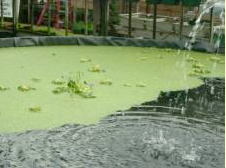
Growing Power uses aquaculture, or the "symbiotic cultivation of plants and aquatic animals in a re-circulating system." A fishery of Tilapia and Yellow Perch is used to fertilize a variety of crops in greenhouses at an urban farm in Milwaukee. In 2008, the Great Lakes Water Institute delivered 10,000 young (three-month old) yellow perch to Growing Power's urban farm in Milwaukee to test this indoor fish-farming system.


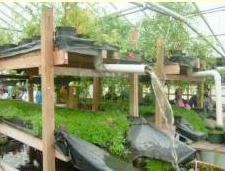
Using gravity for transport, water from the fish tank is drained into a gravel bed for filtration:

Here, beneficial bacteria break down the toxic ammonia in fish waste to Nitrite and then to Nitrogen, a key nutrient for plant development. On the gravel bed, we also use watercress as a secondary means of water filtration.

The filtered water is then pumped from the gravel bed to the crop growing beds. Then the water flows from the growing crop beds back to the fish tank. This is how it works:

Allen's Market Basket program provides weekly deliveries of produce to neighborhoods in Milwaukee, Madison and Chicago. Prices range from $9 to $28 for around 20-25 pounds of 12-15 varieties of produce that is designed to feed 2-4 people throughout the week.

There are so many additional benefits. Communities are brought together, old warehouses in cities are transformed into indoor fisheries and greenhouses, jobs are created and the perch population is restored. In the mid-1990s, the perch population in Lake Michigan collapsed partially due to an invasion of zebra mussels that hitchhiked on the hulls of ships.

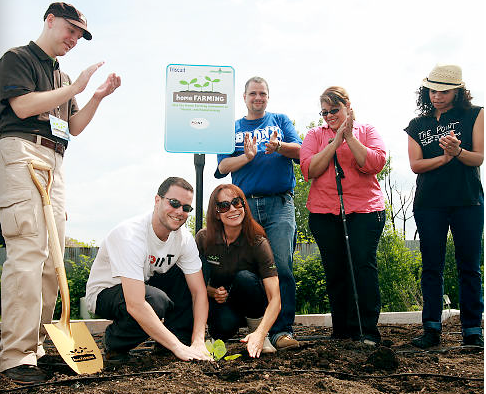
Another program called Urban Farming creates community-based farms nationwide and so far has "planted the equivalent of 1,000 garden plots -- 20 feet by 20 feet" that bring entire communities together from all generations as well as benefitting the environment with more green. A video at the link shows the community spirit of song and dance at the groundbreaking ceremonies.

Urban Farming allows poor communities and local food banks to obtain nutritious food:

This organization has turned almost 20 derelict properties in Detroit into urban farms. Through community support and partnerships with local business, these properties are now community gardens where needy residents can grow and pick their own fresh fruits and vegetables. Any leftover food from the gardens is donated to local food banks.

In 2005, the Detroit Urban Farming program provided one ton of food to food banks and community members. This is not the first time that urban farms sustained our nation:

Urban Farming wants to eradicate hunger in this generation's lifetime, Sevelle said. There is precedent; 20 million Americans grew victory gardens during World War II and grew 40 percent of the nation's produce supply.

A recent survey showed that "South Bronx suffers the highest hunger rate of any congressional district in the country. More than 36% of residents lack enough money for food." Now they have a new community farm on a 400-square-foot plot to feed themselves in a healthy, sustainable manner.

Gardening, on the other hand, means fresh air and exercise, and teaches kids about science, math, cooperation and patience, as well as yielding healthy foods, he said.

The broccoli, collard greens and tomatoes grown at the farm will be harvested for residents of the community, with any excess donated to food kitchens, said Ritz.

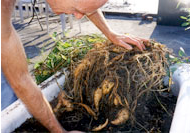
For neighborhoods that don't yet have access to urban farming programs, there is container gardening (resources and guide sheets provided at link) that uses a variety of sources, including old bathtubs to grow sweet potatoes.

Michelle Obama has been working hard to show that we have a food crisis in this nation of hunger, malnutrition and obesity. Local groups are also working hard to build the infrastructure to grow and distribute food. But America needs to realize that our food crisis is not limited to 40 million people receiving food stamps.

Wednesday, 23 April 2008

Latin Americans Make the Path by Walking

Based on articles by (1) freelance writer Clifton Ross in Oakland CA Race Poverty and Environment, (2) Betsy Bowman and Bob Stone, in DollarsandSense.org

Potosi, Bolivia: photo Gerd Breitenbach
Cerro Rico, known to the Spanish conquistadores as the world's richest mine, was sacred to indigeneous Quechua as Sumaj Orko, the Majestic Mountain; it is said to have financed the growth of the Spanish empire, the building of the British Navy, the conquests of Napoleon, and the first two World Wars. It is also known as 'the mountain that eats men' where eight million natives and uncounted African slaves died. Today, the mountain is on the verge of collapsing because of the warren of mines crisscrossing its center, and every rainfall causes rivulets of toxic effluent to flow down its surface, endangering the health of the local population—over 75 percent of whom are considered poor and 45 percent, “extremely poor"... despite this atmosphere of poverty and oppression, many are turning to “green” and “cooperative” business as models for their future economies. Locals see this process as a recuperation of ancient ways. (1)

Co-op Kitchen Photo © 2006 Clifton RossLa Paz, Bolivia
Mama Naturaleza
photo
© Clifton Ross
Consider, for example, Mama Naturaleza, a "green" cafe in the tourist district of Bolivia's capital. Manager Gabriela Gemio believes that with this family-run enterprise, she can restrain, if not reverse, the cycle of exploitation and environmental destruction. The furniture in the café is all made of regional pine wood, the interior is lit with low-energy light bulbs, and most of the food is organically grown on the Gemio farm, in the hills above La Paz. Lettuce and spinach are grown in greenhouses (called “walipinis”) covered with clear plastic, which maintain a relatively warm temperature even during the cold nights at 12,000 feet above sea level. To protect the plants from the intense mid-day sun, Hector has improvised a screen made up of a thin layer of dirt laid over the plastic, which is easily rinsed off when needed. Crops requiring higher temperatures are grown in underground greenhouses, called “sayari.” Hector learned agriculture from his elders growing up in Los Yungas, a semi-tropical region east of La Paz populated by the descendents of escaped African slaves from Potosi. In Los Yungas he learned to make insecticides from tobacco and llama manure...Running a truly green business in a Third World country is not easy, admits Gabriela. She cannot afford cardboard containers for packaging food which have to be imported at a cost that Gemio cannot afford. There is also the local custom of serving drinks with plastic straws. “I hate to use plastic,” admits Gemio, but she feels she has no other choice. (1)

Green jobs in Venezuela
In Venezuela, President Hugo Chavez wants to revive Bolivar's dream of a united and independent Latin America, based on the “bioeconomics” and "endogenous development" ideas of Chilean economist Osvaldo Sunkel's Development from Within. Chavez says he is moving from the “capitalism of Judas,” towards the “socialism of Jesus.” A key component of his Bolivarian revolution is the formation of green co-ops. In the last decade, over 120,000 have been funded from oil revenues.

La Matoma neighbourhood co-op repairs streets in Caracas

Chavez regularly calls on the cooperatives to share their profits with the most needy in their communities, but such calls to altruism have never really worked in any other context to effectively eliminate poverty and are unlikely to produce results even in Venezuela. Still, cooperatives based on sustainable development and an economic orientation that works with, rather than against, nature can only be seen as an improvement over what existed before. (1)

Bottom-up development by NUDES
Under Núcleos de Desarrollo Endógeno (NUDES), which translates as "nuclei of endogenous development",
communities develop their own proposals. Both the leadership and the decisions come from within the community... Secondary cooperatives grow up around the primary nucleus. Campesinos in the corn-growing state of Guárico organized to share equipment and knowledge, built a mill and produced “arepas,” thick Venezuelan corn cakes. agricultural cooperative. In this "green" system of bottom-up development, a crop is grown, processed, sold, and consumed locally. Any surplus is sold to bring in cash for other necessities. (1)

Aguilas Blancas Learns to Fly
The Cooperativa Cinco Aguilas Blancas (Five White Eagles Cooperative) is named for the five snow-covered mountain peaks that surround Merida. 15 women started this cooperative internet cafe, open seven days a week with two shifts of workers per day. (Each member gets one day off per week.) They learned skills in Vuelvan Caras, the Bolivarian government's job-training program, then got a loan from Banmujer, the Venezuelan women's bank. Profits from the café have been low, and the president of the co-op, admits that most of their income comes from the Internet center. Each woman makes under $10 U.S. per day. It is difficult to imagine 15 working class Venezuelan women being able to put together the roughly $30,000 U.S. dollars they needed to start the cafe. The “easy credit” provided at low or no interest has meant that each of the women had only to invest an initial (largely symbolic) amount of 10,000 bolivares, or about $5.00 U.S. (1)

Vuelvan caras: turn your faces
Surrounded by Spaniards in the war of independence, a rebel general ordered his troops to "vuelven caras"... stop being the victim, turn and attack the enemy. The new enemy is unemployment. Zaida Rosas, a grandmother of 15, works in the newly constructed textile co-op Venezuela Avanza, employing 209 barrio women. Most were formerly jobless. Their homes on the surrounding steep hillsides in west Caracas were almost all self-built. Zaida works seven hours a day, five days a week, for $117 a month, much less than the state minimum wage of $188. The cooperativistas voted this policy "so we can pay back our [government start-up] loan," she explained regretfully. As in most producer co-ops, they are not paid a salary, but an advance on profits. "We hope our working conditions will improve with time," she said. The Ministry of Popular Economy (MINEP, now renamed MINEC) had given them small scholarships to train in cooperativism, production, and accounting. Says Zaida proudly, "My family is a lot happier—I've learned to write and have my 3rd grade certificate." Her factory is is now also part of a larger local web: two producer co-ops, both built by a local bricklayers' cooperative, that, along with a clinic, a supermarket co-op, a school, and a community center, make up a so-called "nucleus of endogenous development." (2)

Venezuela Avanza cooperative: from MR Dec 2005

Criticism of the bioeconomic model
Green coops are a strategic response to the dependent and unsustainable model of resource exploitation... critics contend that they lack managerial skills, are oil-financed, with plans imposed from above. Still, by any measure, the remaining co-ops have to be considered a stunning success because they most affect those long neglected sectors of Venezuelan society: women, minorities, and the poor.

Camila Piñeiro Harnecker, who has done field research in Venezuela, reports that up to 30 percent of the MINEP co-ops may not be economically viable. Traditional cooperatives protest that the Chavez scheme is "irresponsible and opportunistic... creates cooperatives with members who don't share the proper values and corrupts them by providing easy credit and too much paternalistic aid”. the NUDES are being "used for political agendas".

Does generous government funding of cooperatives help or hinder the consolidation of worker-ownership? If financing comes too easily, if the struggle to construct the cooperative is won in a day of paperwork, is there a danger that the members might devalue the organization and not give themselves entirely to the struggle to build a worker-owned and controlled business? Anyone who has ever worked in a cooperative recognizes the crucial importance of “worker buy-in”... Otto Fernandez, an organizer and facilitator from Chiguará, talks about the need for Venezuelans to break with a paternalistic culture developed over many years. “We're used to a Daddy government stepping in to do things for us, but we need to learn to take the initiative ourselves.” Another Venezuelan put it more bluntly: “You can't expect to build an enduring cooperative movement by throwing money at it. A moth has to struggle to get out of its cocoon… if you help it, it will die... I think the same thing is true for those of us working in the [Venezuelan] cooperatives.”Ana, from Cooperativa Cinco Aguilas Blancas, disagrees with the moth analogy. They have enough of a struggle to keep their doors open each day, and “without the loans from the government and Banmujer, we wouldn't be here.” (1)

See also Camila Piñeiro Harnecker, The New Cooperative Movement in Venezuela’s Bolivarian Process Dec 2005; Venezuela and the Hackers' Revolution blog 4 Nov 04 on open-source training; the poem Caminante no hay camino / se hace camino al andar by Spanish poet Antonio Machado; Wikipedia on Venezuela's Bolivarian Revolution and Bolivia's Evo Morales; Benjamin Dangl's book The Price of Fire.