Showing posts with label Colombia. Show all posts

Monday, 10 June 2013

Colombia: sustainable planning that includes indigenous partners -- by Carwil Bjork-James

The Brooklyn-based author describes himself as an "anthropologist, revolutionary, adjunct [professor], tutor, translator". This article is from his 23 Mar 2013 blog Carwil without borders.

In March 2013, a group of scientists and development experts and the Colombian indigenous confederation each urged a fundamental rethinking of the priorities for planning “development”* in the twenty-first century. The technical experts published their perspective in a commentary in the prestigious journal Nature,Sustainable development goals for people and planet,” while the National Indigenous Organization of Colombia published a report called Another Vision, Indigenous Peoples and the Millennium Development Goals. (coverage from Intercontinental Cry). Both texts are intervening in the global discussion on the next version of the Millennium Development Goals (MDGs). Outside of the United States (where this kind of international planning is treated as purely a foreign policy matter that won’t affect our future), the MDGs are taken as a general yardstick for directing aid and setting policy objectives, with goals like achieving universal access to primary school and eliminating extreme poverty that may change hundreds of millions of lives. Since I write from the USA, however, let’s pretend that this is just an intellectual discussion for how to think about the world. Even from that perspective, the scientists and the indigenous people raise some really important questions.

Since at least the 1990 Rio de Janeiro Earth Summit, the conversation about the relation between human economic development and the planet on which it happens has centered around the phrase “sustainable development.” To begin with, the idea of development is a way of shoehorning two very different goals into one word: for the poorest and those concerned with them, “development” is having the basics: food, water, education, housing, health care; while for the richest use the same word for building the enterprises, real estate deals, and financial arrangements that make them richer.

After a generation of conversations about whether the economic and demographic growth of humanity could be sustained by our finite planet, “sustainable development” was a catchphrase designed to underlie a conversation that talked about environmental and economic issues. Like the word development itself, there was always a bit of magic to the wording. Environmentalists could feel like they were demanding that development be limited to that small subset of economic systems that were actually compatible with the limited resources of the planet (these were the “sustainable” forms of development). Champions of economic growth could seek out policies that would make growth continue forever (development that would be sustained). Big contradictions were swept under the rug.
The triple bottom line (CC-BY-SA by Triplebotline)

In the 1990s, the companion idea to sustainable development was the parallel existence of the economic, the social, and the environmental. UN conferences don’t really plan the direction of the planet, since nearly all of our effects on the environmental are organized as economic activities: decisions about them are made as economic and resource policies, the actions of corporations and the loans of private and public financial institutions. With this in mind, environmentalists tried to pressure and cajole economic institutions into taking the Earth into account. Literally. The metaphor that was created was the so-called “triple bottom line.” This was basically a request for businesses to put their environmental impact alongside their profit and loss statements. And the idea was that the effect on business owners, society, and the planet, were all similar measures of how right or wrong a particular course of action was. When I had the occasion, in my brief environmental advocacy career, to attend socially responsible investment conferences, the triple bottom line was just a big a buzzphrase as sustainable development was at the United Nations. The fact that any business was just a subset of society, and so didn’t necessarily need a separate account, didn’t really bother anyone. (After all, this was basically a tool for appealing to powerful interests to consider the Earth and humanity, too, alongside their own self interest. It was always intellectually and morally dishonest.) Inside the UN process, this idea was replicated as a “three pillars” (people, planet, profit) model of development.
This week’s intervention from scientists recognizes the growing blowback from damage to the environment upon the possibilities of social advancement and economic growth. The Nature article starts from evidence that “humans are transforming the planet in ways that could undermine development gains.” In response, it urges a rethinking of the triple bottom line:
First … we need to reframe the UN paradigm of three pillars of sustainable development — economic, social and environmental — and instead view it as a nested concept. The global economy services soci ety, which lies within Earth’s life-support system.
sustainable development … should therefore be redefined to “development that meets the needs of the present while safeguarding Earth’s life-support system, on which the welfare of current and future generations depends”
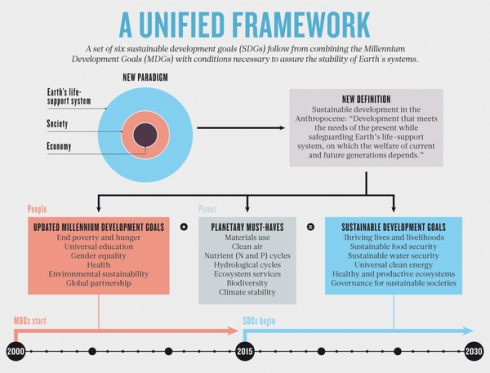
In short, Earth is finally recognized as the outside, without which there can be no social or economic development.
Sustainable Development Goals chart, from Griggs et al. article in Nature.

Colombia’s indigenous confederation takes up the conversation in a different place, grounded on defense of their communities, who have long recognized the Earth as the foundation for their ways of living. Indigenous peoples have most often experienced development as an economic process built on colonizing their territories and extracting their resources for use elsewhere. In the global South, the sale of these raw materials has been the income source for “social development” elsewhere, while many indigenous communities get a shrinking or degraded landbase. The Cauca Regional Indigenous Council (CRIC) had previously laid a critique (es) of the Millennium Development goals, which exclude any specific consideration of indigenous people and focus on the individual distribution of a small proportion of global wealth, rather than on rethinking the economic model.
Now, three Colombian indigenous organizations are offering their own additions to the Millennium Development Goals, five new goals to be achieved in a decentralized way:
1) the protection of indigenous territory;
2) indigenous self-government;
3) the self-development of indigenous communities on the basis of equilibrium and harmony;
4) free, prior and informed consent as a condition for developments on indigenous land;
5) the ‘institutional redesign’ of the state in its relations with indigenous peoples.
Their intervention proposes making these goals as quantifiable and verifiable as the MDGs:
The third goal, of achieving self-development on the basis of equilibrium and harmony, for example, covers subcategories such as indigenous women’s rights, education, indigenous and intercultural health services, and harmony between mankind and nature. The education sub-theme includes the specific indicator of the number of teachers in a given territory who are teaching through indigenous languages. The harmony with nature sub-theme includes the indicator of the number of hectares of indigenous land replanted with native species.
Technocratic objectives are what set apart the MDGs from previous rounds of international targets. However, finding quantitative MDG goals that apply to every situation gave room for only certain very common problems—lack of sanitation, poverty defined by a dollar threshold, maternal mortality—to be addressed. This indigenous initiative is attempting to put locally defined rights, and the relationship with the environment back onto that agenda. The 200-page document is just one example of how indigenous peoples have inserted themselves into global conversations on humanity’s long-term future. By engaging with the global planning around the MDGs, they are raising that voice again.

It remains to be seen whether the power balance among profit, planet, and people can be made to reflect the intellectual reality that people depend on the planet, or to reflect the possibility that the economy could serve the vast majority of people rather than the other way around. A real shift requires changing the conversation, but also pressure to change that balance of power.

* Development is a rightly contentious term, but since the major challenges to it are all incorporated in these two critiques, I’ll just use scare quotes this once. If you’re wondering what is meant by this contentious term in the first place, consider these descriptions of economic development and the right to development.

Monday, 21 November 2011

Colombia: murders for “sustainable” development

In memory of Kimy Pernia Domicó
photo: Kathy Price, Amnesty International
On 2 June 2001, Kimy, a leader of the indigenous Embera Katio, was abducted by armed men. Never seen again, he had just guided a Rights and Democracy delegation from Canada to the Urra damsite, recorded a video, criticized the US-led FTAA, and was about to speak to the Council of Canadians in Vancouver – a major embarrassment to the Colombian and Canadian governments. Five years later, as part of the 'amnesty' process, rightwing paramilitary warlord Salvatore Mancuso confirmed that he planned Kimy's assassination. After deportation to the US for drug-dealing, he admitted to massacres supported by Colombian army and security forces. The Canadian government deliberately ignored this evidence in signing a Free Trade agreement with Colombia. Mancuso's personal assets and land grabs have been estimated at US$25 million. The Urra dam was more destructive, and involved even greater profits.

Chronology
1951- engineers plan a damsite on the Sinú river. Though a small power development, it would flood the traditional territory of the Embera, turning it into a polluted swamp. So-called environmental assessments in later decades ignore the impacts, holding no consultations with native people. “The engineers have come to our huts, but … just to take tourist photographs," said Kimy.
1946 to 1958 - the “Violencia”, civil war which killed 200,000 and made 2 million refugees; land grabs by sugar and cotton barons. Small coffee farmers are displaced or hired as thugs.
1977 - the Sinú valley, including Embera territory, is declared a 'public utility' – i.e., a sacrifice zone.
1994 – Urra Dam construction begins. Embera people paddle to Bogota to protest against construction, its threats to the bocachico fishery, and their right to survive on traditional territory. The dam consortium includes Swedish, Russian and Colombian transnationals, and Dutch and Canadian banks – the latter backed by the Canadian Export Development Corporation. The environment minister states "The construction of Urra will continue, because it offers more development opportunities than ecological ones. We publicly assume the responsibility. This is a ministry for sustainable development, not for the conservation of resources.” The government divides communities, corrupts some leaders, and establishes small 'special territories' (we would call them reserves) for the Embera and U'wa peoples.
1996 – Colombia gives the go-ahead to fill the reservoir immediately,
1994-99 – the Embera occupy the consortium building and the Swedish embassy. Labelled 'subversive' guerillas, 10 indigenous people, as well as a Cordoba University professor and two environmentalists, are 'disappeared' by paramilitaries in the pay of the consortium. In 1996, the Embera Katio occupy the Spanish Embassy to ask for political asylum. In 1998, Alonso Domicó Cabrera, the Embera's spiritual leader, is killed in his home. Soon after, his successor Lucindo Domicó Cabrera. Later, paramilitaries detain a dozen Embera, threaten them and burn their canoes before killing Alejandro Domicó.
December 1999 to April 2000 - Embera indigenous people walk 700 km to Bogota, occupying the garden of the environmental ministry for four months, until the government agrees to halt flooding and study its impacts. One year later, the agreements have not been fulfilled, two more Embera leaders have disappeared, the reservoir rises. Flooded out, 250 natives must live in poverty in the nearest town. Final murder toll: 32. This is a general pattern in Colombia, where hundreds, perhaps thousands, of union leaders and peaceful protesters have been assassinated by paramilitaries.
April to June 2001 – as an international human rights campaign begins, Kimy Pernia Domicó is murdered. His daughter Martha Cecilia, accepts Rights and Democracy's John Humphrey human rights award on her father's behalf. Council of Canadians chair Maude Barlow says, “The disappearance of Kimy highlights the pressure on the developing world, on the poor and on First Nations to hand over their water resources for private benefit, no matter the cost. We are here in Canada with delegates from over 30 countries to push back, to protect the world’s water from the corporate forces that want to profit from it, and today we’re doing this in Kimy’s name.
2002 - the Columbian Bureau of the UN Human Rights Commission warns that indigenous peoples of Colombia are threatened with extermination in the next 10 years.

2003 – CETIM/AAJ submission to UN Human Rights Commission: “20 people die daily of whom 15 are unarmed persons assassinated inside their homes, in their places of work and in the streets. One thousand persons have been displaced per day for the last three years, a high percentage of whom are members of the indigenous community: they represent 12 % of the displaced people, whereas the full indigenous population is only approximately 0,6 % of the entire population of the country.” In the previous year alone, 150 indigenes were murdered.

2007-2010 Hollman Morris Rincón's Contravia.tv investigates massacres, embarrassing the US and Colombian governments. Commercial networks boycott him. Harvard invites him to a prestigious Nieman Fellowship. The US government refuses to issue a visa.

2010 - Canadian Conservatives muzzle Rights and Democracy.

2010 – Canada and the US sign Free Trade agreements with Colombia.


Who benefits? Corrupt politicians, big landowners, rightwing warlords and druglords, Canadian and other mining interests seeking cheap power, foreign bankers and investors. And above all, the currently-postponed FTAA (Free Trade Area of the Americas) meant to funnel resources to the US. Colombia is on the cross-roads of continent-wide investment in the Panama Puebla Plan (PPP) highway, the Atrato canal [linking two oceans] and the Integration Initiative of the South America Regional Infrastructure (IISARI). According to CETIM-AAJ, all aim to tie Latin America closely to the United States.
***
Based on dossiers by Kairos, Amnesty, Council of Canadians, FOE Colombia, Contravia.tv videos on Youtube. See also our previous posts on violence in Chiapas and Guatemala.

Friday, 31 July 2009

Canada: the Liberian flag of mining

Mexico City mining protest 24 July 09: photo Carlos Ramos Mamahua
Updates
30 Oct. 2010: Canada Corporate Accountability Bill C-300 defeated in House of Commons. It asked simply for corporate disclosure similar to US SEC requirements.
21 Jul. 2010: US Dodd-Frank law tells SEC to tighten disclosure rules.
23 Mar. 2011: Globe and Mail: Canada's anti-corruption enforcement deliberately lags behind US.
1 Oct 2014 Kairoscanada: Harper government refuses mining oversight bill C-584.

A system of sleaze was created over the last two decades by successive Canadian governments and financial wizards. Like Liberian shipping, you fly the flag, follow no rules, answer no questions, do what you want and take your profits elsewhere. And better yet, the Canadian taxpayer will bankroll you.

More than 2/3 of the world's oil, gas and mineral companies are now Canadian (most of them in name only). They get hundreds of millions of dollars in export credits. They have given us a world reputation for toxic dumping, murder, massacre, forced displacement of aboriginals, cozying up to dictators, and financial fraud. (1) Our diplomatic service have become their touts and apologists. (2) Says Development and Peace, a Catholic NGO, “This is not a case of a few bad apples: Canadian extractive companies have been implicated in human rights abuses and environmental disasters in more than 30 countries." The latest annual report of the Canadian Mining Association boasts 4900 projects, a huge worldwide expansion thanks to lax supervision by the 'virtual' Toronto Stock Exchange. (3)

Riding roughshod over aboriginal rights is nothing new in Canadian mining. To name only a few of the most flagrant: BC's century-long refusal of treaty, yellowcake poisoning of NWT Dene that left a “village of widows”, the shameful treatment of the Lubicon Cree, and a rash of recent jailings of native protesters in Ontario. (4) With world commodity prices soaring, Canadian governments have made things even easier at home. Ottawa overrode its own environmental legislation to allow lakes to be used as toxic dumps. (5) Ontario has exempted mines from environment assessments for at least a decade. (6) To the Bay Street boys, the message is clear: “anything goes”.

Even worse things were happening in the Third World, where corruption, bribery, and murderous contempt for natives were added to the mix. A map of the most notorious cases has been published by the Halifax Initiative; Amnesty has protested CPP investment in some of them (7). A few examples must suffice. There are many more.

Talisman Energy (ex-BP Canada), Sudan was accused in 2002 by the Presbyterian Church of helping the Sudan government "bomb churches, kill church leaders and attack villages in an effort to clear the way for oil exploration." A US lawsuit failed, but divestment by Ontario Teachers and other pension plans forced Talisman to sell out its Sudan holdings. (8)

Ivanhoe's joint Monywa copper mine with the SLORC dictatorship of Burma has been marked by 13 years of slave labour, torture, and genocide, according to Amnesty International (9); in all that time Canada consistently failed to take action. In July 2009 the company hired ex-Prime Minister Jean Chretien as “senior adviser” -- meaning lobbyist -- to get US sanctions lifted. (10)

Ms Otiego Mseti, one of the Tanzanian villagers suffering from Barrick's “alleged” contamination of the Tigethe River: courtesy ProtestBarrick.net

North Mara mine, Tanzania, June 2009: “More than 20 people have died in recent weeks as a direct result of the contaminated water. We have no problem with investors. But the investors must respect and treat us like human beings. These Canadians are killing us... they are not doing business,’’ says a villager. (12) Protests have gone on for eight years, with forced evictions, dumping on village land without permission or compensation, arrests of elders, company collusion with corrupt politicians, and murder of at least 6 villagers. Recently scientists found cyanide and heavy metal contamination associated with “a wide range of carcinogenic effects such as skin, kidney, teratogenic effects; mutagenic effects; and brain damage". For years, the company has refused to clean up. (13)

Colombia: Canadian mining lobbyists were the spearhead of the neoliberal Washington Consensus. After the World Bank ordered deregulation in 1996, Canadian experts rewrote Colombia's mining law, slashing royalties and safety provisions. In 2003 the World Bank ordered the state to sell off its national mines. Since then, corrupt deals with politicians, paramilitaries and big landowners have resulted in evictions of afro-Colombians and aboriginals, over 400 murders and disappearances. Last year two environmental groups challenged the Mining Law, on grounds that it violates the Constitution by permitting destruction of unique ecosystems. (14)

Colombia mining on U'wa aboriginal land: courtesy FOEI
Omai mine, Guyana: in 1995 there were five cyanide incidents. In the worst and last, a tailings pond spilled 120 million gallons of toxic effluent into the Omai and Essequibo rivers. Aboriginals, traders and miners reported dead fish and animals; they complained of skin rashes and blistering for two months after the accident. Many of the 50,000 inhabitants fish, boat, bathe and drink water from the river. The government issued warnings to all residents downriver of the mine to cease using the river for washing, drinking and fishing. No current information on cleanup activity is available. (15)

Ecuador: in April 2008 after a political movement of aboriginals voted against corruption and environmental destruction, the government revoked 4/5 of mining concessions. But in 2009 president Correa restored the concessions, winning high praise from the Canadian mine lobby. Canadian church protests stopped his attempt to outlaw the NGO Acción Ecológica, which is now backing the native group CONAIE's court challenge to the new mining law as a violation both of aboriginal rights and the Rights of Nature law. (16)

Porgera, Papua New Guinea: a Barrick mine has dumped millions of tonnes of toxic tailings into rivers. Hundreds of natives have been killed or injured by security guards. In protest, the Norwegian Pension Fund has divested its stock. CPP and QPP continue their holdings. In April 2009 PNG police torched over 300 houses in the area. (17)

Marinduque, Phillipines: "forests, river basins and coral reefs have been smothered by hundreds of millions of tons of pulverized mining waste rock and toxic tailings laden with arsenic, cadmium, lead, manganese, nickel and sulfate". Bankrupt, facing civil suits and angry stockholders, the original owner Placer Dome was bought out by Barrick. National mining laws had been gutted under the Ramos dictatorship in the 1990s. Those who protested were murdered or disappeared by security forces, a practice which has continued to the present day under President Macapagal-Arroyo. (18)
blasting at Cerro San Pedro: Tamara Herman photo
Cerro San Pedro, Mexico: Metallica plans to level the sacred mountain, destroying most of the historic town, poisoning the water and soil for miles around with cyanide. It will take 32 million litres of water daily, has defied court orders to stop blasting, and sent gangs to attack peaceful protesters, the majority of the population. Corrupt federal politicians refuse to enforce the law. In May 2009, Montreal sympathizers “staked a claim” and announced an open-pit mine in Mount Royal park – to show what a Canadian equivalent would be. (19) A secret July 2009 memo from the Canadian Embassy in Mexico City says it is seriously worried by country-wide protests against mine pollution and corruption; "4/5 of the companies are Canadian," it admits. Two weeks later it was occupied by a sit-in -- see top photo. (20)

a pile of D&P petitions to Harper 2008
Canadian churches and human rights groups have kept the cause alive. This spring, Development and Peace took another 150,000 petitions to Parliament calling for a mining ombudsman who can hear evidence of offshore violations, and a new corporate accountability law. The Conservative government refused, ignoring the advice of expert Roundtables which urged it to create “a Canadian CSR Framework for all Canadian extractive-sector companies operating in developing countries.” Nevertheless, a private member's draft (Bill 300) passed first reading in April. (21)

Here are the principles that should underlie such legislation, according to Development and Peace: (22)

1. The Earth is sacred. All life is interconnected and interdependent. Therefore, the Earth’s ecological diversity, beauty and health must be protected.
2. The Earth’s resources must be shared by peaceful means in an equitable manner that allows current and future generations to meet their needs.
3. All people have the right to participate fully in and have control over decisions that affect their lives and communities.
4. In the interests of solidarity and the common good, decisions made for the benefit of one community must not violate the rights of other communities.
5. The importance of the Earth’s resources to the common good takes priority over any possible commercial value. In the extraction, management, and use of resources, human rights must be respected.
6. Preference must be given to the rights of indigenous peoples and those who are marginalized by poverty or because of race and gender.
******
Notes
(1) See 13 Jun 09 public statements by Development and Peace and Halifax Initiative.
The latter, a coalition of churches, human rights lawyers and environmental groups, in 2003 severely criticized Export Development Corporation's seven deadly secrets: huge export subsidies to mining projects without real environmental assessment or public hearings.
(2) In the USA, Barrick lawyers in 2003 and 2009 admitted financial fraud, claiming that the company was acting on on behalf of central banks, which cannot be sued.
(3) For the role played by Canadian diplomats in bribery and death in Tanzania, among other places, see Alain Denault, Noir Canada: Pillage, corruption et criminalité en Afrique (Montréal, Ecosociété, 2007). Barrick Gold launched a $6 million SLAPP suit in Canada trying to stop the book's distribution, although the company had lost a similar suit in a UK court against a British journalist who first broke the story. See also http://Protest.Barrick.net
(4) See Wikipedia on Toronto Stock Exchange, now the TSX/TSVX. In 2001 it closed its floor to trade entirely online (and unsupervised) after swallowing up the penny-stock Vancouver and Calgary exchanges. Its 2009 report crows that it is now bigger than New York's NYSE. Many US firms have shell listings on TSX/TSVX, allowing them to avoid SEC disclosure.
(4) The century-long Gitksan case in BC, NWT yellowcake poisoning, the Lubicon story; on recent jailings see previous posts in this blog: one two three four five six
For a full account see the highlights and CD of the 1990s Royal Commission on Aboriginal Peoples. The current Tory government has refused to honour the resulting Kelowna Accord.
(5) CBC news 16 Jun 08.
(6) Ontario extends EIA moratorium 2002-2012: MiningWatch report.
(7) example of an Amnesty protest of CPP investment.
(8) Halifax Initiative's map, part of the campaign for government supervision, gives details of human rights abuses by Canadian mining companies and $100s of millions in taxpayer subsidies. CPP and QPP have also invested heavily: see note 22.
(9) Amnesty 2002 statement to Ivanhoe shareholders. Our previous posts on Burma.
(10) Chretien hired by Ivanhoe, Rabble.ca news July 2009.
(12) Mother Africa blog 29 Jun 09.
(13) Protest Barrick 17 June 06.
(14) Colombia stories from Friends of the Earth and IPS news.
(15) Omai is one of the world's worst ten toxic sites.
(16) For native protests and police killings see Mining Watch, Ecuador Rising and Grain. Canadian churches campaign Mar 2009 in support of Acción Ecológica. Protests in Peru and Bolivia June 2009, linked to “special clauses” in free-trade agreements imposed by the US and Canada, were broken by police massacres.
(17) Wikipedia on Porgera; June 2009 police action.
(18) quotation from Wikipedia on Marcopper disaster in Marinduque.
(19) Cerro San Pedro and Montreal sympathy action.
(20) secret Canadian Embassy memo and later sit-in.
(21) Development and Peace news 12 May 09; see also its reasons for CPP disinvestment and for an ombudsman. The March 2007 national Roundtable report calling for a corporate accountability law, was refused by the Harper government. The Montreal Social Justice Committee's Upstream July 2009 issue notes that the government's March 2009 proposal for a "CSR counsellour" is far nore restricted than an ombudsman; the proposed CSR centre has no enforcement powers; and corporate compliance is voluntary. NGOs and corporations provide the main impetus in Voluntary Principles (VPs), an international stakeholders group which Canada just joined. Liberal John McKay introduced the private member's Bill 300 in February 2009.
(22) Development and Peace Declaration of principles. See also the Natural Resource Charter and Publish What You Pay.

Update from Africa Report 26 Nov 2013: Harper imposes "investor rights" on Africa
Update from Mining Watch 21 Sep 2015: Canadian corporate offenders in the Americas.

Thursday, 12 June 2008

The women of Barrancabermeja, Colombia

OFP photo courtesy of Amnesty USA
The Barrancabermeja videos can be viewed at GlobalVoicesOnline, posted 11 June 2008 by Juliana Rincón Parra, who says:
This nine part documentary created by Taline Haytayan as part of the Peace Brigades International organization in the strife ridden Barrancabermeja region of Colombia captured my attention throughout. It follows the OFP Organizacion Femenina Popular (or Feminine Popular Organization) which works together to prevent violence against women and violent conflict in a region where people have been trying to live in the middle of crossfire between two different guerrilla factions, the army and the paramilitary forces. At the moment, many of the women who head the OFP need constant protection due to threats on their lives, murders and disappearances of group members. The videos have English captions throughout, telling the story of the OFP, the struggles with oil refineries, candle lit vigils against war rich with cultural artistic expressions, hip hop as a protest against war and violence; a creative outlet for youth in the community, peaceful marches, government policies that affect the community negatively, testimonies from victims of armed violence and provides reasons why Plan Colombia and the practice of coca plantation dusting are detrimental to the wellbeing of the communities.

Barrancabermeja houses the biggest oil refinery in the country and is also the home to the Petrol Christ, a giant steel figure meant to represent Jesus with water spraying from the tips of his fingers. The first part explains a bit of the history of Barrancabermeja and its struggles with the oil refinery industries, and follows the strike run by workers against [privatization that stripped oil unionists of their jobs]…. It also tells the story of the OFP which runs soup kitchens that feed about 600 people… on a daily basis.

The second and third videos follow the women of the OFP during the preparation and at the event: the day of the candle-lit vigil for peace and against war and violence, where the rallying cry was: ”not one boy, not one girl, not one cent for war.”
(Editor's Note: The video shows the close connections between the Uribe government and rightwing paramilitaries, the so-called War on Drugs, and the privatization of Colombian oil under the Washington Consensus and US-sponsored bilateral "free trade" agreements, known to activists as "NAFTA on steroids". Decades of civil war, and huge corporate profits, all at the expense of the poor. Canadian corporations have joined enthusiastically in the ripoff — with Canadian government help, these private interests recently wrote the new Colombian mining law! For details see MiningWatch.org)