This is cross-posted from Ruah's research blog
transitionvision.wordpress.com. She returned home in late July after visiting Transition Towns in Israel and Europe.
***
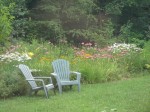 |
My flower garden has fruit trees
and tomatoes growing in it. |
I so looked forward to coming home and then I returned to a heat wave. I had been complaining that I never got warm enough in Europe and then [in Vermont] had to suffer 97 degree Fahrenheit temperatures during the day and sweltering nights. But the heat wave’s finally broken and I’m reveling in the lush beauty of a Vermont summer. Our garden is producing lots of berries, summer squash, broccoli, peas, onions, potatoes, and tomatoes so far. What a bounty!
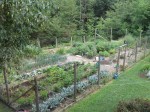 |
The main garden protected from deer.
Several more gardens outside the fence |
I’m loving the weeding and harvesting and especially the cooking. Last night at our neighborhood potluck we had a delicious pasta primavera, a salad from a neighbor’s garden greens, home baked bread, great wine, and another neighbor’s blueberries in a fabulous dessert. With great conversions sprinkled in, what more could one ask for? Currently our land is saying, “produce, produce, produce.”
Bound Brook Farm, not too far from where we live, is owned by friends of ours, Erik Andrus and Erica Hurwitz. Erik and Erica’s dream was to grow wheat, partly to supply Erik’s fledgling bakery and partly to sell in the Champlain valley. Erik started a bread CSA (Community Supported Agricultural farm), selling his excess bread, croissants, and other mouth-watering delights at local farmer’s markets. His goal of a net-zero-energy farm is assisted by the use of horses. What Erik didn’t know about the land he purchase in 2005 was that a good deal of it stays wet and this isn’t good for wheat farming. Pulling up stakes isn’t an option after all the labor to build the house, outdoor wood-fired oven, and other essentials for the bakery. Instead he is learning to adapt in a different way.
Erik is learning that there’s another niche to fill in the Champlain valley, where so many people are focused on eating locally–rice. As he was quoted recently in the
Burlington Free Press, “I love bread, and I love beer more than I love a plate of brown rice and a glass of sake – but if my inclination says bread, and the land says rice, I have to listen to what the land says.” And with that said, he’s invested money and time for his first rice harvest this year, hoping to produce 4,000 pounds of the stuff. The rice will be harvested with a horse-drawn reaper binder, and after the drying and threshing, it will be processed with a recently-purchased rice huller Erik ordered from China.
I was so moved by Erik’s statement. Actually, how brilliant is it to truly understand the land where you live, to have a deep sense of place? How often in human history have we not listened to what the land says? Deserts made green for agriculture and cities built where wildlife should have flourished are just two examples of how our incredible human creativity has backfired with unwanted results. What would it be like if we all took the time to observe and listen to the place where we live? It’s one of the basic principle’s of Permaculture. Once you really know your place, observe where the sun shines on the land in all seasons, know the changing temperatures, and observe how the natural world adapts to the place, it’s time to grow your food.


