Showing posts with label CSA. Show all posts

Wednesday, 28 September 2011

Listening to what the land says -- by Ruah Swennerfelt

This is cross-posted from Ruah's research blog transitionvision.wordpress.com. She returned home in late July after visiting Transition Towns in Israel and Europe.
***
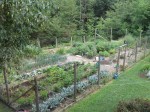
My flower garden has fruit trees and tomatoes growing in it
My flower garden has fruit trees
and tomatoes growing in it.
I so looked forward to coming home and then I returned to a heat wave. I had been complaining that I never got warm enough in Europe and then [in Vermont] had to suffer 97 degree Fahrenheit temperatures during the day and sweltering nights. But the heat wave’s finally broken and I’m reveling in the lush beauty of a Vermont summer. Our garden is producing lots of berries, summer squash, broccoli, peas, onions, potatoes, and tomatoes so far. What a bounty!

The main garden protected from deer. Several more gardens outside the fence.
The main garden protected from deer.
Several more gardens outside the fence
I’m loving the weeding and harvesting and especially the cooking. Last night at our neighborhood potluck we had a delicious pasta primavera, a salad from a neighbor’s garden greens, home baked bread, great wine, and another neighbor’s blueberries in a fabulous dessert. With great conversions sprinkled in, what more could one ask for? Currently our land is saying, “produce, produce, produce.”
Erik is learning that there’s another niche to fill in the Champlain valley, where so many people are focused on eating locally–rice. As he was quoted recently in the Burlington Free Press, “I love bread, and I love beer more than I love a plate of brown rice and a glass of sake – but if my inclination says bread, and the land says rice, I have to listen to what the land says.” And with that said, he’s invested money and time for his first rice harvest this year, hoping to produce 4,000 pounds of the stuff. The rice will be harvested with a horse-drawn reaper binder, and after the drying and threshing, it will be processed with a recently-purchased rice huller Erik ordered from China.

I was so moved by Erik’s statement. Actually, how brilliant is it to truly understand the land where you live, to have a deep sense of place? How often in human history have we not listened to what the land says? Deserts made green for agriculture and cities built where wildlife should have flourished are just two examples of how our incredible human creativity has backfired with unwanted results. What would it be like if we all took the time to observe and listen to the place where we live? It’s one of the basic principle’s of Permaculture. Once you really know your place, observe where the sun shines on the land in all seasons, know the changing temperatures, and observe how the natural world adapts to the place, it’s time to grow your food.

Sunday, 22 November 2009

If developers ruled the world -- NFB Citizenshift

Cartoon by Anthony Piraino, Greensboro NC - see his blog
click on cartoon for clearer view


Sprawl
(13m 42 s, NFB 2009)
by Montreal actress, journalist and videographer Tamar Kozlov
Two views of Montreal: Dr. David Suzuki at a 2009 youth conference held by C-Vert, an environmental program for youths founded by Stephen Bronfman. They speak about urban sprawl, the dangers of meddling with natural systems (e.g. GMOs) and the state of the planet. David Côté and his chef Chris Eschleman launch Crudessence, a raw / living food restaurant, and speak of a younger generation's hopes of greening the city.
*****
See previous post on results of urban sprawl in Duncan BC.
Other Citizenshift videos and podcasts at http://citizenshift.ca/categories/environment
En français http://parolecitoyenne.org/categories/environnement

Monday, 27 July 2009

Single mom brings farms to the Bronx - one of the Changents

Tanya Fields is one of hundreds of young Americans in Changents.com, where her story first appeared.

I am a single mom in the South Bronx who quit her day job to become a full time activist. I am now seeking to create the first Hunt's Point Urban Farm and creating a nonprofit that would create a network of urban farms in the Boogie Down!

I have always been a big mouth and growing up on in the city of New York I had to be resourceful. So it is no wonder that my work in the community now depends on my resourcefulness and big mouth. I am an environmental justice activist, mom of three burgeoning revolutionaries and an upcoming urban farmer.

By day I am the Operations Manager at the Majora Carter Group, the original South Bronx environmental justice trailblazer. By night -- and weekends and holidays to boot -- I am working to create community programs to address food justice and remediate public health issues that I know affect all too many folks of color in the ‘hood.

3 years ago when I realized that I was unhappy in the corporate sector. I worked while raising my family to put myself through school only to find myself in an high demand, unfulfilling job on the lower rungs of the corporate latter and in the evening I myself coming home to a community frauught with [garbage] transfer stations, smells from water treatment facilities and an asthmatic child. I knew there had to be a way to help myself, my children and my community. I started volunteering with a local community group, Mothers on the Move where I excelled as a fearless speaker, a capable leader and an effective organizer and quickly caught the eye of the local press and other activists including Majora Carter.

Suddenly the big mouth that my mother warned would get me in trouble was stirring up trouble, but in the best way possible. I became known to community members and local elected officials as candid (sometimes to a fault), witty, relatable and articulate.

In the three years that I have dedicated myself to environmental work, I have started an organization called The BLK Projek which focuses on food justice particularly as it relates to public and mental health for underserved women of color. It includes using yoga to improve women's health and sex lives with sustainability, organic food and nutrition. My latest challenge has been rallying the cause to place an urban farm on a piece of underdeveloped NYC Parks Dept land...

About 7 years ago, I was a burgeoning spoken-word poet and emcee. My future work includes bringing hip-hop and 'hood culture together with the environmental work that I do. Most of the "isms” our people feel stem from environmental degradation. To change that, we must rise up and fight for the resources that will create a better, greener, healthier 'hood.

If I can be one of many successful architects of that -- and raise and inspire future architects -- then I will have been both an effective environmental leader and mother...

*****
Changents is a US social network started by Deron Triff and Alex Hoffman, now going worldwide with Earthkeepers; it is sponsored by Timberland clothing, and seeks more partners.

Friday, 24 July 2009

La décroissance conviviale - MQDC

George Heriot, danse ronde des canadiens (gravure de 1807): BAC
Texte tiré du manifeste du Mouvement québécois pour un Décroissance conviviale. Voir ses principes de base, et d'autres références en bas. En bajo del texto, referencias en español.
*****

Quatre crises intimement liées

Crise écologique, d’abord. Inutile de rappeler que depuis l’industrialisation, les êtres humains ont fait disparaître des milliers d’espèces, pollué l’air, l’eau et le sol, décimé des forêts, produit assez de gaz à effet de serre pour modifier le climat, faire fondre les glaciers et élever le niveau des mers, le tout avec des conséquences incontrôlables. La population mondiale consomme comme si nous avions une planète et demie. Si les six milliards d’habitants de la planète pouvaient se permettre le mode de vie que les pays industrialisés font miroiter à travers le monde, c’est de six planètes dont nous aurions besoin.

Crise sociale, encore. Malgré toutes les promesses de l’idéologie de croissance, la sous-alimentation et l’insécurité alimentaire compromettent la santé de millions de personnes, dans le tiers-monde et dans les pays industrialisés, incluant le Québec. Au même moment, les maladies liées à l’american way of life et à sa pollution font leurs ravages : asthme, cancer, allergies, obésité, maladies cardio-vasculaires, problèmes de santé mentale, etc. Des milliers de personnes vivent des épisodes d’épuisement professionnel pour avoir trop travaillé tandis que des milliers d'autres personnes sont exclues du marché du travail et soumises à l’opprobre.

Crise du sens, toujours. Le stress et le sentiment de vide provoquent dépressions et suicides. Entraînés dans le tourbillon du productivisme et du consumérisme, nous n’avons pas le temps de réaliser que notre liberté se limite à celle de choisir parmi des produits et à s'identifier à des marques de commerce. Le sens véritable de la vie, qui est quête en soi, est évacué du programme. Continuellement occupés, agités, divertis, nous n'avons plus la possibilité de réfléchir alors même que nous consommons biens, services, ainsi que nos relations. Les liens humains prennent place dans un système où le réflexe cultivé est de chercher notre plus grand profit, au détriment de toute solidarité. Branchés sur des médias de masse qui procurent une illusion de présence, nous constatons avec impuissance notre difficulté d’être, tout simplement, avec nos semblables.

Crise politique, enfin. Les citoyens désabusés ne font pas confiance aux politiciens. Rien de surprenant, quand les multinationales imposent leurs règles avec la complicité des gouvernements en place. De grandes institutions non élues, telles l’Organisation mondiale du commerce, la Banque mondiale et le Fonds monétaire international, prennent des décisions qui affectent la vie de peuples entiers n’ayant pas leur mot à dire. Les contestations sont réprimées par la force policière, quand ce n’est législative et judiciaire. Mais qu’est-ce donc qui légitime le fait que les intérêts financiers des entreprises pèsent plus lourd que les droits des peuples?

Nous, «objecteurs de croissance», déplorons les ravages provoqués par l'idéologie de la croissance et toutes les conditions qui la déterminent.

Culs-de-sac
… L’expression développement durable, issue du rapport de la commission Brundtland en 1987, présuppose la possibilité du respect de l’environnement dans un contexte de croissance économique et propose de répondre aux besoins du présent sans compromettre la capacité des générations futures à répondre aux leurs. En faisant de la croissance une nécessité, le développement durable abandonne toute tentative sérieuse d’éliminer les activités économiques nuisibles. ... La satisfaction de nos « besoins » de mobilité, de confort et de télécommunications prépare aux générations futures un legs de pollution, de catastrophes climatiques et de déchets, entre autres.

... Le mouvement de la consommation responsable réussit lui aussi à convaincre une partie de la population de consommer des produits équitables, locaux, sans pesticides, biologiques, éco-énergétiques... Mais la possibilité de faire des « achats éthiques » évite de poser la question de la nécessaire réduction de la consommation (seul moyen direct de réduire la pollution, les émissions de gaz à effets de serre, la production de déchets). De la même manière, un effet rebond a été constaté avec les technologies éco-énergétiques...

L’idéologie du progrès … conçoit que l’Homme, maître de la nature, avance inéluctablement dans l’amélioration du monde. (Mais) la frénésie de l’innovation raccourcit le cycle de vie des objets, dont l’obsolescence est planifiée... Rapidement, les objets se retrouvent dans les dépotoirs, après avoir participé à l’exploitation des personnes qui les fabriquent, au gaspillage des ressources, à la consommation d’énergie et à la production de pollution. Ces phénomènes se trouvent légitimés par l’impératif de la croissance, même si l’exploitation des ressources naturelles engendre des conflits meurtriers et que la gestion des déchets coûte des sommes astronomiques. Cette idéologie, en posant comme légitime, sensée et nécessaire l’accumulation de richesses, justifie tous les moyens de faire de l’argent et de croître : marchandisation de l’eau, exploitation des enfants, guerres pour le pétrole - et marketing artificieux.

(Quant à l'auto, l'avion, l'ordinateur et d'autres «outils» censés nous libérer) ... nous devenons complètement dépendants de la technologie, incapables de fonctionner sans elle, incapables pour la plupart de comprendre comment elle fonctionne et de la réparer quand ses appareils se brisent. Les innovations technologiques exigent de grands investissements financiers, pour la recherche, le développement et la production. Leur confier la sauvegarde de l’environnement signifie au bout du compte l’abandon entre les mains des détenteurs de capitaux et des grandes compagnies de la possibilité des populations de prendre en main les défis de la vie commune ... La technologie métamorphose notre vision du monde et nos principes mêmes.

... la décroissance n’est pas le désir d’un impossible retour au passé. Elle se veut un choix lucide des inventions. La décroissance, c’est cesser de croire que ce qui est nouveau est meilleur... Nous accueillerons les inventions, les techniques qui aideront l’humanité à vivre plus simplement.

Sortir de la croissance
L’idéologie dominante pose la croissance économique comme souhaitable, nécessaire et inévitable. Une loi de la nature, dit-on. Évidemment, tout organisme vivant croît, mais cette croissance se stabilise rapidement. La croissance à l’infini est une construction mentale humaine, pas une fatalité économique.

La pensée dominante invoque de même la nature humaine pour justifier l’«inévitable» recherche du profit à court terme. Notre espèce survit pourtant depuis des millénaires grâce à l’entraide et à la coopération... l’intelligence, la créativité et la bonne volonté ....

...la croissance économique repose sur une consommation importante d’énergie fossile, dont la diminution des capacités de production est annoncée pour les prochaines décennies, et qu’il ne sera pas possible de remplacer si aisément, des perturbations importantes du système actuel sont à prévoir. De là l’urgence de repenser les choses au-delà de l’idéologie de la croissance.
Si on prétend que l’industrialisation a permis de produire des objets à moindre coût, c’est qu’on ne comptabilise pas la pollution de l’air, de l’eau et du sol, la maladie physique et mentale des employés de l’industrie, l’exil rural et la gestion des déchets … vu l’impossibilité écologique pure et simple de voir se perpétuer la croissance à l’infini, les «objecteurs de croissance» proposent une tentative de sortie du paradigme de la croissance. Il s’agit de préparer, et ce dans un souci de justice sociale, les sociétés aux défis des limites physiques de la biosphère.

Réinventer le vivre ensemble
Le mouvement de la décroissance ne prône pas la récession.… Puisant dans notre expérience de la simplicité volontaire, nous sommes convaincus qu’une société de décroissance...entraînera l’amélioration de la qualité de vie... (les) environnements sains, la participation du plus grand nombre aux décisions, l’entraide et les échanges humains gratuits, la créativité et les occasions d’épanouissement … l’économie consiste(ra) en échanges de biens et de services à petite échelle. Le travail est une occasion de participer à la vie communautaire ... Les entités de production sont de petites tailles et utilisent des machines simples à réparer et économiques d’usage. Par exemple : des métiers à tisser mécaniques actionnés par l’énergie humaine ou animale permettent une production beaucoup plus grande qu’un tissage manuel, sans demander les milliards de capitaux de construction et d’opération d’une manufacture industrielle et sans engendrer de perturbations écologiques. Le temps ne s’achète pas, ce n’est pas de l’argent, c’est un espace où s’épanouir.

Dans une société de décroissance, les talents et les habiletés sont consacrés à fabriquer des objets esthétiques et durables ... dans les communautés locales où chacun fait ses courses à pied, en vélo, en tricycle ou en tramway, en empruntant d’étroites allées bordées de jardins. Pourquoi ne pas importer le modèle des petits villages européens, évitant ainsi de parcourir des milliers de kilomètres outre-atlantiques en touristes pour les visiter? Échangeons simplement nos recettes plutôt que de faire voyager des cargaisons de biscuits outre-mer. La sécurité alimentaire incite à une production de proximité des aliments de base. Le jardinage, même en ville, en est une composante essentielle ...

Les rues et les boulevards urbains sont convertis en pistes cyclables et en trottoirs bordés de parcs. Puisqu’on engloutit moins de ressources dans la réfection des routes et dans la construction des ponts, celles-ci sont disponibles pour l’entretien du transport ferroviaire et l’installation de couloirs à l’abri du vent et de la neige pour le vélo d’hiver, par exemple. Dans une société favorisant ainsi l’activité physique … la médecine occupe une place beaucoup moins importante … (D)ans plusieurs pays du tiers-monde, actuellement affamés par les systèmes de production et de consommation des sociétés dites développées, une (telle) augmentation de leur accès aux biens et services, établissant une plus grande justice planétaire, chose écologiquement impossible si nous maintenons notre niveau de vie.

Cette partie apeurée de nous qui cherche la sécurité dans l’accumulation grincera des dents devant la rareté retrouvée et l’effort à fournir. Mais au-delà de la peur du manque et de l’inconfort, ces nouvelles structures changeront nos rapports aux autres et à la nature. En comblant notre besoin d’appartenance à une communauté et à un lieu, elles favoriseront des existences signifiantes.

La société actuelle est fort complexe et nous apparaît comme immuable … Évidemment, de nombreuses entreprises dont les activités n’ont d’utilité que dans le cadre d’un système de croissance économique (publicité, objets jetables, produits du pétrole, etc.) n’auront tôt ou tard pas le choix de ralentir puis d’arrêter leur production, bouleversant la situation de l’emploi. De là l’importance de s’éduquer et de se réoutiller vers une plus grande autonomie non marchande.

Les fermetures d’usines, événements dévastateurs dans une petite communauté, peuvent être l’occasion d’envisager autrement l’économie d’une région. En règle générale, on est prêt à investir des millions pour conserver les emplois, sans considérer la pertinence de ce qui est produit ni les conséquences de sa production. Pour la plupart des gens, la consommation et le crédit font partie des «acquis» qu’il ne faut pas remettre en cause, d’autant plus que le système économique actuel n’offre pas vraiment d’autre choix. Nous avons espoir qu’une éducation réaliste aux conséquences de notre niveau de vie, jointe à des expériences d’alternatives de subsistance qui permettent une réelle autonomie des communautés, mènera à des choix qui bénéficieront aux populations touchées en leur redonnant du pouvoir sur leur devenir, tout en préservant l’équilibre écologique.

Pour mettre en œuvre une société qui respecte vraiment les êtres et la nature, il est essentiel de réviser nos valeurs et notamment de rejeter l’accumulation et la compétition. Pour maintenir les écosystèmes et la biodiversité, il ne peut y avoir de millionnaires. Concernant la survie de l’espèce humaine, il est essentiel de cultiver le détachement face à l’appât du gain.

Sommes-nous rêveurs? Peut-être devrions-nous poser autrement la question : sommes-nous plus rêveurs que ceux qui pensent améliorer le bien-être général en soutenant une forte croissance économique?

*****

Voir Wikipédia sur les penseurs de la décroissance (ou bioéconomie), de la simplicité volontaire, aussi le bonheur national brut, l'après-développement, l'anti-consommation, ville en transition, altermondialisme. Et la Charte des Verts mondiaux (2001).

En español, ver Wikipedia sobre desarollo sostenible, ODM, decrecimiento, economía del don, anticonsumismo, Carta de los Verdes mundiales, economía ecológica. Red y concepto de Transition Towns.

Saturday, 18 July 2009

Eat Canadian, eh! - an essay in media literacy

This engaging video for multinational Hellman-Unilever's Eat Real campaign urges us to eat local. Average distance travelled by fruit on our market shelves: 4500 km, adding to our already heavy carbon footprint. But in a strategy survey for the video, 86% of Canadians said they would rather be locavores.

Here is the videomakers' story of the production; a critique of the strategy by Vancouver's City Food magazine; and of Unilever's international marketing campaign by Corpobligation. Is it greenwash? Make up your own mind.

See also Wikipedia on local food, food security, permaculture, poverty and fair trade, and the Toronto Food Policy Council (TFPC). You will find in-depth analysis of urban gardening, CSA, Canadian food security, and international implications, in the TFPC's Foodforethought.net by activists Wayne Roberts and Amber McNair, James Kuhns of the American Community Gardening Association and others. And in Roberts' personal blog.

Saturday, 8 November 2008

A new sustainable agriculture wiki - by CIELAP

The following are excerpts from the new Resilient Agricultural Systems wiki created by CIELAP. It is hoped that this will develop into a useful forum on sustainable farm policy.
diagram: NZ Ministry of Forestry and Agriculture

1. Agricultural Production

Below are examples of a growing movement toward sustainable agriculture, in response to increasingly consolidated farm ownership, declining numbers of new and young farmers, and the costs of environmental degradation.

FarmStart, a non-profit organization based in Guelph, Ontario, works to increase the presence of young and new farmers in Canada by providing the capital, training, and networks necessary to establish and operate their own farm enterprises. FarmStart addresses concerns about an aging farmer demographic; the consolidation of small farms; and the need for more sustainable, locally produced food. Hence, in addition to supporting a new generation of farmers, FarmStart programs promote sustainable business models, coordinate and communicate local market research, and emphasize stewardship. Realizing that there are many economic and structural barriers to conventional farming, FarmStart takes innovative approaches to agriculture, including the introduction of mid-scale, precision-farming techniques; no-till organic farming; and addresses urban or near-urban farms. Another innovative aspect of the program is the operation of two “incubator farms”, on which accepted participants can rent land, on-site infrastructure, and equipment; and receive training, business support, and mentoring for several years before leaving to establish their own farm.

Greencover Canada is a five-year, $110-million national program that offers technical and financial assistance for better managing grassland and sustainable practices. The program has five components:

  1. converting environmentally sensitive cropland to perennial cover,
  2. adopting beneficial management practices in riparian ecosystems (land that is near water),
  3. establishing shelterbelts (trees and shrubs on farmland),
  4. providing technical assistance to provincial projects, and
  5. providing technical assistance to regional projects.

Depending on the program component, a wide range of groups and individuals may apply, including producers, industry, government, non-profit organizations, cooperatives, incorporated environment groups, and educational institutions are eligible for support. Greencover Canada is funded under the Agricultural Policy Framework (APF), which came into force in 2003 as a five-year agreement between territories, provinces, and the federal government. There are 52 programs and services under the APF, which is being replaced this year by an updated plan, entitled Growing Forward.

Established in 1979, the Ecological Farmers Association of Ontario (EFAO) is a non-profit organization that offers courses, workshops, advisory services, farm tours, and other resources for farmers interested in sustainable agriculture. Its purpose is threefold:

  1. to develop programs that promote ecological farming practices,
  2. to educate the public on environmentally sound agricultural methods, and
  3. to foster information exchange between people interested in ecological agriculture in a supportive community.

EFAO promotes practices such as soil tillage, green manures, cover crops, composting, crop rotations, erosion control and conservation practices. It also runs a library, maintains an organic seed directory, publishes a newsletter, and posts market prices and classifieds on its website.

2. Local Food Systems and Urban-Rural Linkage

Examples of local food infrastructure, including farmers markets, partnerships between farmers and retailers in urban areas, and community-supported agriculture (CSA):

Local Food Plus (LFP), a Toronto-based non-profit organization, works to certify farmers (mostly from Ontario’s Greenbelt) who meet certain social and environmental criteria and links them with local purchasers. LFP’s certification scheme is built on five principles:

  1. employing sustainable production systems (which reduce pesticides and fertilizers, avoid hormones, antibiotics, and genetic engineering, and conserve soil and water), \
  2. providing safe and fair working conditions for on-farm labour,
  3. providing healthy and humane care for livestock,
  4. protecting and enhancing habitat and biodiversity on working farm landscapes, and
  5. reducing food-related energy consumption.

Certification allows large purchasers access to supply of a guaranteed quality. Thus far, Local Food Plus has certified roughly 70 farmers and distributors, while 29 retailers, restaurants, and institutions in southern Ontario sell certified LFP food.

The non-profit Farm Folk/City Folk Society in Vancouver has been working towards “re-localizing” the food system in BC by supporting community-owned farms that produce food for local consumption, expanding the production of grains in southwestern BC, and educating city dwellers about the benefits of eating locally.

Equiterre is a Quebec based organization that helps to support local food systems through the establishment of community-supported agriculture. Consumers pre-purchase a share of a farmer’s harvest to increase the farmers’ financial security and food is delivered weekly to consumers across the province. There are 97 participating farms, with an estimated 7,500 contracts involving roughly 20,000 people penned this year.

Just Food in Ottawa provides information about resource-sharing for community gardens in the city, develops a food guide to local farms in the area around Ottawa, and, like Equiterre, provides networking for CSA farms in the Ottawa area.

FoodShare, a Toronto non-profit, was founded in 1985 by then Mayor of Toronto, Art Eggleton, and others seeking to address hunger issues in the city. Over the years, it has taken a broader approach to addressing food insecurity by considering how food is produced, distributed, accessed, and consumed. Today FoodShare focuses on self-help programs such as co-op buying systems, collective kitchens, and community gardens, which strengthen communities and help low-income individuals and at-risk youth gain training and employment. For instance, FoodShare operates a program called the Good Food Box, which packs boxes of mainly local and organic food and delivers them to designated neighbourhood locations at reduced rates. Among these and other activities, FoodShare advocates for better social assistance, creates jobs and runs job training, educates people on good nutrition, and supports the preservation of farmland.

There is also growing support for local food from various levels of government. The province of Ontario has pledged to invest $56 million over the next four years to support local food initiatives, including $12 million through the Ontario Market Investment Fund to promote consumer awareness of the importance of Ontario food and $4 million to support farmers markets.

Through the British Columbia Agriculture Plan, the Ministry of Agriculture and Lands in BC intends to reallocate $5.6 million over the next three years from existing sources to develop a promotional program to brand BC food, increase extension services provided to farmers, and develop a “food miles” program that educates British Columbians about the distance their food travels.

The Agri-Food Market Development Program launched last year by the province of New Brunswick committed $400,000 to support the consumption of agri-foods produced in the province to help agri-food businesses increase capacity to improve visibility, attract more consumers, increase promotion and advertising, and develop strategic market opportunities.

Earlier this summer the Buy PEI Initiative was launched as part of a $500,000 allocation to support buying PEI foods as well as a regional Buy Atlantic strategy.

Even municipalities such as Prince Edward County in eastern Ontario, which has developed a “Harvestin’ the County” program with services such as the production of a locally grown food guide and map and a logo which distinguishes Prince Edward County produce, are supporting local food initiatives.

3. Valuing Landscape Services

On the broader issue of urban sprawl into farmland: in 2005 the Ontario Ministry of Municipal Affairs and Housing established the
Ontario Greenbelt by passing the Protecting the Greenbelt: Greenbelt Act. The Greenbelt permanently protects 1.8 million acres of sensitive land, including farmland, from development. In 2008 criteria were passed to evaluate municipal requests to expand the Greenbelt in the interest of growing this protected land.


Two recent reports have helped to elucidate the monetary benefits that ecosystem services provide to Canadians. The first, entitled The Value of Natural Capital in Settled Areas in Canada, by Nancy Olewiler, provides a compelling case for preserving and restoring natural areas in some of Canada’s most populated watersheds. Dr. Olewiler found that protecting wetlands, forests, grasslands and estuaries in the Lower Fraser Valley, an area of over 16,000km2 which includes the Greater Vancouver Area, could save the region hundreds of millions if not billions of dollars in the future. The services provided by wetlands alone in the form of assimilating agriculture inputs such as phosphorus and nitrogen were estimated to be worth at least $230 million per year in forgone treatment costs alone, without factoring in the increased infrastructure costs associated with new treatment plants. Dr. Olewieler came to similar conclusions in the Grand River watershed in Ontario, where the value of ecosystem services was estimated to be $195/hectare/year, in the Upper Assiniboine River watershed ($65/hectare/year), and the Mill River watershed in PEI ($142/hectare/year). The most substantial savings would be gained from saved government payments (less land requiring crop insurance), increased recreational fishing and hunting, and decreased water treatment for phosphorus reduction. These estimates show that there is a significant economic case for preserving ecosystem services across the country.


A second report, entitled Counting Canada’s Natural Capital: Assessing the Real Value of Canada’s Boreal Ecosystem by Mark Anielski and Sara Wilson, was a similar endeavour intended to quantify the value of Canada’s boreal forest, which stretches from Newfoundland to the Yukon. The researchers first calculated the net market values of all activities that make use of the boreal; timber harvesting; mineral, oil and gas extraction; and hydroelectric generation. The net value from these activities amounted to $48 billion per year, however the figure was adjusted to $37 billion after environmental (air pollution) and social (subsidies) costs were included. The authors then calculated the net value of total non-market values of the boreal, which included the economic value of carbon sequestration by forests and peatlands, wilderness recreation, biodiversity, water supply and regulation, pest control, non-timber forest products, and aboriginal subsistence values. The total economic value of these services amounted to $93 billion, approximately 2.5 times greater than the value of resource extraction and hydro-electricity.


Initiatives such as the Agricultural Policy Framework, the North American Waterfowl Management Plan, the North American Bird Conservation Initiative, the Prairie Conservation Action Plan and many prior government and non-government initiatives have used instruments like land use agreements, conservation easements, land purchase and leasing, property tax credits and others to recognize and reward provision of EG&S by Canadian farmers for over 20 years.

On November 18, 2005, Canada’s first pilot project seeking to protect and restore ecosystem services on agricultural land (known as Alternative Land-Use Services or ALUS) was initiated in the Regional Municipality of Blanshard, Manitoba. The program was originally conceived by the Keystone Agricultural Producers, Manitoba’s largest farm organization, with the support of the Delta Waterfowl Foundation, Agriculture & Agri-Food Canada, Manitoba Agriculture, Food & Rural Initiatives, the Regional Municipality of Blanshard, Manitoba Rural Adaptation Council, Manitoba Agricultural Services Corporation, and the Little Saskatchewan River Conservation District. Farmers are compensated varying amounts for the different services their lands provide: $5 per acre for managed grazing areas, and $15 per acre for natural areas, riparian areas and wetlands taken out of agricultural production, and $25 per acre for certain ecologically sensitive lands. The program has expanded to other pilot sites, including Norfolk County in Ontario. This past spring, Prince Edward Island became the first province to adopt ALUS as a province-wide policy.

Currently, Agriculture and Agri-Food Canada (AAFC) is assessing 8 specific pilot projects (to which the Blanshard ALUS pilot is one) that incorporate the idea of EG&S into policy instruments. Some of these other pilots include evaluating the economic and environmental costs and benefits of wetland restoration and retention in South Tobacco Creek, Manitoba, identifying and assessing the provisioning of EG&S by the primary agriculture sector in Nova Scotia, and estimating the social and economic value of EG&S from agro-forestry practices in Canada. It is important to stress that valuing ecosystem goods and services is still a novel concept. In time, a better understanding of the links between ecosystems and the economy, and the development of policies that seek to secure EG&S, will emerge.

It is also worth examining a number of other Canadian initiatives, including AAFC’s additional pilot projects; Alberta’s work on carbon and EG&S; and work on environmental markets including cap and trade, mitigation banking, transferable rights, etc..

Between 1974 and 1976 the government of British Columbia established the Agricultural Land Reserve (ALR). This zone of approximately 4.7 hectares makes agriculture a priority use and controls non-agricultural uses.The concept of a ‘land trust’ or ‘conservation trust’ has been promoted as a way to safeguard agricultural land near cities in perpetuity. Land trusts are essentially organizations that protect ecologically or culturally significant areas that are not currently protected. Often this occurs when an organization purchases the land directly, but it can also occur through legally enforceable “easements” between landowners and a trust that specifies land-use on farm. The Ontario Farmland Trust (OFT), operated out of the University of Guelph, is one such example. Most land trusts in Canada, including the Nature Conservancy and the Manitoba Habitat Heritage Corporation, focus strictly on protecting natural areas. The Ontario Farmland Trust is the only organization in Ontario solely devoted to protecting farmland. According to their website, OFT has so far secured properties in Brant County, Goderich and Wellington.

Tuesday, 16 September 2008

The Sky Farm - by Suzanne Elston

The world is running out of arable land (see our previous post Peak everything). Add to this the rising cost of oil, which dramatically affects both the cost of shipping food and many of the fertilizers used to produce it, as well as the growing demand for feed stocks such as corn to produce ethanol, and the impact of climate change on agricultural production, and it would appear that we are only a few bushels away from a global famine.

That is unless you talk to Gordon Graff, a graduate student at the University of Waterloo.... In architectural schools, “the idea of sustainability is rather vague,” he says. “Architects are closer to the fashion industry than they are to creating sustainable cities. It’s more about fashion than things that matter,” said Gordon. He set out to prove the concept of sustainable architecture is not an oxymoron.

He found direction and inspiration in the work of American architect, Edward Mazria. "I wanted to tackle urban sustainability. The question is, how do we make an existing city like Toronto sustainable?”

(click on images for greater detail)
Gordon's answer is the 59- storey Sky Farm, a new paradigm in urban design and locally- supported agriculture.
Using hydroponic gardening to maximize food production, his design translates 3.8 million square feet of floor space into 11 million square feet of growing area -- all on a mere 1.32 hectares.

By his own estimate, the Sky Farm could produce 54 million pounds of fruits and vegetables, nearly a million pounds of animal meat and nearly a half a million pounds of eggs – enough food to feed 40,000 people year round. A ground level grocery store could sell the produce, making the entire food cycle carbon neutral.

The building’s heating and lighting are provided by a wall of photovoltaic cells and a Living Machine – an anaerobic digester that uses organic wastes from the gardens and an exterior grow wall (depending on the climate) to produce power and filter waste water. By also capturing waste methane from the city’s sewer system, Gordon estimates his Sky Farm could easily provide electricity back to the grid.

Gordon’s second design, Grow Housing, incorporates a smaller version of the Sky Farm into a low-rise city block development that includes condominium and town house units, a grocery market, and street level retail and commercial space. The complex is topped off with a green rooftop that is designed to function as a community garden for low-income earners.
Gordon hopes that his designs will help us to avoid “the tragedy of the commons”, that age-old conflict over finite resources between individual interests and the common good – a pretty amazing goal for this modest 29 year-old grad student from Perth, Ontario.

Once Gordon completes his thesis his hope is that he might be able publish his work, get his architectural licence and start practicing sustainable architecture as soon as he can.
*****
This is a digest of the full text in Elston's splendid blog Your Earth. See also other articles about Gordon Graff's ideas in GROW housing, in Tree Hugger 28 July 08 and The Independent 1 June 08, SustainableCities.net, and Sustainable Buildings Canada (SBC). For different visions of a "Resilient Agriculture" see the CIELAP Nov 08 conference and papers.

Monday, 15 September 2008

Gleaners supply food banks - NY Times

Gleaners deliver to seniors in Berkeley CA Following is a digest of the full text in NYT 14 Sep 08:

The concept of gleaning, leaving a portion of crops for the needy, goes back to Biblical times. Natasha Boissier started North Berkeley Harvest, which collects fruit and delivers it to food banks and senior centers. She noticed the fruit-bearing trees in her neighbours' yards — and how much wound up on the ground. “There was all this fruit going to waste,” she said of the apples, pears and plums in her midst. “It seemed like such a natural way to deal with hunger.”

She is one of many urban gleaners, volunteers who gather surplus fruit and donate it to food banks, centers for the elderly and other nonprofit organizations. “Farmers' markets are great for those who can afford to spend $2 on a peach,” said Aviva Furman of Community Harvest in Seattle. “But a huge percentage of Americans can’t afford the two cups of fruit a day recommended by the government.” In Silicon Valley, Village Harvest uses sophisticated databases and remote telephone answering systems to track the group’s 700 or so volunteers, 1,000 homeowners who report when fruit is ready to be gleaned, and those who receive it: 40 seniors' centers and food banks. “You feel like you’re actually doing something,” sats one volunteer gleaner. “You pick a piece of fruit and know that someone’s going to eat it.” Pickers form something like an internet-driven instant mob: “Their speed is astonishing,” says a local food bank director. “They’ll call and say, ‘Hey, we’re hitting an orchard in San Jose.’ Then they walk in with 1,000 pounds of plums.” The fruit is fresh, and highly nutritious. “It’s really about tying the community together.” In Los Angeles, three “social activist” artists who call themselves Fallen Fruit mapped neighborhood free-fruit zones -- alleys, sidewalks and parking medians -- leaflet neighbours with harvestable treesm and sponsor public “fruit jams”. At the Bay Area Rescue Mission in Richmond CA, Roy Hunderson, homeless for four years, prepares meals in the kitchen. “The fresher the fruit, the better it is,” Mr. Hunderson said. “If I had a backyard with fruit going, I’d bring it here too.”

Feeding America, a nonprofit that supplies more than 200 US food banks around the country, has introduced fresh produce to respond to lack of access to nutritional food in low-income neighborhoods -- 150 million pounds a year. It is well-known that ghetto stores charge more for lower quality food. And Rick Bella, the director of food purchasing, regrets the skewed priorities of the commercial market: "...a package of Twinkies per pound costs a lot less than a pound of fresh apples” !

Back in World War II the private garden became “a place of civic obligation,” says Amy Bentley, an associate professor of food studies at New York University and the author of Eating for Victory. That spirit may be returning.

Wednesday, 23 July 2008

Sustainable meat - by Jill Richardson

excerpt from "You can have your meat and eat it too" in OrganicConsumers.org

The idea that animal products in particular (above all other foods) contribute to global warming is fairly established by studies such as one called "Diet, Energy, and Global Warming" published by University of Chicago researchers a few years ago. It is true. When considering only conventional, factory farmed meat, the less you eat of it the better. I became a vegetarian for that very reason. The silver lining is that the flaw isn't in animal products themselves but in how we produce them.

A friend of mine, Judith McGeary, produces sustainable lamb, chicken, turkey, and eggs on her small Texas farm. The sheep graze on pasture, harvesting their own food. Judith tries to source feed for the chickens and turkeys locally when possible.

Most of all, the farm represents an enormous carbon sink. Instead of collecting manure in polluting, smelly lagoons like a factory farm, Judith lets nature take its course. Dung beetles on her land take care of all of the manure and they improve the soil at the same time.

Then she sells the meat to local customers who use little oil to transport the meat home. She uses a lot of energy for refrigeration but she offsets it with solar panels on her roof. Her new home, currently under construction, will be a green building.

See also : Jill Richardson's blog La Vida Locavore, and previous posts in this blog tagged "food"

Sunday, 6 July 2008

G8, agribusiness blackmail the world's hungry

Judge not that ye be not judged... what man is there of you, whom if his son ask bread, will he give him a stone?
Jesus' Sermon on the Mount, Matt 7:1,9

Sam Urquhart, a London UK journalist, reports that agribusiness lobbies control the highest levels of the UN food aid program, and that the G8 (the richest countries) are blackmailing the FAO and UN -- insisting that the UN and poor nations support the WTO Doha program, unrestricted globalization, environmental deregulation in agriculture, and unrestricted entry for GMO and agribusiness interests -- while holding back funds desperately needed for emergency food shipments.

Secretary General of the OECD Angel Gurria states, "The way to address rising food prices is not through protectionism but to open up agricultural markets and to free up the productive capacity of farmers, who have proven repeatedly that they will respond to market incentives." FAO news 29 May 08

FAO Secretary General Jacques Diouf [stated officially 28 May 08] that "high food prices represent an excellent opportunity for increased investments in agriculture by both the public and private sectors to stimulate production and productivity" adding that "Governments, supported by their international partners, must now undertake the necessary public investment and provide a favourable environment for private investments."

Diouf deliberately ignored alternatives proposed by NGOs. (1)

Urquhart concludes:

The agenda for the [Rome FAO] summit is clear – more of the same, with the World Bank back at the helm. The systematic destruction continues. Critics of the World Bank have long questioned its motives in dispensing aid to poorer nations and have attacked the conditionalities that it has attached to its loans as a means of opening up undeveloped economies to corporate predation. Yet the IMF and World Bank have stumbled in recent years, partly due to their failed policies, but also due to a credit glut brought on by spiraling oil prices. Smaller nations have not needed the services of the global institutions and their power has begun to wane. But with the credit crunch and rising food prices, some nations are headed back to the trough.

John Holmes of UN Humanitarian affairs told Reuters on 30 Apr 08

People have described it as a silent rolling tsunami and I think that's quite a good analogy... you have hundreds of millions of people who are eating less, and eating less well. This will have a dramatic effect ... because if you are malnourished as a young child you will never recover from it mentally or physically." On top of that, if parents have to spend more on food, they will be forced to cut back on their children's healthcare and education, further harming the next generation's ability to prosper later in life.

Urquhart insists there is not a food shortage. It is “the global food market” that has made starvation inevitable, by destroying local food security, increasing trade imbalances, and raising prices when the rich – and their biofuelled vehicles – increase consumption. The market serves the wants of those who can pay, not human needs.

Forty years ago, developing nations as a whole had a food export surplus of $7 billion, by 1980 that had shrunk to $1 billion and, according to Food First, 'the southern food deficit has ballooned to US $11 billion/year'.

The official Declaration of the June 08 FAO food summit (as reported by Canada's IISD) does not contradict Urquhart in any significant way:

  • ...donors and international financial institutions should provide balance of payments support and/or budget support to food-importing, low-income countries. The relevant international institutions are called upon to simplify the eligibility procedures for existing financial mechanisms to support agriculture and environment. [See NZ blog "Carbon Credits to fund GMOs" in Celsias 9 Jan 08]

  • [aid is to include] locally-adapted seeds, fertilizers, animal feeds and other inputs, as well as technical assistance, to increase production; [from Cargill, now linked with Monsanto, and ADM, Dupont, Dow, Novartis, and others (3)]

  • development partners are called upon to undertake initiatives to moderate unusual fluctuations in food prices;

  • WTO members reaffirm their commitment to the rapid and successful conclusion of the Doha Development Agenda...implementing an aid for trade package should provide a valuable complement to the Doha Development Agenda

  • the prioritization [of]... financial mechanisms and investment

  • increased investment in science and technology for food and agriculture and the establishment of supportive policies and governance structures in accordance with the Monterrey Consensus [dictated by WTO, WB and IMF] (4)

  • continued efforts toward liberalizing international trade in agriculture by reducing trade barriers and market-distorting policies

A sustainable global agriculture must move in the opposite direction, explains Katarina Wahlberg in Global Policy Forum May 2008:

Governments must immediately increase food aid, ban biofuel production and develop policies to supersede factory farms and other unsustainable farming practices.

The [April 2008] IAASTD report (2) ...presented a compelling vision of truly sustainable agriculture. It argues for an alternative to the “New Green Revolution”, [an industrial-agriculture model that increases production at the cost of severe environmental damage.] It focuses less on increasing yields, and more on reducing hunger, through “environmentally, socially, and economically sustainable development.” The report talks about addressing the needs of small-scale farmers, by increasing their access to land and natural resources. It cautions against Genetically Modified (GM) crops, as too little is known about their long-term effects. Further, the report warns that patenting of GM crops undermines local farming practices and concentrates ownership of resources. Finally, the authors propose financial incentives to reduce deforestation and conserve natural habitats so as to mitigate climate change. A “fundamental shift” in agricultural policy is needed.

(1) Food First urges 4 steps to global food sovereignty: take agriculture out of WTO to protect small farmers, put a moratorium on biofuels, rebuild national farm economies with import controls against G8 dumping, prefer agroecology to GMO technofixes.

California writer William M H Kotke's article 10 June 08 on the global ecovillage network describes a similar alternative. He is the author of Garden Earth and Final Empire.

(2) The IAASTD (International Assessment of Agricultural Science and Technology for Development) based on three years of international research by 400 scientists and other experts, was sponsored by the World Bank, FAO, GEF, UNDP, UNEP, UNESCO, WHO and representatives of governments, civil society, private sector and scientific institutions from around the world. It used a consultative 'bottom-up' process to assess the different needs of different regions and communities.

(3) See Corpwatch reports and QIAP (Quaker International Affairs Program), The Future Control of Food: free download.

(4) see
ELDIS summary of the Monterrey consensus. July 2008 summary of Promises and Perils of Agricultural Trade Liberalization in Latin America by Tufts University GDAE and the Washington Office on Latin America (WOLA).

See also
Urquhart's article "Speculate to annihilate" 4 June 08
Wikipedia on the food crisis and the Washington consensus
Guardian 4 July 08 and Grist 9 July 08 leak a World Bank study contradicting Bush USDA: 75% of food price hike is due to biofuel
Previous posts on food in this blog

Thursday, 8 May 2008

Deconstructing Dinner: heritage plants, biodiversity and slow food

Slow Food USA poster from Creative DC .
Kootenay Coop Radio in BC has produced a series of podcasts on Michael Pollan's Ominivore's Dilemma; Judy Alexander on rainwater irrigation; environmental impact of pesticides; a local CSA and its plans to improve school meals; organic farming, food politics and food sovereignty; agribusiness, GMOs and nutrition; Dan Jason's Seed and Plant Sanctuary for Canada to preserve heritage plants.

KCR also provides links to videos of Wendell Berry, Judy Alexander, Michael Pollan, and Dan Jason's Gardens of Destiny. Thanks to Bill Curry of Saskatchewan for this alert.

For in-depth information on these concerns see other food posts in this blog, Slow Food International, Wikipedia on slow food, Community-Supported Agriculture, food sovereignty and food security; the ETC Group, and the QIAP book The Future Control of Food (2008). Read personal stories by US farmers at The Land Institute, DailyKos blogs on food issues and Mark Wynne's Closing the Food Gap: Resetting the Table in the Land of Plenty

Sunday, 17 February 2008

The Buddhist Economics of E.F.Schumacher

Schumacher worked as an economic planner with Keynes. His principles of appropriate technology have been applied worldwide. A refugee from the Nazis, and a lifelong Christian who was open to the wisdom of other faiths, he urged a "Buddhist economics" (today's term would be eco-economics) founded on "a fully developed sense of the sacredness of all existence" -- a vision of a sustainable economy that fuses morality and science. Good work, he says, should have three goals: to develop and use each person's creative faculties; to cooperate with others; and to create the goods necessary for existence. Work becomes an act of mindfulness, a middle way between material comfort and spirituality, a system of production that builds community while respecting the environment that makes human life and production possible.

He sharply criticized scientism, a reductionist worldview that maximizes utility and profit. The worker's creativity and spirituality are discouraged. Consumers are asked to put aside their moral considerations in economic decisions.
Toxic substances and nuclear waste are "a transgression against life itself, a transgression infinitely more serious than any crime ever perpetrated. ” He extended Gandhi's philosophy to the biosphere: “A way of life that ever more rapidly depletes the power of the Earth to sustain it, and piles up ever more insoluble problems for each succeeding generation, can only be called violent."

In the US, the E. F. Schumacher Society was founded in 1980 by Robert Swann, a pacifist and advocate of decentralism. Swann persuaded Schumacher to publish Small Is Beautiful (1973) and Guide for the Perplexed (1977), landmark books on appropriate technology, community-based ecology, and ethical science. The Society preserves their personal library, and continues to publish books by leading environmental thinkers such as Peter Barnes and Wendell Berry. It also practices what it preaches.

Its SHARE (Self-Help Association for a Regional Economy) is a nonprofit microcredit organisation for a sustainable regional economy, making loans to businesses that provide local products or services. Members have interest-earning deposits in a local bank, which are used to collateralize loans. It also developed BerkShares, a local currency (aka "green dollars"). Jane Jacobs' book Cities and the Wealth of Nations (1984) describes local currency as an elegant tool for for regional credit and local development.

Community Land Trusts
and CSA gardens: Inspired by
Vinobha Bhave in India, Swann and Slater King founded the first US land trust for poor US blacks in 1967. A land trust accepts donations of -- or buys -- land, leasing it back to members under conditions that avoid speculative profit-taking, for purposes like affordable housing, nature conservancy, or community agriculture. In conjunction with land-use planners, local government, and residents, the trust determines the most appropriate uses: a wildlife refuge, "green" housing, a managed woodlot, a commercial development, or a farm producing vegetables grown for the local market. These principles have been applied by many groups. Similar principles were applied by Mohammed Yunus' Grameen Bank in Bangladesh. Richard Heinberg's 2006 Schumacher lecture predicted that 50,000,000 family farms could be created in the USA in place of today's environmentally destructive agribusiness based on unsustainable chemicals, pesticides and fossil fuels.

The UK Schumacher Society includes a Soil Association which certifies organic farming and products, restaurants and crafts. The Society also offers New Economics educational programmes, training, international aid projects like Jeevika, and publishes Resurgence.

Further reading: Bringing morals back to the table by Michael Gordon 17 Feb 08; Wikipedia on food miles analysis and Village Earth international projects; Eating locally in Kingston and Timing in community development.

Wednesday, 16 January 2008

Eating Locally in Kingston, Ontario

by Nathalie Sorensen.
Like most of us in the decades since the second world war which saw the rapid transformation of agriculture from small family farms to huge industrial agribusinesses, I was feeding my family less and less from food produced locally and more and more from food brought to us from thousands of miles away. Today it is hard to find any Canadian food in the large supermarket where I shop, let alone anything local.

Though the displays of a great variety of food from all over the world is certainly enticing (who of us can resist trying some exotic new fruit ?) eating produce which has spent days in travel is neither healthy nor appetizing. And trucking it to our town releases greenhouse gases into the atmosphere which we all know must be drastically reduced as soon possible.

I recently read Barbara Kingsolver’s Animal, Vegetable, Miracle: A Year of Food Life (Harper Collins, 2007) , and was inspired to eat locally as much as possible. I grow a large vegetable garden every summer and freeze much of what I grow, but in Ontario, with our long winters, a vegetable plot is not enough.

Kingston is a medium sized university city with historical roots reaching to the early French regime in Canada. It has some fine limestone Georgian style architecture from the 1840’s. One of these is the City Hall and behind the City Hall in a newly refurbished square is the local farmer’s market, which has existed for nearly two hundred years. This colourful market provides local food all spring, summer and fall as well as local arts and crafts. Often musicians entertain the shoppers and visual artists have long documented the lively scene. But even this wonderful source of local food cannot fill all our needs.

Fortunately a local group Food Down the Road was started by National Farmers Union Local 316, to bring farmers and consumers together. On November 2, 2007, it held a Summit attended by over three hundred people. Thomas Homer-Dixon spoke on “Local Food Systems and Social Resilience”. All day there were workshops on food topics. If you are looking for local honey, for instance, the website will show the apiaries in the local area and where they sell their honey. Such networks, growing fast throughout North America, are called CSAs: Community Supported Agriculture.

Several articulate and well informed local farmers spoke at the food summit. They told how difficult it is to make a decent living on a small family farm these days. What I found remarkable and very moving was their passion for farming and their determination to make it work despite the odds against them. Establishing a viable local food system is a big step toward rewarding farmers fairly.

There is more. CSAs encourage organic farming, reduce use of chemical pesticides and fertilizers, conserve soil quality, reduce transport costs and greenhouse gas emissions. Due to corporate control, most food you buy in supermarkets is trucked 1,500-1,800 miles from chain-owned sources thousands of miles away, even when local produce is available. CSA reduces that carbon footprint 100 times!

They also encourage discussion of the 100-mile diet. But that will be another story.


Food for thought 
CRAFT Kingston (Collaborative Regional Alliance for Farmer Training in Ontario)
Emily Dowling's blog Root Radical Rows, Howe Island CSA
Br. David Andrews, Eating is a Moral Act 2002
Peter Singer and Jim Mason,
The Ethics of What We Eat 2006
NFU Canada The Farm Crisis 2005, on corporate control
The Nation 11 Sep 06 issue on food summary
Foodnews.ca
Greater Toronto Local Food CSA
Local Food Plus see: principles, why local, certification
Foodforethought.net
Mark Lattanzi's Be a Local Hero CISA in western Massachusetts, other states, USDA info on CSAs
cartoon video The Meatrix y el mismo video en español