This inspiring video was produced by SPACE Rip, using incredible images from Landsat, a joint initiative between NASA and the U.S. Geological Survey. We thank Ecology.com where it was posted.

Showing posts with label miracles. Show all posts
Showing posts with label miracles. Show all posts
Thursday, 26 June 2014


Sunday, 27 October 2013
Everyday miracles 5: we are stardust

Listen to Joni Mitchell's Woodstock as you watch:
I came upon a child of God
He was walking along the road
And I asked him, "Where are you going?"...
We are stardust.We are golden.
And we've got to get ourselves back to the garden.
Then can I walk beside you?
I have come here to lose the smog,
And I feel to be a cog in something turning...
We are stardust. We are golden.
And we've got to get ourselves back to the garden.
By the time we got to Woodstock,
We were half a million strong
And everywhere there was song and celebration.
And I dreamed I saw the bombers
Riding shotgun in the sky,
And they were turning into butterflies
Above our nation.
We are stardust.
Billion year old carbon.
We are golden..
Caught in the devil's bargain
And we've got to get ourselves back to the garden.
And we've got to get ourselves back to the garden.
By the time we got to Woodstock,
We were half a million strong
And everywhere there was song and celebration.
And I dreamed I saw the bombers
Riding shotgun in the sky,
And they were turning into butterflies
Above our nation.
We are stardust.
Billion year old carbon.
We are golden..
Caught in the devil's bargain
And we've got to get ourselves back to the garden.
Further reading: Quaker Mary Coelho on the new cosmology. Biologist Edward J Greding Jr, Journey into Deep Time. Brian Swimme and Thomas Berry book The Universe Story (1992). Feature film Journey of the universe (2011) by Swimme and Mary Ellen Tucker of Yale FORE. Sam Guarnaccia's music Emergent Universe Oratorio (Sep 2013).
Sunday, 21 July 2013
Everyday miracles 4: transforming trauma in community -- by Lucy Duncan, AFSC
Cross-posted with the author's permission from the American Friends Service Committee website. This is the first of a series of blog posts on a Healing and Rebuilding our Communities workshop in May 2013. It shows what N. Americans can learn from HROC developed by Quakers in Africa. See our previous posts about AGLI.
"Unless pain is transformed, it will be transferred." -- Richard Rohr, quoted by Amy Rakusin
When I was in Burundi after the World Conference of Friends in 2012, I visited a Peace Village outside Bujumbura where Hutu and Tutsi refugees were living. AFSC staff Triphonie Habonimana and Florence Ntakarutimana of Healing and Rebuilding our Communities (HROC) program served as my hosts. They brought together perpetrators and victims of the decades-long conflict that had participated in the trauma healing workshops that HROC conducts in Bujumbura and elsewhere, sometimes in partnership with AFSC. The participants gathered in a small Friends church in the village and told me how the workshops had impacted them.

Each of them told stories of transformation: victims talked of forgiving horrendous acts perpetrated on them, and perpetrators talked about how they had reconnected with those they had harmed and had been healed from the shock of their acts. Listening to these stories of such deep and seemingly lasting change, it sounded like the workshops must work magic for there to be such healing. I wanted to learn more.
In mid-May three of us from AFSC participated in one of these three-day HROC workshops in Baltimore at Stony Run Meeting, led by one of my hosts in Burundi, Florence Ntakarutimana, as well as Americans Amy Rakusin and Bill Jacobsen.
During the workshop a woman who was a trauma nurse talked about how, with physical trauma, the wound often needs to be abraded, opened, exposed in order for there to be healing; if the wound isn't cleaned and opened, it festers and can get worse or cause the loss of a limb, or even death.
This is true with wounds of the spirit, too. People can suffer spiritual death if they hold their wounds too tightly; they can let their hearts turn to stone.
 In
one activity on the first day, Florence provided a vivid demonstration
of how stress and trauma operate in individuals and impact the
community. She put a large glass on a tray in the middle of the room,
with a pitcher of water next to it. She said, "Things happen that cause
stress."
In
one activity on the first day, Florence provided a vivid demonstration
of how stress and trauma operate in individuals and impact the
community. She put a large glass on a tray in the middle of the room,
with a pitcher of water next to it. She said, "Things happen that cause
stress."
"In Burundi, it's sometimes not so easy to get breakfast for your children. They go to school without tea. One day you might not have bread."
She filled the glass about a quarter full of water--the water was the stress, and the cup was the person without bread for their child.
She said, "You don't have bread, but the next day you get some and feed your children. You feel better."
Florence poured most of the water back out of the glass. She said, "You feel better, but not all of the stress is gone, the stress you've known."
Florence said, "Normal stress comes and goes."
"But let's say, I am here in the United States and I get a phone call that my first born is in the hospital." Florence filled the glass nearly to the top with water.
"And then I get another call, my son has died. Now I have no more space to hold the stress." Florence filled the glass until it overflowed, the water spilled out onto the tray.
 "Then
I return to Burundi and my husband is hit by a car and dies. This kind
of stress is hard, it makes a hard place in my belly." She added a piece
of wood to the cup and more water spilled out onto the tray. The wood
represented repeated, difficult events in one’s life, but not
necessarily ones that people planned.
"Then
I return to Burundi and my husband is hit by a car and dies. This kind
of stress is hard, it makes a hard place in my belly." She added a piece
of wood to the cup and more water spilled out onto the tray. The wood
represented repeated, difficult events in one’s life, but not
necessarily ones that people planned.
Florence said, "And some stress is like stones, it breaks me."
"What if some parents raped their own children and killed them… this is like a stone, a stone in one's heart."
Florence put a large stone into the glass. The water overflowed into the tray.
"This kind of stress is beyond what we can hold, beyond our capacity to hold."
"This is traumatic stress. Sometimes we experience or perpetrate such hard things, sometimes our heart is broken, there are scars and they remain. Some wounds are fresh, others aren't fresh, but they are still there."

"Some are caused by natural disasters, but the hardest are those that people planned. This kind of stress causes trauma, because of what we have heard, what we have seen, or what we have done. There is also cumulative stress; all together things are so hard to bear. When you live on the edge of stress, it can be what seems to be a small thing that puts you over the edge."
"What if your parents experienced trauma and haven't healed, then you could be born with a stone in your belly, and that makes it hard to bear stress, to be resilient."
Florence invited us to look at the tray. The tray holding the glass was full of water. "The family and community around the person who has experienced or is experiencing stress and trauma also is affected because the trauma, the pain, the stress overflows into the community."
Sharing, she said, is critical in the healing process. In order for people to heal, it is important for them to expose the trauma they’ve experienced to the light and re-discover the threads of human care and connection. "The more we are able to open our hearts, the more we can let love in," Florence said. As people share in community, the more all can sit together in the mystery and face what is unknown together.
This was the first day of three. In the next two days we explored how the stones of trauma can be softened and melted. We learned how the water in that overflowing glass can be replaced by healing waters from the community through sharing and that as each person heals, they can support the healing of others.
On that first day I was already beginning to see that through this very intentional and powerful, but quite simple, process the healing that occurs isn’t magic, but is miraculous nonetheless.
"Unless pain is transformed, it will be transferred." -- Richard Rohr, quoted by Amy Rakusin
When I was in Burundi after the World Conference of Friends in 2012, I visited a Peace Village outside Bujumbura where Hutu and Tutsi refugees were living. AFSC staff Triphonie Habonimana and Florence Ntakarutimana of Healing and Rebuilding our Communities (HROC) program served as my hosts. They brought together perpetrators and victims of the decades-long conflict that had participated in the trauma healing workshops that HROC conducts in Bujumbura and elsewhere, sometimes in partnership with AFSC. The participants gathered in a small Friends church in the village and told me how the workshops had impacted them.
Each of them told stories of transformation: victims talked of forgiving horrendous acts perpetrated on them, and perpetrators talked about how they had reconnected with those they had harmed and had been healed from the shock of their acts. Listening to these stories of such deep and seemingly lasting change, it sounded like the workshops must work magic for there to be such healing. I wanted to learn more.
In mid-May three of us from AFSC participated in one of these three-day HROC workshops in Baltimore at Stony Run Meeting, led by one of my hosts in Burundi, Florence Ntakarutimana, as well as Americans Amy Rakusin and Bill Jacobsen.
During the workshop a woman who was a trauma nurse talked about how, with physical trauma, the wound often needs to be abraded, opened, exposed in order for there to be healing; if the wound isn't cleaned and opened, it festers and can get worse or cause the loss of a limb, or even death.
This is true with wounds of the spirit, too. People can suffer spiritual death if they hold their wounds too tightly; they can let their hearts turn to stone.
In
one activity on the first day, Florence provided a vivid demonstration
of how stress and trauma operate in individuals and impact the
community. She put a large glass on a tray in the middle of the room,
with a pitcher of water next to it. She said, "Things happen that cause
stress.""In Burundi, it's sometimes not so easy to get breakfast for your children. They go to school without tea. One day you might not have bread."
She filled the glass about a quarter full of water--the water was the stress, and the cup was the person without bread for their child.
She said, "You don't have bread, but the next day you get some and feed your children. You feel better."
Florence poured most of the water back out of the glass. She said, "You feel better, but not all of the stress is gone, the stress you've known."
Florence said, "Normal stress comes and goes."
"But let's say, I am here in the United States and I get a phone call that my first born is in the hospital." Florence filled the glass nearly to the top with water.
"And then I get another call, my son has died. Now I have no more space to hold the stress." Florence filled the glass until it overflowed, the water spilled out onto the tray.
"Then
I return to Burundi and my husband is hit by a car and dies. This kind
of stress is hard, it makes a hard place in my belly." She added a piece
of wood to the cup and more water spilled out onto the tray. The wood
represented repeated, difficult events in one’s life, but not
necessarily ones that people planned.Florence said, "And some stress is like stones, it breaks me."
"What if some parents raped their own children and killed them… this is like a stone, a stone in one's heart."
Florence put a large stone into the glass. The water overflowed into the tray.
"This kind of stress is beyond what we can hold, beyond our capacity to hold."
"This is traumatic stress. Sometimes we experience or perpetrate such hard things, sometimes our heart is broken, there are scars and they remain. Some wounds are fresh, others aren't fresh, but they are still there."
"Some are caused by natural disasters, but the hardest are those that people planned. This kind of stress causes trauma, because of what we have heard, what we have seen, or what we have done. There is also cumulative stress; all together things are so hard to bear. When you live on the edge of stress, it can be what seems to be a small thing that puts you over the edge."
"What if your parents experienced trauma and haven't healed, then you could be born with a stone in your belly, and that makes it hard to bear stress, to be resilient."
Florence invited us to look at the tray. The tray holding the glass was full of water. "The family and community around the person who has experienced or is experiencing stress and trauma also is affected because the trauma, the pain, the stress overflows into the community."
Sharing, she said, is critical in the healing process. In order for people to heal, it is important for them to expose the trauma they’ve experienced to the light and re-discover the threads of human care and connection. "The more we are able to open our hearts, the more we can let love in," Florence said. As people share in community, the more all can sit together in the mystery and face what is unknown together.
This was the first day of three. In the next two days we explored how the stones of trauma can be softened and melted. We learned how the water in that overflowing glass can be replaced by healing waters from the community through sharing and that as each person heals, they can support the healing of others.
On that first day I was already beginning to see that through this very intentional and powerful, but quite simple, process the healing that occurs isn’t magic, but is miraculous nonetheless.
Wednesday, 20 February 2013
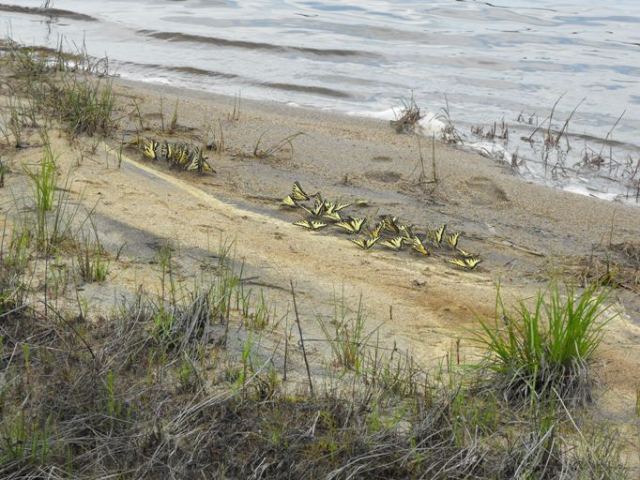
Everyday miracles 3: thirsty butterflies -- by Evelyn Yvonne Thériault
originally posted by Evelyn Yvonne Thériault in the blog Canoeing In Canada 7 June 2010.

*****
Lac de la Vieille is Home Base
for me and my husband when we go canoe camping in Parc de la Verendrye.
I never fail to discover something new and last week (May, 2010) was no
exception! I happened upon this scene while strolling along the beach
at the campsite and I had to do a little research when I got back home
to figure out what I was seeing. In fact, the only butterfly I’ve ever
been able to identify by name is the large, orange Monarch – and I’ve
never stopped to consider butterfly behaviour.
So, please keep in mind that this is my first try at identification, but I’m pretty confident that these are Canadian Tiger Swallowtails (Papilio canadensis). Not only does it match the description, but a species sheet for this Swallowtail says that it is “an avid mud-puddler and sometimes hundreds will gather at the same puddle, jostling for position”.

What is mud-puddling, you ask? Well, Tiger Swallowtail males cluster
together in damp places (such as mud puddles) and use their proboscis
to suck up liquids. Butterflies need these liquids to obtain vital
nutrients (e.g. salt and minerals) which are not present in the nectar
of flowers. Now for the especially fascinating part – how do the Swallowtail females obtain these nutrients? Apparently, these nutrients are passed on by the male to the female during the mating process.

Friday, 1 February 2013
Everyday Miracles 2: a blizzard in Iowa – by Jim Kessler
cancellations and freedom from pressing
responsibilities
 a day to do whatever came to mind
 the beauty of the Creation magnified
the beauty of horizontal flying snow
blessed isolation

blessed isolation

enchantment and heat from flames in the
fireplace
time to think great thoughts
the purity of fresh pure white snow
time to think great thoughts
the purity of fresh pure white snow
 a day to do whatever came to mind
thankfulness for a warm, tight abode
birds flocking to feeders a hundred at
a time
dazzling white savanna and prairie
quietness and simplicity
a sense of the greatness and power of
God my protector. provider, and Saviour
the intricate patterns of drifts
delicate snow and intricate snow flakes
childlike joy and breathlessness on a
snowshoe hike at dusk
smallness when observing power in the
wind
a simplified landscape
 the beauty of the Creation magnified
a day of peacefulness, joy, calm, and
thankfulness
more reason to care for the Earth and
its multitude of living forms
fullness and purpose for living
peaceful rest
Thursday, 24 January 2013
Everyday miracles 1: snowflakes
Caltech professor Ken Libbrecht's research into snowflakes, ice crystals, and their growth:
This morphology diagram shows how they are formed under different conditions of temperature and humidity:


his stunning

photos.

More at his Caltech website, his snowcrystals.com and in the book Ken Libbrecht's Field Guide to Snowflakes.
Subscribe to:
Posts (Atom)