This summary is based on information from a number of NGOs and ecojustice coalitions.
Verily I say unto you, Inasmuch as ye have done it unto one of the least of these my brethren, ye have done it unto me:
Jesus, in Matthew 25:40.
We are called to cooperate lovingly with all who share our hopes for the future of the earth:
the Kabarak Call, approved at Friends World Conference 2012
We need heart politics. The immediate victims are non-white and aboriginal peoples, peasants, fishers -- the majority mothers and children. They are casualties of a world war, now being fought by stealth on at least ten fronts. They have no effective vote. Few powers-that-be in the rich countries care about them. As the aboriginal peoples of Idle No More remind us, We are on today's frontline, and you will be next. Climate refugees: today's 30,000/year will rise to a minimum 50 million in your children's lifetime. Climate change deaths, already 350,000 a year, will be four times that by 2030. UN head Ban Ki-Moon says, “Climate change is every much a security threat as an armed group bent on plunder.”

1. At climate negotiations, rich countries have consistently refused adequate direct aid, proposing “market mechanisms” instead, “leveraging private finance” in various “climate funds” under UNEP and the World Bank. This means carbon offsets: big corporate polluters can buy cheap “emissions credits” to continue polluting under any of the following labels -- CDM, JI, AR, REDD, LULUCF, PES, TEEB, WAVES, EU-ETS, other cap-and-trade systems and “voluntary” offsets, Natural Capital, Green Economy, Green Growth – while bragging about their “sustainability”. Banks, marketers and so-called "independent" consultants take a lion's share. The rest trickles down to big conservation NGOs and Third World governments who declare protected "natural" areas – in which GMO plantations and ethanol crops are counted! Those living there, aboriginal and local populations, are denied true consultation (FPIC), independent monitoring or appeal procedures. In many cases they are evicted at the point of a gun. Back on Wall Street, derivatives and tax deductions can grossly inflate the paper values of offsets into a card castle waiting to collapse: Friends of the Earth call it a "carbon casino" with few winners, many losers.
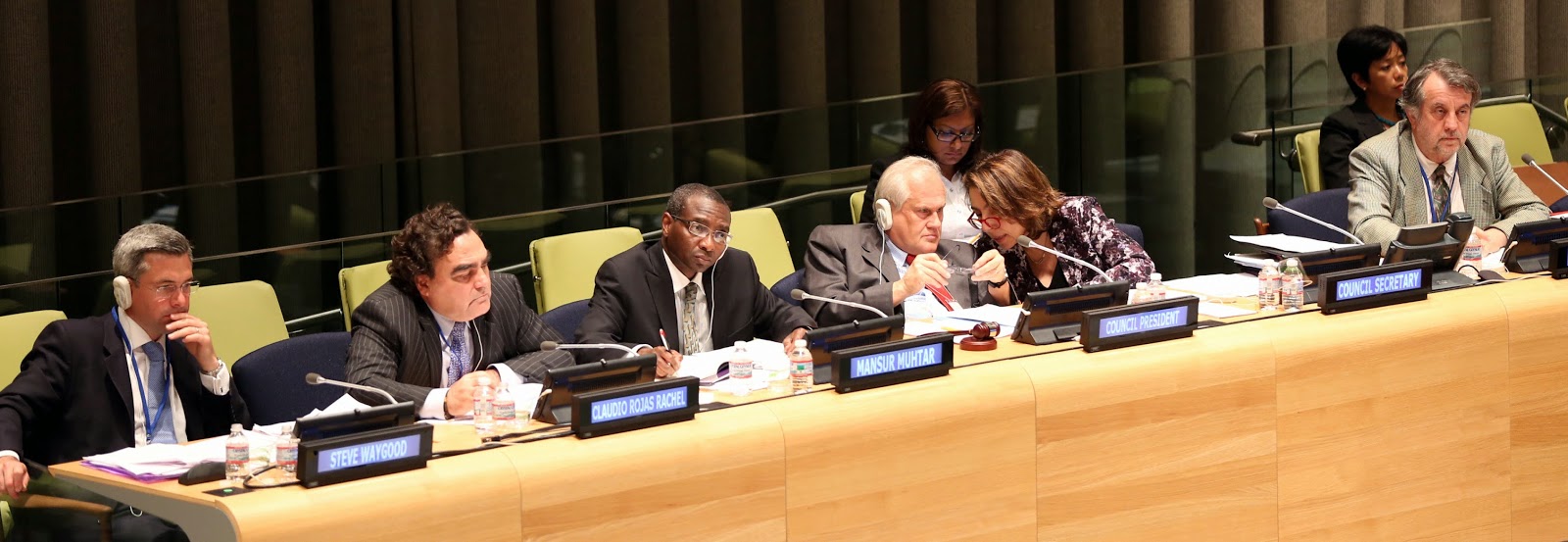
2. In SDG negotiations, “post-2015” Sustainable Development Goals (combining both climate and poverty action to replace expiring Kyoto goals and MDG) all UN agencies have committed themselves to offset financing. Rio+20's World We Want document June 2012 dictated by business lobbies (such as WBCSD, International Chamber of Commerce, and World Economic Forum at Davos) was massively criticized by NGOs as the “world we don't want”. Since then planning has continued behind closed doors, with NGOs excluded, by a committee of 'experts' drawn from banking and stock markets.

3. In the Convention on Biodiversity (CBD) there is a Nagoya agreement on Access and Benefit Sharing (ABS) which was meant to provide some revenue to poor countries and aboriginal groups whose genetic resources (GR) and traditional knowledge (TK) are being used for vast profit by big pharma and other multinationals. The ABS is halted by legal quibbling. With negotiation deadlocked, the payments are virtually nil, but bio-piracy continues. Is that justice? The CBD Alliance (of NGOs and aboriginal organizations) is now appealing to the UN General Assembly's Open Working Group.

4. In the World Trade Organization, the same interests beat down poor countries' laws to protect food security. Despite rhetoric about "level playing fields" the reality is market rule, not human need. Those who cannot buy food -- urban poor, peasants, fishers, women and children -- will starve. States who break WTO rules face closed-door 'arbitration' courts composed of corporate lawyers. This is already happening. Countries are being sued for loss of anticipated profits, democracy and environmental laws over-ruled, and billions of dollars in fines imposed under 'investor rights'.

5. At the Food and Agriculture Organization (FAO), attempts to rein in food speculation are being stymied by business lobbies -- a situation proven to drive the price of food to starvation levels (as in the 2007-08 food crisis), despite the best attempts at obfuscation by rightwing economists. Food stocks have dwindled. Speculators will game the market, again. Children's brains will be stunted. People will die. And we will be told (again) "nothing can be done".
6. Fishing to extinction has already occurred in many places. A major source of protein for the poor, still more key fish stocks are in imminent danger. Just offshore in places like Somalia and Senegal, unreported unregulated and illegal (UUI) fishing by rogue fleets continues, financed by the big banks. Bottom trawling, pollution, and climate-caused acidity are destroying marine ecosystems. Marine Protected Areas (MPA) have been proposed – some to be financed by offsets (see 1 above) but so far little has been done.
 |
| a new article for the Universal Declaration of Human Rights ? |
7. The World Water Council, a business lobby supported by UN agencies, continues its efforts to privatize one of life's essentials. For more than a decade Maude Barlow, Nnimmo Bassey and others have argued that water is not a commodity but a human right. Do we remember the Cochabamba water wars of 2000 that brought Evo Morales to power in Bolivia? AS Maud Barlow told the European Citizens Initiative in 2013, "The struggle for water justice is the most powerful struggle I know and absolutely key to all the others. We need democratic, just and public control of water if we are to survive."

8. Pricing medicine. Big pharma continues to insist on huge profits from patents -- “intellectual property rights” (IP) – while pricing AIDS and other vaccines beyond reach of the poor. Pay or die. Though some generic agreements have been reached they are far from adequate. Meanwhile (see 3 above), the same lobbies avoid paying for the genetic resources and indigenous knowledge on which many new medicines are based. And big pharma does "placebo" trials in the Third World (basically leaving a comparison group untreated), exposing those populations both to higher risk without consent AND higher prices.

9. Privatizing public services and resources. Under World Bank-IMF rules, poor countries mired in unjust debt are still forced as in previous Structural Adjustment Plans (SAP) to abandon public services, including hospitals and education, and to sell off lucrative state enterprises that are natural monopolies (electricity, telephone, posts and communications) or scarce resources (old-growth forests, minerals, gas and oil) at fire-sale prices. Business lobbies send lawyers in to “reform” mining codes and deregulate. This is called being “open for business”. Low royalties, tax avoidance, transfer pricing by multinationals, and hot money flight then drain the poor countries’ revenues. In some cases, huge areas of agriculture land are sold or leased – local inhabitants driven out by security forces. They must grow industrial crops for export, rather than develop sustainable smallholder agriculture to feed their people.
 |
| abandoned school, Detroit, USA |
10. Debt: bringing the Third World home. Now we see the SAP methods being applied in European “austerity”, with youth employment rising as high as 50%. In the USA: 1.3 million jobless thrown off UI benefits. In Detroit: bankruptcy, wiping out of pensions and union rights. Student debt enforcing servitude to the system; “temp” jobs that last forever; jobs with lower-tier benefits and pensions, if any; families falling below the living wage, inequality exploding. It is hard to escape the conclusion that coming generations are being robbed to benefit the 1% whose creed is that their incomes must rise forever. Not to mention the threat that the financial games will fail, the system itself collapse -- taking with it all the sub-systems: capitalist, communist, crony kleptocratic, nature itself with all life, "all our relations" that sustain us. Amid the ruins, at every crisis, there will be less and less ability to rebuild. Gated communities and security systems may keep the desperate hordes at bay; but who will ensure the guards' loyalty?
 |
| Police in Ferguson MO August 2014: slate.com photo |
Friends United Meeting, Minute on Care for God’s Creation, 2000 (excerpt): We call upon Friends to examine their own lives to see if their own patterns of consumption reflect self-centeredness and greed rather than a concern for living harmoniously in the creation, that we might witness to the world that harmony. We call upon the nations of the world, and in particular our own governments, to enact laws and reach agreements which will protect the creation from the effects of human exploitation, greed, and carelessness.
A green alternative
None of the above is inevitable. A sharing, caring economy that serves human need and safeguards “all our relations” in the living planet is not only possible, but is being practiced at the local level. My next draft will explore this vision in detail. Some sources: Caring Economy, Transition Network, It’s the Economy, Friends (Quaker Institute for the Future pamphlet, 2012), Beyond the Growth Dilemma (QIF pamphlet, 2012), NEF New Economics Foundation (UK) publications, and the checklist of earthcare goals What can we do?
References
Intro – climate deaths and refugees
Surplus deaths due to climate change were 140,000/year in 2004: World Health Organization (WHO) factsheets. DARA's Climate Vulnerability Monitor calculates over 5 million deaths and 350,000 refugees yearly, the latter rising to four times that rate by 2030. Overall threats to human security: UN Secretary General Ban Ki-Moon at Munich Security Conference 2 Feb 2014; and IPCC’s AR5 report (Mar 2014). See also Wikipedia on Environmental_refugees; current estimates are fogged due to political motives -- the American Association for the Advancement of Science (AAAS) predicts 50 million as early as 2020; other estimates range as high as 200 million by 2050: Myers 2002 and Reuters 2014. (On this scale, they dwarf the 50 million European immigrants to the US and British colonies between 1840-1914; or current 14 million “refugees”, 22+ million “internally displaced”, and 140 million “migrants” in UN estimates 2010). Massacres of migrants in the Mediterranean, and payment by EU states to corrupt North African regimes to shoot or imprison them before they reach its shores, have been reported for years by investigative journalist Gabriele del Grande's Fortress Europe. Currently the world's wealthiest one billion people alone consume the equivalent of the earth's entire sustainable yield: Hollister Knowlton, "Living in Right Relationship" Friends Journal 2009, quoting 2002 Living Planet Report..
One – climate negotiations
Friends of the Earth International director Nimmo Bassey says, Developed countries should radically cut their carbon emissions through real change at home, not by buying offsets from other countries. Carbon offsetting has no benefits for the climate or for developing countries -- it only benefits developed countries, private investors, and major polluters who want to continue business as usual.
Offset programs are described and compared in Dutch-Swiss governments' PMR Technical Note 6: Overview of Carbon Offset Programs - Similarities and Differences (INFRAS 2013). Wikipedia has good explanations of the Clean Development Mechanism and Joint Implementation (esp. “risk of fraud” - see also NGO fraud charges in 2010), REDD (see also redd-monitor.org ), LULUCF, Payment for Ecosystem Services. One of the more flagrant examples of greenwashing business-as-usual is the “clean coal” campaign at COP-19 in Warsaw November 2013;the Polish environment minister was fired for protesting. Rich countries are abandoning the Kyoto principle of common but differentiated responsibility (CBDR), pushing the burden of emissions reduction onto the victims, charges Ecuador negotiator Andrés Mogro's Jan 2014 statement to Foundation for International Environmental Law and Development (FIELD). Some evictions for offsets: Guatemala, Ethiopia, Mexico. Kenya. See also QUNO-Geneva reports 2013-14. For climate vulnerability by country, see Notre Dame U’s ND-Gain index and graphs (but even the “better” countries are threatened, as EPA’s drought map shows).
Two – SDG negotiations
The Economics of Ecosystems and Biodiversity (TEEB) and Natural Capital, intended as green reforms of business accounting to include externalities, environmental and social impacts excluded by standard economics, are now (despite warnings from the reformers) being used by offset promoters of PES. The 2012 Natural Capital Declaration at Rio+20 was backed by major global banks, business lobbies, UN agencies and big conservation NGOs who benefit from corporate donations. Opposing a November 2013 (Edinburgh) World Forum on Natural Capital, the NGO counter- forum Nature Is Not for Sale stated, Once a price is put on nature, all of our common resources can be bought, sold and packaged. Worse, as we have seen in the recent financial crisis, a market can be manipulated, repackaged and resold as financial derivatives, bonds and other products. In Dec 2013 UNEP aimed a TEEB/Natural Capital campaign at poor African countries. A parallel campaign by the World Bank, Wealth Accounting and Valuation of Ecosystem Services (WAVES) presents Natural Capital and PES as a green reform of national accounts to replace GDP; apparently benign, this initiative opens the door to offsets that would further indebt the poor countries – the “public leveraging of private resources” urged by the rich countries' G20 and accepted by the UN General Assembly Open Working Group (OWG) Technical Support Team brief Global Partnership (Jan 2014). See also “Problems of SDG Finance”, in The new Jubilee convergence (Quaker Earthcare Witness minute Oct 2013).
Three – the Convention on Biodiversity (CBD)
The CBD Alliance of environmental and indigenous NGOs is deeply concerned that proposed SDGs developed by business and carbon-market lobbies, incorporated in UN policy by OWG Technical briefs, will override CBD protections of indigenous and local communities (ILC): see its Jan 2014 appeal to the Open Working Group.
There are also problems with implementation. The Nagoya Protocol on Access to Genetic Resources and Benefit Sharing (ABS) was agreed in 2010. Three years later, the first draft rules (by the EU; other countries are even slower) weaken supervision, prior and informed consent (PIC) and access to benefit sharing (ABS); and threaten to legalize biopiracy: according to a 14 Jun 2013 email from Hartmut Meyer of GENET. He cites the 2013 study The Nagoya Protocol - Background and Analysis by Berne Declaration, Bread for the World-Church Development Service, ECOROPA, TEBTEBBA, and Third World Network. According to the Berne study, implementation has been seriously delayed by lack of certificates of compliance, failure to establish patent offices as checkpoints (p.131); multinationals and rich countries have been privileged over ILC (p.132). S Faizi’s 18 Mar 2014 email to biodiv_civsoc attaching a submission to CBD Expert Group on Poverty, repeats and substantiates these charges.
Experts are still quibbling over transboundary payments to support an ABS clearinghouse, indigenous knowledge (IK) vs intellectual property (IP), PIC consultations & mutually agreed terms (MAT) for bio-prospecting by multinationals. For legal and technical details, see International Union for Conservation of Nature and Natural Resources (IUCN), Explanatory Guide to the Nagoya Protocol on Access and Benefit-sharing (2012). CBD Alliance’s report CBDA Implementation Analysis (April 2014) concludes that when the poor “megadiverse” countries get desperately needed funding, hitherto denied by the rich and the corporations, it will be “just too late” for them and the planet.
Four – the World Trade Organization
Rich and poor countries clashed at the WTO in Bali Dec 2013. Blunt threats were made behind the scenes. The so-called “peace clause” merely delays harsh penalties on Third World regimes. Abandoned by many of its allies, India appeared to have won an exemption to protect food security, but its permitted subsidy cap is in doubt. Rich countries retained their domestic subsidies, which often result in dumping. Indonesia's Jakarta Post said flatly, The right to protect food has been traded away. WRI’s longterm forecast and the recent collapse of metals markets will drive commodities speculators back to food.
Food security depends on support to the world's small farmers, not on expansion of industrial agriculture, say experts in Wake Up Before it is Too Late: Make Agriculture Truly Sustainable Now for Food Security in a Changing Climate (UNCTAD 2013).
Five – Food speculation
See "A recipe for starvation" in this blog 8 Oct 2015; Wikipedia on the 2007-2008 food crisis with unprecedented price peaks in 2009 and 2012; commodity speculators were first accused by the NGO World Development Movement (report July 2010), Oxfam (2011), later by the UK Guardian and US Foreign Policy; the latter openly blamed “Wall Street greed” and Goldman-Sachs derivatives. Hundreds of economists called for action, but Congress failed to close the loopholes it had opened by the controversial US deregulation of 1999. Similar inaction followed the crashes of 1987, 1998, and 2007. The UK Independent reported a new round of speculation in 2013, betting on food as millions starve. UNEP's report to Davos Jan 2014 Assessing Global Land Use warns of increasing environmental limits. See the stinging critique of the present food system by Indian NGO Kalpraviksh (editorial, People in Conservation Apr-Oct. 2013). In earlier years, NGOs denounced the influence of agribiz lobbyists in the FAO. Expert reports by Quaker International Affairs Program (QIAP) The Future Control of Food (2008), Oxfam, Growing a Better Future (2012) and UNCTAD, Wake Up Before it is Too Late (2014) insist the whole system must be reformed to support small scale agriculture, food security, and allow the poor to survive. See also QUNO-Geneva reports 2013-14, Oakland Institute 2016 report Unholy Alliance (reviewed by GPF 3 Jun 2016)
Six – Fishing
Seven - Privatizing water
The World Water Council is dominated by corporations such as Suez, Veolia, Nestle, and the pro-offset IUCN: see Fighting the corporate agenda and Observations from the Budapest water summit 8-11 Oct 2013. For water wars, see Wikipedia on Cochabamba 2000, the movie FLOW (2008), and US Intelligence Community Assessment predictions in Global Water Security (2012), and Quaker Council for European Affairs (QCEA) 2013 reports on the Middle East situation (part 1, part 2). The five-country Amazonia Security Agenda (Oct 2013) raises questions of human security, water, food, health and climate regulation. Barlow's speech is from ECI 2013; for the campaign for water as a human right, see resolutions of the UN General Assembly 2002 and 2010; NGO actions in Circle of Blue and Blue Planet Project. The latter cites statistics such as unsafe water kills 200 children every hour; one third of consumer spending on bottled water would provide safe water for the whole world.
Eight – Pricing medicines
Rich countries refuse aid: Jeffery Sachs, World to Poor: Drop Dead, Huffington Post 12 Apr 2013; on TRIPS+ rules for big pharma, pay or die: Martin Khor, A Matter of Life and Death, IPSnews 10 Apr 2014. See Wikipedia on the Intellectual Property treaty (TRIPS), Generic drugs, and Trans-Pacific Partnership proposals. Global Issues 2010, Harvard Global Health Review 2011, International Health Journal 2011, and Catholic Medical Missions 2013 report typical Third World problems that call into question the defence of “price discrimination” by rightwing economists. In Jan 2014 big pharma threatened to pull investment from South Africa unless its terms were met; the rightwing Economist magazine is taking the side of the companies (no surprise). Primary healthcare needs: UNFPA says 800 women/day die in pregnancy or childbirth; add 200 children/day who die from unsafe water (section Seven above). See also the effect of IMF loan conditions (aka SAP) on medical services in Africa. On use of Third Worlders as "placebo" control groups: Marcia Angell, "Medical research on humans: making it ethical," NYRB 3 Dec. 2015. South Centre's plea for access to medicine June 2016.
Nine – Privatizing public services
UNCTAD 2014 reports historically low levels of investment (FDI) in poor countries; World Bank reports longterm trends in FDI and overseas direct aid (ADA) which is even lower, with remittances from migrants gradually replacing both as a main source of LDC revenues. See Wikipedia on Structural Adjustment, driven by the Washington Consensus in World Bank-IMF policy, and Public-Private Partnerships. The new World Bank president Jim Yong Kim has promised to reverse these policies and aid the poor. Time will tell. The UK New Economic Forum, Action Aid, Bretton Woods Project, US Global Policy Forum, and Jubilee USA criticize long-standing international investment and debt policies, corporate bribes/demands for public subsidy, transfer pricing (first practised by Big Oil: see Anthony Sampson's book The Seven Sisters, 1975), and tax avoidance, that suck billions of dollars out of poor countries' economies – often many times the amount of foreign aid they receive. Land grabs: see Global Policy Forum articles and the Land Matrix database. Evictions: see section One. See also DAWN reports of the impacts on women and girls.
Ten – Debt: bringing the Third World home
29 May 2016 update: Arizona Republican suggests "sterilizing women as a condition for receiving food stamps". The 2008 crash forced many US homeowners (especially minorities) to become renters, and repo men are rack-renting them: http://www.newyorker.com/magazine/2009/02/09/the-ponzi-state and http://www.newyorker.com/magazine/2009/04/06/cash-for-keys
Unaffordable America: poverty, housing and eviction (U Wisconsin study 2015)
See also:
Spain
https://www.hrw.org/report/2014/05/27/shattered-dreams/impact-spains-housing-crisis-vulnerable-groups
The crash of 2008 has caused 10,000 suicides in the developed countries: BBC 11 June 2014. In the EU, ICC (a form of SAP) austerity programs, together with migrant travail détaché [cheap contract labour] rules dictated by business lobbies, drive social welfare and working conditions down to the lowest common denominator: Monde Diplomatique (avril 2014) pp.1, 18-20. See also Mar 2014 Campaign for a European New Deal and Eurodad, Alternative Solutions to the Debt Crisis Mar 2014.
For China, see “Building the Dream”, Economist special report 19 Apr 2014: municipal debt, land grabs, and inequality.
For the USA, see the hard-hitting UPR stakeholder report (July 2014) by Rutgers' Center for Women's Global Leadership (CWGL) and the Political Economy Research Institute (PERI); NYRB 9 June 2016 Why the Very Poor Have Become Poorer
by Christopher Jencks; Prof. Robert Reich’s short video War on the poor and middle class, and documentary Inequality for All (2013); he summarizes his argument in Huffpost 25 Jan 2014 and his blog; George Graeber's overview in Debt: the first 5000 Years, ch.12. European austerity only increases inequality and poverty, warns Oxfam (Sept 2103). “It's the Austerity, Stupid: How We Were Sold an Economy-Killing Lie” in Mother Jones (Sep-Oct 2013) and “Truth has no place in the attack of inflation hawks” in Truth-Out 25 Aug 2014 show how rightwing economists and political echo-chambers mislead US media. 1.4 millions more might have lost their homes if Republicans had successfully stopped extended unemployment insurance: Dailykos 5 Aug 2014. The US home debt/foreclosure racket was analyzed by New Yorker 9 Feb 2009, Rolling Stone 10 Nov 2010, and Mother Jones 13 Jan 2014; NYRB 10 Mar 2016 on evictions: Kicked Out in America;
Bankrupt Detroit is only one of several US cities where “emergency managers” do Wall St bidding by cutting union rights, pensions and basic services to the poor; Sojourners May 2016 reports Detroit water now costs twice the US average, and 100,000 residents have had their water shut off. We The People of Detroit (WPD) are organizing to fight back.
The US student debt crisis affects 40 million, with 7 million in default -- their lifetime credit rating spoiled, according to Kyle McCarthy in Huffpost 25 Jan 2014; Forbes 7 Aug 2013 says it totals $1.2 trillion or 6% of national debt, averages $26,000, but is over $40,000 for one out of ten grads; "Million Student Protest" in Washington Post 12 Nov 2015; Mother Jones Sep-Oct 2013 reported a student debt racket in “For-Profit Colleges: Screw U”; a typical case in Alternet 1 Apr 2014; high debt ~ high pay for college admin: Institute for Policy Studies The One Percent at State U (June 2014). See studentdebtcrisis.org Does a college degree get you out of poverty? In 2012, 1.1million Americans with a bachelor’s degree, household heads working fulltime, earned less than $25,000/year: “10 poverty myths busted”, Mother Jones Mar-Apr 2014. US payday loan banks charge 350% annual interest: Guardian 23 Mar 2014.
The rightwing Economist 22 Feb 2014 urges “pension reform” (cutbacks) in the US, where 15 of 50 states owe 80%-120+% of revenue to ex-employees, a high debt level; and castigates Detroit’s “revenge of the 99%”; p.37 some Chinese provinces face debts 40-80% of revenues.
Finally, see Occupy / Strike Debt, Debt Resisters' Operations Manual (free online, 2012).
Martin Khor of Third World Network (TWN) 10 Oct 2016 warns of new debt crises; quantitative easing benefited only the 1% in rich countries but failed to induce growth, developing countries are severely indebted to speculatots (aka investors), threatened by instant capital flight and/or "investor rights" lawsuits. Financial reforms after the 2007-08 crash have been weak or absent.


 “Social
ecology advocates a reconstructive
and transformative outlook on social and environmental issues, and
promotes a directly democratic, confederal politics. As a body of
ideas, social ecology envisions a moral economy that moves beyond
scarcity and hierarchy, toward a world that reharmonizes human
communities with the natural world, while celebrating diversity,
creativity and freedom. Historically, the Institute for Social
Ecology has been a pioneer in the exploration of ecological
approaches to food production, alternative technologies, and urban
design, and has played an essential, catalytic role in movements to
challenge nuclear power, global injustices and unsustainable
biotechnologies, while building participatory, community-based
alternatives. The Institute strives to be an agent of social
transformation, demonstrating the skills, ideas and relationships
that can nurture vibrant, self-governed, healthy communities.”
“Social
ecology advocates a reconstructive
and transformative outlook on social and environmental issues, and
promotes a directly democratic, confederal politics. As a body of
ideas, social ecology envisions a moral economy that moves beyond
scarcity and hierarchy, toward a world that reharmonizes human
communities with the natural world, while celebrating diversity,
creativity and freedom. Historically, the Institute for Social
Ecology has been a pioneer in the exploration of ecological
approaches to food production, alternative technologies, and urban
design, and has played an essential, catalytic role in movements to
challenge nuclear power, global injustices and unsustainable
biotechnologies, while building participatory, community-based
alternatives. The Institute strives to be an agent of social
transformation, demonstrating the skills, ideas and relationships
that can nurture vibrant, self-governed, healthy communities.” 





