Wednesday, 28 September, 2011

Listening to what the land says -- by Ruah Swennerfelt

This is cross-posted from Ruah's research blog transitionvision.wordpress.com. She returned home in late July after visiting Transition Towns in Israel and Europe.
***
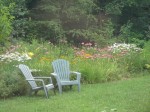
My flower garden has fruit trees and tomatoes growing in it
My flower garden has fruit trees
and tomatoes growing in it.
I so looked forward to coming home and then I returned to a heat wave. I had been complaining that I never got warm enough in Europe and then [in Vermont] had to suffer 97 degree Fahrenheit temperatures during the day and sweltering nights. But the heat wave’s finally broken and I’m reveling in the lush beauty of a Vermont summer. Our garden is producing lots of berries, summer squash, broccoli, peas, onions, potatoes, and tomatoes so far. What a bounty!

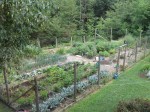
The main garden protected from deer. Several more gardens outside the fence.
The main garden protected from deer.
Several more gardens outside the fence
I’m loving the weeding and harvesting and especially the cooking. Last night at our neighborhood potluck we had a delicious pasta primavera, a salad from a neighbor’s garden greens, home baked bread, great wine, and another neighbor’s blueberries in a fabulous dessert. With great conversions sprinkled in, what more could one ask for? Currently our land is saying, “produce, produce, produce.”
Erik is learning that there’s another niche to fill in the Champlain valley, where so many people are focused on eating locally–rice. As he was quoted recently in the Burlington Free Press, “I love bread, and I love beer more than I love a plate of brown rice and a glass of sake – but if my inclination says bread, and the land says rice, I have to listen to what the land says.” And with that said, he’s invested money and time for his first rice harvest this year, hoping to produce 4,000 pounds of the stuff. The rice will be harvested with a horse-drawn reaper binder, and after the drying and threshing, it will be processed with a recently-purchased rice huller Erik ordered from China.

I was so moved by Erik’s statement. Actually, how brilliant is it to truly understand the land where you live, to have a deep sense of place? How often in human history have we not listened to what the land says? Deserts made green for agriculture and cities built where wildlife should have flourished are just two examples of how our incredible human creativity has backfired with unwanted results. What would it be like if we all took the time to observe and listen to the place where we live? It’s one of the basic principle’s of Permaculture. Once you really know your place, observe where the sun shines on the land in all seasons, know the changing temperatures, and observe how the natural world adapts to the place, it’s time to grow your food.

Tuesday, 27 September, 2011

Boycott that bottle - don't add to the Great Pacific Garbage Patch

The Great Pacific Garbage Patch, a Texas-sized ocean garbage dump of plastic debris concentrated by ocean currents that gradually turns into a life-killing sludge, was predicted by the NOAA in 1988 and explored by sailors Charles J. Moore, David de Rothschild, and trans-Pacific rower Roz Savage.

The Pacific Gyre picks up flotsam, plastic bottles, containers and objects from ships and shores, which photodegrade into ever smaller pieces, while remaining chemically a polymer even when ground down to the molecular level. Some plastics decompose within a year of entering the water, leaching potentially toxic chemicals such as bisphenol A, PCBs, and derivatives of polystyrene. Light enough to float, and invisible to the eye, this plastic sludge poisons the web of life (neuston) of surface waters.

Besides the particles' danger to wildlife, the floating debris can absorb organic pollutants from seawater, including PCBs, DDT, and PAHs – thus concentrating toxics and endocrine disruptors. The particles are small enough to be ingested by diatoms, plankton, fish and birds and thus enters the food chain. Next stop: you.

photo: Abbotsford Today 28 Sep 2010
When Roz Savage rowed more than 18,000 km across the Pacific, she encountered the visible marks of the GPGP: “Today...the worst I have ever seen it. I saw about 30 plastic bottles, yoghurt pots and bits of packaging. There is something deeply upsetting about seeing a beautiful blue ocean glinting in the sunshine, marred by a plastic bottle bobbing along on the surface.”

Savage at sea 27 Dec 2005: photo from flickr.com
Her journey took her almost a year, and 3 ½ million oar strokes – what counts, she says, is that “people are getting the message that when it comes to taking care of our planet, just like my oar strokes, every individual action counts.”


courtesy of franklygreen.com
David de Rothschild and Plastiki, courtesy of The Guardian
De Rothschild built a catamaran from 12000 bottles, the Plastiki, to sail from Sydney Australia cross the GPGP, to raise awareness of plastic pollution. He says,”Waste is a design flaw that doesn't occur in nature. It's time to rethink the life cycles of the materials we create...” Remember the 3Rs: reduce, re-use, recycle.

There is more than one toxic ocean dump. Another is reported in the Atlantic, and recent samples of albatross suggest a second garbage patch in the Pacific. Due to the small size of the particles, the patches cannot be detected by the naked eye or by satellite, only by towing fine nets through the water.
***
***
Quotations from UNEP "climate heroes" Savage and de Rothschild are from Tunza magazine vol.8, no.3. De Rothschild has written The Live Earth Global Warming Survival Handbook: 77 Essential Skills to Stop Climate Change—Or Live Through It, and an action graphic novel, The Boy the Girl the Tree. See also rozsavage.com. Wikipedia articles are referenced in the links above, and see our previous post on seabird ingestion. An essential industrial solution is cradle-to-cradle design

But the greatest impact could be made by you: boycott bottled water (which is often ordinary tapwater, resold to you at obscene profits), refuse to patronize its vendors, bottlers, and financiers. Above all, be conscious of your impact on the planet.

Sunday, 25 September, 2011

Financement climatique : le coup monté derrière le rideau

(Traduction en français de notre article du 23 sep)
Depuis un an, tous les agences de l'ONU sont ordonnées par le sécrétaire-général Ban Ki-Moon à suivre la ligne des « banquereaux » du WBCSD (le lobby des multinationaux non-pétroliers) dans le financement de l'« économie verte » ni pas par l'aide directe ni par la taxation les spéculateurs internationaux, mais par les marchés du carbone (MDP, REDD, PES) sans garanties suffisantes sur l'additionnalité, ni le consentement éclairé des populations vulnérables, par exemple dans la DDPA, ni garanties des droits de l'homme, ni procédure d'appel. Tout ce qu'il faut pour créer un casino de carbone, éclore une nouvelle bulle pour finir dans un autre krach, ajoutant à la dette des pays pauvres, et faussant le « développement ».

Banquereaux, ça veut dire la bande qui nous a amené ces effondrements mondiaux de 2000 et 2007, ces sauvetages que paieront vos enfants et petits-enfants, cette reprise sans emploi, cette «régulation» édentée de la spéculation financière internationale à Bâle III, et qui se préparent maintenant un coup dans les marchés non-réglementés de carbone. Un coup mortel: 300 000 décès chaque année sont dus au chaos climatique. Parmi les perpétrateurs, les suspects habituels: les grandes banques (depuis l'abolition de la loi Glass-Steagall indifférenciées des fonds vautours et speculatifs), qui contrôlent les institutions de Bretton Woods (le FMI, la Banque mondiale), tous compris dans le Consensus de Washington qui maintient le Tiers Monde dans une pauvreté abjecte. Les mêmes pouvoirs refusent l'aide directe aux pauvres du monde. Dans le cas où l'aide est accordée, elle prend soit la forme d'une bradage des biens de l'Etat et des ressources naturelles forcée par la dette, soit « aide liée » aux produits et services du pays donateur, c'est à dire une autre subvention cachée aux lobbyistes du donateur. L'ONU à beau d'annoncer une triple crise de l'alimentation, du climat et de carburant; cette « aide » bidon les aggrave tous les trois.

Les consultations PNUE-RONA d'octobre 13 à 15 à Washington (voir nos précédents rapports) visent à obtenir des ONG bien intentionnées et les groupes confessionnels un appui naif à l'« économie verte » tel que proposée -- sans garanties pour les peuples autochtones et pauvres, sans mécanisme d'appel, sans financement adéquat des OMD. Moins d'une semaine plus tard, le 19 octobre, le PNUE lancera son Initiative du marché du carbone, afin que l'affaire soit scellé avant qu'on sache.

Regardez bien la séquence d'événements:


3 au 5 septembre 2011: consultation du PNUE à Bonn, où les ONG européennes ont insisté sur:1. Une économie verte durable pour promouvoir l'équité sociale, l'égalité des sexes et l'équité intergénérationnelle. Qui respecte les limites de la planète, et assure une répartition équitable des ressources entre tous les pays, les groupes sociaux, hommes et femmes. Qui offre des incitations pour les économies zéro-déchet et à faible émission de carbone afin d'améliorer et restaurer l'environnement naturel, tout en fournissant des moyens de subsistance "vert" – de nouvelles possibilités d'emploi et d'entreprise pour les femmes comme les hommes. C'est pourquoi le 10 YFP SCP mise en œuvre devrait être le fondement des politiques de l'économie verte.
2. Afin de réaliser une économie véritablement verte, nous avons besoin d'une meilleure régulation des acteurs financiers internationaux et des flux financiers. Des instruments spécifiques pour parvenir à une écologisation de l'économie ont été proposées ...
- De nouveaux indicateurs de bien-être. Il est dans l'intérêt des générations jeunes et futures, que des mesures audacieuses seront prises vers une économie verte dans le contexte du développement durable et d'éradication de la pauvreté. Afin de réaliser la transition vers une économie verte, la politique réelle
mise en œuvre de nouveaux concepts tels que (ensemble de) des indicateurs pour mesurer le développement et l'internalisation des coûts externes doit être assurée et soutenue par des systèmes de gouvernance efficaces.
- Respecter les limites planétaires en toute décision, basée sur les meilleures
les connaissances scientifiques, eet tenant compte du principe de précaution
- L'introduction d'une TTF (taxation des transactions financières mondiales), afin de contribuer à la protection de financement de notre patrimoine mondial et du développement durable et les investissements dans les économies vertes et inclusive.
- L'éco-efficacité des instruments sont importants, mais il ya aussi un besoin de «suffisance» des instruments (l'innovation sociale, les bouchons sur l'utilisation des ressources, ...), en particulier dans les pays du Nord de s'attaquer à la surconsommation de - et une pression excessive sur - - les ressources naturelles.
3. Évaluation indépendante de la technologie ...
4. Contrôle du cycle de vie du nucléaire et de l'uranium ...

Ces demandes répétées des ONG, en commençant par la COP-15 à Copenhague, ont été soigneusement ignorées par l'ONU, le WBCSD, le G20 et le Consensus de Washington. La TTF ralentirait la spéculation, donc Wall Street, la City et les gnomes de Zurich feront tout pour l'arrêter.

22 septembre: lancement Green Building Council du Rio+20, partenariat du PNEU et du WBCSD -- suivi le 4 octobre par sa conférence à Toronto

11 octobre: Forum ouvert sur le marché du carbone du PNUE et son
Global Environment Facility (GEF) à la Banque mondiale, Washington

13 au 14 octobre: PNUE-RONA consultation régionale avec la société civile en Amérique du Nord, Washington

19 au 20 octobre: lancement de l'Initiative financière du PNUE à Washington. Regardez bien le programme pour le jour 1 et jour 2. Si ce n'est pas cuit d'avance, je démissionne comme analyste. La liste des participants comprend:
Depuis un an, tous les agences de l'ONU sont ordonnées par le sécrétaire-général Ban Ki-Moon à suivre la ligne des « banquereaux » du WBCSD (le lobby des multinationaux non-pétroliers) dans le financement de l'« économie verte » ni pas par l'aide directe ni par la taxation les spéculateurs internationaux, mais par les marchés du carbone (MDP, REDD) sans garanties suffisantes sur l'additionnalité, ni le consentement éclairé des populations vulnérables, par exemple dans la DDPA, ni garanties des droits de l'homme, ni procédure d'appel. Tout ce qu'il faut pour créer un casino de carbone, éclore d'une nouvelle bulle pour finir dans un autre krach, ajoutant à la dette des pays pauvres, et faussant le « développement ».

Voir la liste des promoteurs à la fin de notre article en anglais.

Friday, 23 September, 2011

The climate fix - behind closed doors

UN Sec-Gen Ban Ki-Moon has ordered all UN agencies to toe the line supported by the banksters and WBCSD (the lobby of the big non-oil multinationals) --  to finance the "green economy" not by direct aid or by taxing international financial speculators, but by carbon markets (CDM, REDD, PES) without adequate safeguards on additionality, informed consent of vulnerable populations e.g. in UNDRIP, human rights guarantees, or an appeal procedure. This will create a carbon casino, a new bubble that will end in another economic bust -- while adding to poor countries' debt burden, and distorting "development".

By banksters, I mean the crowd who brought you the world-economy meltdowns of 2000 and 2007, the bailouts that your children and grandchildren will still be paying for, toothless "regulation" of international financial speculation in Basel III, the jobless recovery, and now expect to make a killing in unregulated carbon markets. A real killing: an estimated 300,000 die yearly from the impacts of climate change. The perps include the usual suspects: big banks, indistinguishable from vulture cap and OTC finance since the abolition of the Glass-Steagall law, the Bretton Woods institutions they control (IMF, World Bank), bound up together in the Washington Consensus that keeps the Third World in abject poverty. The same powers refuse direct aid to the world's poor -- when aid comes, it takes the form of debt that forces fire-sale prices of state assets and natural resources, or is "tied" to products and service of the donor country, i.e. just another subsidy to corporate lobbyists. The UN refers to the triple crisis of food, climate and fuel; phony "aid" worsens all three.

UNEP-RONA civil consultations Oct 13-15 (see our previous reports) are intended to get well-meaning NGOs and faith groups to back the UN's Rio+20 "green economy" deal -- without safeguards for indigenous peoples, with no appeal mechanism nor adequate MDG financing. Less than a week later the UNEP Finance Initiative will launch the carbon market scheme in Washington, pre-empting both Durban and Rio.

The climate deal with the banksters will be sealed before people even know about it.

Look at this sequence of events:

3-5 Sep UNEP Global Consultation with Major Groups and Stakeholders on Rio+20, September 1, 2011 and the 64th Annual UN DPI: NGOs Conference, Bonn where European NGOs called for:
1. A ‘green’ economic system [that] must promote social equity, gender equity and intergenerational equity. A truly sustainable ‘green economy’ [that] functions within the limits of the planet, and ensures a fair distribution of resources among all countries and social groups - as well as between men and women. We need an economy that provides incentives for zero-waste, low-carbon economies that enhance and restore the natural environment, while also providing new ‘green’ livelihoods, employment and entrepreneurial opportunities for women as well as men. That is why 10 YFP SCP implementation should be the basis of Green Economy policies.
2. In order to achieve a truly green economy, we need better regulation of international financial actors and financial flows. Specific instruments to achieve a greening of the economy were proposed ...
- New indicators for well-being. It is in the interest of youth and future generations,that bold steps will be taken towards a green economy in the context of sustainable development and
poverty eradication. In order to achieve the transition to green economies, the actual political
implementation of concepts such as new (set of) indicators for measuring development and the
internalisation of external costs must ensured and backed up by effective governance systems.
- Planetary boundaries to be assessed and made the basis of decision-making on the basis of best
available scientific knowledge, taking into account the precautionary principle
- The introduction of a global Financial Transaction Tax [on international transfers], to contribute to financing protection of our global commons and of sustainable development and investments in green and inclusive economies.
- Eco-efficiency instruments are important, but there is also a need for ‘sufficiency’ instruments(social innovation, caps on resource use, …), especially in the Northern countries to tackle the over-consumption of -- and excessive pressure on -- natural resources.

3. Independent Technology Assessment...
4. Nuclear and uranium lifecycle control...
These repeated NGO demands, beginning at COP-15 in Copenhagen, have been studiously ignored by the UN, WBCSD, G20 and Washington Consensus. By no coincidence, they would slow down speculation. Wall St, the City and the gnomes of Zurich hate the FTT and will do anything to stop it.

22 Sep U.S. Green Building Council, UN Environment Programme and World Business Council for Sustainable Development Announce Partnership on Rio+20 - followup at Oct 4 Toronto conference

Oct 11 UNEP and GEF's Open Forum on the Carbon Benefits Project at the World Bank, Washington

Oct 13-14 UNEP-RONA Regional civil society consultation for North America, Washington

Oct 19-20 UNEP Finance Initiative, Washington DC - its Global Roundtable. Look at the program and speakers for day 1 and day 2. If that ain't "the fix is in" I'm a lousy analyst. Confirmed participants include:

Accession International, Inc.
Acciona Energia Mexico
AE
ALIDE-Latin American Association of Development Financing Institutions
American University
APG Asset Management US Inc
Argo Insurance Group
ASN Bank
ASOBANCARIA
Aviva Investors
AXA Group
Banco Bradesco 
Banco do Brasil 
Banco Rabobank International Brasil S.A. 
Banco Santander Brasil 
BANCOLDEX S.A. 
BANCOLOMBIA 
Bank of America Merrill Lynch 
Bank of Montreal 
Banking Association South Africa 
Barclays PLC 
BECAUSE 
Bentall Kennedy (U.S.) LP 
Bernstein Center, Columbia University 
BICBANCO 
Bloomberg 
BNDES 
BNP PARIBAS 
BNY Mellon 
Brazilian Federation of Banks 
Brown & Co 
BSD Consulting 
BSR
Caisse des Depots, Québec
CalPERS 
Calvert Investment 
Cambridge Programme for Sustainability Leadership 
Carbon Disclosure Project 
Carbon War Room 
cent.Force CO.,LTD 
Ceres, Inc. 
CFA Institute 
Change Logic LLC 
China Development Bank 
China Merchants Bank 
CIBC 
Citigroup 
ClearBridge Advisors 
Colonial First State Global Asset Management (Commonwealth Bank of Australia) 
Commercial Mortgage Alert 
Connexis Strategy Consultants 
Conservation International 
CREDIT ANDORRA 
Credit Suisse 
Cybaxx Enviromental Service Co. Ltd
DEG 
Deloitte 
Desjardins Group 
DEUTSCHE BANK 
Division for Sustainable Development, UN DESA 
DnB NOR 
DVFA
EarthSea 
EBF 
EBRD 
ECOFACT AG 
Econoler 
ecos 
Ecosystem Marketplace 
EFIC 
EIRIS 
Embassy of France 
Environmental Law Institute 
EPA 
Ethical Markets Media (USA and Brazil) 
Eurizon Capital 
EUROBANK EFG 
European Bank for Reconstruction and Development 
Evironmental Resources Management
F&C REIT Asset Management 
FD 
FGVces 
FirstRand Limited 
FirstRand Ltd 
FMO 
Forest Footprint Disclosure Project 
Fox School of Business, Temple University 
Fundaciao Social
GiCaP Products 
GIIRS 
Global Energy Assessment 
Global Leadership Interlink 
GLOBE Foundation 
GUARDIAN HOLDINGS LIMITED
Handelsbanken 
Harvard Business School 
Helm Group 
Hermes Focus Asset Management Ltd 
HSBC Bank plc
Indepedent Consultant 
Industrial and Commercial Bank of China 
Industrial Development Corporation 
Inflection Point Capital Management 
Infrastructure Leasing & Financial Services Ltd 
Insurance Australia Group 
Inter-American Development Bank 
International Finance Corporation 
International Institute for Sustainable Development 
IRRC Institute 
Itau Unibanco
Jones Lang LaSalle Incorporated 
JPMorgan
KfW 
KPA Pension 
KPMG
Macquarie Bank 
Manulife Financial 
MaRS Discovery District 
mecu Limited 
Ministry of Economic Affairs, Netherlands 
MINISTRY OF NIGER-DELTA, Nigeria 
Mizuho Corporate Bank, Ltd. 
MSCI, Inc. 
Munich Re 
Munich Reinsurance Company 
Mutualista Pichincha
National Academy of Sciences 
National Association of Insurance Commissioners, USA 
National Institute of Advanced Industrial Science and Technology, Japan 
National Round Table on the Environment and the Economy, Canada 
Nedbank Ltd
Oceanic Insurance Group 
OPIC
Pace Law School 
Pacific Institute 
Pax World Management LLC 
Portfolio 21 Investments 
Principles for Responsible Investment 
PROFONANPE 
PRUPIM
Rabobank Nederland 
Raiffeisen Zentralbank Austria AG 
RBC Capital Markets 
Renco Technologies Private Ltd. 
Royal Bank of Canada 
Royal instute of thecnologhy 
ROYAL MICROFINANCE OF ZAMBIA LIMITED
Samsung Fire and Marine Insurance 
Santam 
Santander Brazil 
Sarah Cleveland 
SEB 
Shell Oil Company 
Social Investment Organization 
Societe Generale 
Sovereign 
SSgA 
Standard Bank  
State Street Corporation 
State Street Global Advisors 
Sumitomo Mitsui Financial Group 
Sustainable Business Institute (SBI) 
Sustainable Prosperity 
Sustainalytics 
Swiss Re
TD Bank Group 
The Conference Board 
The Co-operators Group Ltd. 
The George Washington University Law School 
The Jervey Group 
The Northern Trust Company 
The Sumitomo Trust and Banking Co., Ltd. 
The Transition Group 
The World Bank 
Trillium Asset Management, LLC
U.S. Environmental Protection Agency 
U.S. General Services Administration 
U.S. Green Building Council 
U.S. House Natural Resources Committee
UBS 
UNDP 
UNFCCC 
UniCredit 
Uniethos 
United Nations Foundation 
University of Cambridge Programme for Sustainability Leadership 
University of Waterloo 
US Agency for International Development 
US Department of Energy
Village Corps 
Virgin Islands Legislature
Washington State Insurance Commissioner’s Office 
WestLB 
Willis 
World Economic Forum 
World Green Building Council 
World Resources Institute 
WWF China 
WWF US 
WWF-SA
XL Insurance
Zenith Bank PLC
And at the Jan 2012 Climate Finance & Carbon Markets Africa:
Ariesta Ningrum, Team Lead, Sustainable Development Mechanisms, UNFCCC
Nelly Magubane, Director General, Department of Energy, South Africa
Adam Simcock, CEO, Carbon Check, South Africa
Geoff Sinclair, Head of Carbon Trading, Standard Bank, UK
Kevin Whitfield, Head, African Treasury and Financial Products Unit, Nedbank Capital, South Africa
Henk Sa, Managing Director, Ecometrix, South Africa
Antoine Degri, CEO, ADERCI, Ivory Coast
Ntombifuthi Ntuli, Business to Business Programme Officer, Danish Embassy, South Africa
Enoch Lerato Liphoto, Senior Advisor, Climate Change, Eskom Holdings, South Africa
Hussein Elhag, Executive Director, Africa Energy Commission, Algeria
Georges Bakaly, Managing Director, WESD Capital, DRC
Bubu Jallow, Chief Technical Adviser, Department of Water Resources, The Gambia
Amos Wafula Wekesa, Environmental and Climate Change Advisor, VI-Agroforestry Programme Eastern Africa, Kenya
Philippe Decq, Sales and Marketing Manager, South Europe,Africa and Middle East, DnV, France
Ciska Terblanche, Managing Director, CDM Africa, South Africa
Heba Rabie, Regional Manager, Africa and Middle East, The Gold Standard Foundation, Egypt 

Sunday, 18 September, 2011

La voie, pour l’avenir de l’humanité -- par Edgar Morin


Critique du nouveau livre de Morin, au blogue Tournezlespages du 7 fév 2011. ***
Les mauvaises langues se gausseront de cette « prétention » du philosophe à définir une nouvelle voie, pour notre avenir commun. Ces mauvaises langues qui se sont unies dans un concert haineux contre le petit opus du grand résistant  Stephane Hessel devenu, par la grâce de quelques petits pisse- froid, un antisémite forcené, comme ce pauvre Umberto Eco, se retrouveront dans la dénonciation de ce qui est pourtant l’un des livre-programme les plus exigeants de ce nouveau siècle.

Edgar Morin nous rappelle, ce que les monothéismes et la philosophie de l’homme-dieu nous ont désappris, les humains sont une partie d’un univers plus vaste, ils ne peuvent vivre hors de cet univers, en dehors de leur fantasme technophages. Si chaque individu est unique, il ne peut vivre bien longtemps hors des autres. Dans un monde global, où la mondialisation tient lieu de politique de civilisation, il est temps de rappeler que nous sommes interdépendants et qu’il est temps pour nous de penser le monde et non les profits que nous pouvons tirer du monde.

Quatre parties, une politique pour le monde et trois grandes réformes. Des constats puis des propositions. Pas des rêves ou des fantasmes, non des réformes à court, moyen et long terme, exigeantes et fortes, demandant autant au politique qu’aux citoyens. Pour les amateurs du consumérisme forcené et du « après moi le déluge », du moment que j’ai ma crème antiride sur la gueule et mon livre de chair élevée en batterie dans mon assiette, autant de crimes contre la sacro sainte liberté de vivre dé-cul-pa-bi-li-sé. Pourtant le travail de Morin est exemplaire. Brillant, sans concession pour nos égoïsmes, plein d’espoir pour notre avenir, pour peu que nous essayions de nous souvenir que nous sommes des individus au cœur d’un cosmos. Curieusement nous sommes prêts à abandonner notre vie privée sur tous les réseaux sociaux du monde, mais nous nous refusons à sacrifier un peu de notre « confort » pour partager l’eau, l’air, la  nourriture, la terre, la connaissance et le respect.

Mais qui est ce donc ce « nous » ? « Nous », c’est l’homo occidentalus, celui qui depuis que son dieu a brisé les premiers liens avec l’univers, pour achever le travail de Cronos, et avec la complicité de ses philosophes prométhéens, a mis la terre, puis les autres hommes, les différents, les barbares, les autres, en esclavage. Notre système, nos valeurs s’imposent comme universelles et se noient dans le sang de ceux et celles qui ont tenté de résister. Notre système économique, notre sacro-sainte économie de marché épuisent les sols et les hommes, mais qu’importe. Elle réduit la culture, l’éducation, la santé, l’eau, l’air, le sang et chaque cellule de notre corps à des biens marchands que de moins en moins d’êtres humains, de descendants de sapiens peuvent espérer atteindre. L’inertie de ce système est telle que rien ne semble pouvoir ralentir le navire fou sur lequel nous sommes pourtant tous embarqués.

Edgar Morin refuse pourtant de renoncer. Il propose à ceux que ce système dégoûte et à tous les indignés, d’opposer à ce système qu’on nous impose comme le seul vivable, une autre voie, d’autres voies, des bifurcations, des chemins de traverse. Réformer le système nous impose de nous réformer profondément nous même. Refuser notre égoisme qui nous pousse à accepter la déforestation massive des grandes forêts pluviales pour construire nos terrasses, à accepter la souffrance et la barbarie de l’élevage de masse qui détruit l’environnement et notre propre corps, à accepter que des états dit démocratiques se comportent en occupants, détruisant et humiliant, à accepter pour pouvoir aller nous dorer la pilule dans des îlots de rêve que des millions d’hommes, de femmes et d’enfants souffrent de manque de nourriture, d’eau, de terre et de respect. Il nous faut refuser la nouvelle doxa qui nous invite à refuser la « culpabilité » du discours écologique, car ce discours est celui d’un nihilisme criminel.

Vivre sur une terre limitée avec des ressources limitées nous impose le contrôle de nous même et de nos appétits, bref l’abandon de ce lamentable stade anal dans lequel l’homo occidentalus semble se complaire depuis deux siècles. Une  nouvelle voie…

Edgar Morin était l’invité de Matthieu Vidard dans l’Emission La Tête au Carré sur France Inter. Passionnant.

Wednesday, 7 September, 2011

Un orme se meurt -- par Noëlle de Roo Lemos


D'origine hollandaise, Mme Lemos habite Montréal, et élève des abeilles sur sa feme au nord (où se situent ses articles précédents sur abeilles 1, 2, 3, et à propos d'une rivière sux saumons). En anthropologue, elle a publié des recherches  sur les dernières potières de Saint-Anne, Martinique. Ce video de 1m40s est une élegie pour un orme mourant dans les Laurentides.

Monday, 5 September, 2011

En descendant la Châteauguay -- vidéo par Olivier D. Asselin

This video is a unique view of the history and ecology of the Chateauguay River. Carte de la rivière / Map of the Chateauguay River watershed. It may inspire a similar youth project in your region!
Documentaire de 40 min sur l'état de la rivière Châteauguay au sud de Montréal et sur une volonté citoyenne de la sauvegarder. Le film est une production des Amis et Riverains de la Rivière Châteauguay, des Scouts 29e du Châteauguay et du réalisateur Olivier D. Asselin.


Friday, 2 September, 2011

A perfect summer -- by Peggy Senger Parsons

Peggy Senger Parsons is pastor of Freedom Friends Church, a Christ-centered, gay-friendly Quaker meeting in Salem OR. This post is reprinted with permission from her blog A Silly Poor Gospel 13 Aug 2011.
I am having a really great summer.

As you know, I believe deeply in the spiritual and emotional benefits of seasonality. I believe humans are hard-wired to need renewable predictable change. You should eat, wear, and do different things in each season. When fruits are fresh and abundant you should eat them until you are sick of them. Then you should not eat them until you crave them and have to wait for them again.

I have a recipe for a perfect summer. It includes:

  • a bowl of cereal, eaten in the backyard with my own strawberries, blueberries and raspberries
  • a day at the beacha visit with a large group of Quakers
  • a motorcycle ride with friends
  • fireworks
  • going out late in the evening for ice cream
  • fireflies
  • extra reading; 1-mystery, 1-Sci fi or fantasy, 1-true crime, 1-chick lit
  • a home grown tomato
  • a long solo bike ride without a map or destination
  • an extended road trip
  • an outdoor concert
  • enough free time to be bored at least once
The right combination of these things creates the sense of time stretching. This summer I have almost re-created that childhood feeling of the endless summer. I am deeply grateful.

I won't see fireflies this summer, and the tomatoes are in doubt, but I am knocking off everything else on the list.


We went on the road most of August. Covered five states. No computer, nor even a cell phone. When I wanted news (not always) I would buy a newspaper (while I could) and mail a few postcards (while we could). Eat when we are hungry and stop when we are tired. No flight plan. Sounds like heaven to me.


And when we get back, there will still be three weeks until school starts. Life is good.


What is on your summer list?