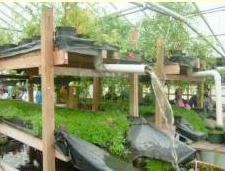
Sunday, 27 June, 2010

Interfaith Power and Light -- by Elaine Emmi

Elaine Emmi
Interfaith Power and Light does interfaith environmental action. To join it is a logical step for many Friends, and may become an important form of outreach for Quaker Earthcare Witness, to people of other faiths engaged in earth care.

I first heard about it when I asked Ruah Swennerfelt of QEW to present to the Salt Lake Interfaith Roundtable. I asked her how people of faith might turn their concerns into action.

At the same time I learned that Rev. Sally Bingham was coming to Salt Lake City to speak to the Episcopalians. So we asked her to speak to the interfaith roundtable as well. It was the best attended meeting they ever had, so we created Utah Interfaith Power and Light as an offshoot of the roundtable, which had just obtained 501(c)(3) status. We shared it through a DBA filing. A year later we got our own 501(c)(3).


"Jesus was an active person. Praying about clean water and air is fine. But taking action to make sure that the air and water are clean, that’s where we put our faith into action." -- Reverend Sally Bingham, Grace Cathedral, San Francisco

When we started, we asked the LDS (Mormon) representatives on Roundtable if they could be involved. They said, yes, as long as UIPL is not political. But education and outreach are "policy" and that is okay. Also we found that the outreach could include letters to politicians stating concerns, as long as we do not tell them how to vote. We also suggested in newsletters and emails that if they so desired they could sign onto this but it was not required as part of Utah Interfaith Power and Light. We take small steps, one at a time that everybody is comfortable with. Since we started we've gotten a little more political. We publish a monthly newsletter, The Light Pages, with news items (about COP-15 for instance), state and national updates, and invitations to write to Congress. We posted Sara Wolcott's blog from Copenhagen. Our website has in-depth material additional to what you find in the newsletter.

Doing an energy audit: photo by Leah Hogsten

What does Utah Interfaith Power and Light do? It is a religious response to climate change, but it's also a continuous worshipful reflection on the connections between spirituality and reverence for life on Earth. That's one of the most important things we do, helping all the faith communities make that connection. We do energy audits in churches, mosques, and temples. Our director will preach a sermon, or present a PowerPoint on earth spirituality. We also offer materials that help faiths in their explorations: "Sunday" school curricula, postings on the website, a lending library of books and videos. When a faith community joins they get a packet with a reading list, and a 90 minute video DVD, Renewal. [8 parts, also available on Youtube]


One of the most meaningful things Quakers can do in their own region is get involved. It's not only a means of personal transformation, but of action. One of the major reasons I became a Quaker was in order to be faithful seven days a week, not just on Sunday. As I became involved with interfaith work and regional health issues I found it very fulfilling. And in my own region there are specific issues that touch people of all faiths. Salt Lake City last year had the worst air quality in the USA. And currently we are still in shock from our own oil spill catastrophe - which happens to be in my neighborhood. The need to reduce the need for fossil fuels is even more imperative.
*****
See also the national InterfaithPowerandLight.org site, Sally Bingham videos and her blog, formerly IPLog. now called The Regeneration Project. Mormon proposals for greening churches, interfaith videos from Powering a Nation.

Friday, 25 June, 2010

G8 / G20 weak climate commitments get weaker -- by Geordie Gwalgen Dent

This is part 3 of a week-long series by Geordie Gwalgen Dent on the Toronto Media Co-op website. See parts one (world health), two (economic "reform"), and four (native issues), and its protest coverage.


With environment being a key focus for for global foreign policy and with Copenhagen plans in limbo, the Canadian government's decision to take climate change off the G8 agenda in May drew fire from environmental groups, the UN and other G8/20 countries.

The decision, highlighted by Stephen Harper's May declaration that all other issues besides the economy were 'sideshows', was also underscored by Canada's decision not to hold a a G8 environmental ministers meeting before the summit, the first time the meeting hasn't been held since 1994.

Last week, the Canadian government decided to put climate change back on the agenda of both summits. Such an idea has been pushed by UN Secretary General Ban Ki-moon since last year. Ki-moon has not been invited to attend the summit.

While the Canadian government has backpedaled on climate being on the agenda, it is unclear whether being on the agenda will lead to any tangible results.

Proof is in the Pudding

Several climate plans have been released at previous G8 summits including plans on carbon emissions and biodiversity with targets coming up in 2010. Previous comments in 2010 have suggested the G8 will also discuss phasing out fossil fuel subsidies, while preparing for a UN climate summit in Mexico this year to solidify the results of the disastrous Copenhagen summit.

Scott Harris, an organizer with the Council of Canadians, isn't buying it. "Some of the issues they are tackling are positive [but] if you look at the history of promises coming out of the G7/8, they are very bad at keeping them." Harris points out that the 2005 pledge by the G8 to double aid to Africa by 2010 is currently $20 billion short of the goal. Meanwhile, last years commitment to a $20 billion food security program by 2010 has only generated $800 million. "I’m not sure of the number but roughly 50 commitments are due for 2010. [The G8] makes roughly 200 commitments a year going back to 1997. The G8/20 make a lot of big promises, but the proof is in the pudding and they do not come through on promises in any way," he said.

"In Pittsburgh they said that they were going to seriously phase out fossil fuel subsidies but we’ve only seen increases," says Kimia Ghomeshi, a G20 / Climate Organizer with the Canadian Youth Climate Coalition. She points out that though commitments were made at Kyoto in the late 90’s, emissions have continued to rise.

Sakura Saunders, editor of protestbarrick.net, isn't even sure how some commitments would be implemented. "I think ending fuel subsidies is great, but it's going to have negative consequences. People are dependent are these things and I'm concerned it would be implemented badly. For example, Venezuela has the worlds largest fuel subsidies," she said. "Would [the G8/20] be trying to end the subsidies on a global scale? Or just G20 countries?"

Commitments aside, unlike the detailed plans released for economic or health plans, Harper has only said that "some issues surrounding climate change" will be discussed "on the margins".

Other Forums For Talks

Ghomeshi says she is "not surprised" by G8's failures on climate change. "I don’t think [the G8/20] are accountable or competent. They do not have administrative structure. The Harper government has no interest in climate change. We’re not a leader in climate change [policy] and we’re the worst performing G8 country [in carbon emissions]. What they want to do is continue business as usual."

Besides subsidies and emissions, Ghomeshi and Saunders say other issues like local, renewable, community energy infrastructure, climate reparations, and international environmental law should be on the table in talks on the environment. "The G20 owes $141 billion a year for climate debt to the Global South as well as indigenous communities," says Ghomeshi.

Where do they see these issues being addressed?

For Harris, the choice is obvious: "The G20 has been presented as more legitimate than the G8 because it represents 2/3rds of the population and 85% of global economic output. But we don’t think they are; they exclude 172 countries and 1/3rd of the world's population. We believe these issues should be dealt with at the UN."

Ghomeshi believes the Cochabamba Summit held in Bolivia this year is a far better model. "I had the opportunity to go to Cochabamba in April and that was really inspiring and monumental for me. After going to two UN conferences what I saw was impacted communities taking the lead on issues that impact them the most. A people’s declaration was submitted to the UN," she said.

Toronto Days of Action Continue

In Toronto, two events yesterday targeting the G8/20 focused primarily on climate issues.

The 'Toxic Tour' [see video above] saw 300-400 people visiting key players in Canada's mining industries in Toronto's downtown. Canada is home to 75% of the worlds mining companies including the notorious tar sands. Mining companies Barrick Gold and Gold Corp were targeted as well as Royal Bank of Canada (a major tar sands investor), Enbridge (an oil and gas distributer) and many others.

Later in the evening on 23 June, there was a People's Assembly on climate justice. Brett Rhyno, an Organizer with the Toronto Climate Campaign for "Kyotoplus", says that the meeting, inspired by the Cochabamba Summit, discussed the need for
* a moratorium on the tar sands
* changing energy usage
* changing consumption
* indigenous sovereignty.

For Ghomeshi, the Toronto assembly is a local way to address climate issues democratically. "People get to talk about their communities and provide good work and address those inequalities," she said.
*****
See also analysis of the rich nations' Copenhagen Accord tactics, reports on the Cochabamba climate justice movement, and the desperate call by the UN for support of Millenium Development Goals.

Tuesday, 22 June, 2010

Fièvre d'essaimage, mai 2010 -- par Noëlle De Roo Lemos


Après cinq ou six semaines de froidure, le temps s'est finalement mis au beau. Nous sommes à la mi-mai. Du côté de l'étang, bernaches, becs scie, oiseaux migrateurs, tout un petit monde ailé s'agite autour des nids et des nichoirs. Plus près de la maison, les pommiers achèvent leur floraison. Pour un temps, à partir de maintenant, les fleurs vont se raréfier et, d'ici la prochaine miellée (production de miel allant de pair avec une importante floraison), les abeilles vont devoir se rabattre sur leurs réserves.

photos N. Lemos
Un bourdonnement inhabituel et une nuée d'abeilles faisant du sur-place devant les plateaux d'envol annoncent le début de la saison des essaimages.

On dit qu'il y a essaimage quand une colonie se divise en deux populations distinctes. D'un côté, l'essaim qui, aussitôt constitué, s'envole et se met généralement en grappe. De l'autre, les abeilles qui restent dans la ruche mère. On attribue le plus souvent ce phénomène à des conditions de congestion à l'intérieur de cette dernière. Nous aurions probablement pu l'éviter si les vérifications d'usage, les jours précédents, avaient pu être faites. La perte d'un essaim, dans la mesure où elle entraîne une diminution importante du nombre des butineuses, peut en effet sérieusement affecter la production de miel. Mais le froid des semaines précédentes a empêché toute visite.

Ruches à gauche, en contrebas de la maison
Présentement deux ruches sont en pleine révolution. Une fièvre les a saisies qui s'empare de nous également. Sans un mot et d'un commun accord, Pedro et moi sommes déjà en train de tout mettre en oeuvre pour les capturer. Qu'est-ce qui nous motive? Bien plus que des considérations techniques (pas même celle, comme il a été de tradition chez des générations d'apiculteurs, de vouloir augmenter le nombre de nos ruches), c'est un je ne sais quoi d'excitant, de motivant, qui nous pousse à agir ainsi. Nous sommes là, en plein milieu d'une nuée d'abeilles qui, bercée par le vent, oscille tantôt à droite, tantôt à gauche, tantôt droit sur nous. Une sorte d'atavisme nous entraîne à l'action.
Grappe avant l'envol
Pour s'emparer d'un essaim il faut savoir que ce dernier, après être resté un certain temps à faire du sur-place devant sa ruche, au moment de quitter, ne va jamais très loin. Les abeilles se rassemblent en grappe, à proximité, jusqu'à ce que les éclaireuses trouvent l'abri idéal, tronc d'arbre évidé ou autre, pour les accueillir. C'est à ce moment-là que l'apiculteur a quelques chances de les capturer. Il importe également de se dire qu'on n'est jamais en possession d'un essaim tant que la reine elle même nous échappe.

Essaim pénétrant dans la hausse
Posé en grappe tout en haut d'un tronc d'aubépine, le premier essaim a commencé, dans un premier temps, par accepter la ruchette mise à sa disposition en haut d'une échelle.

Pedro l'apiculteur heureux
À notre grande satisfaction, une longue procession d'abeilles a commencé à s'y introduire. Mais alors que nous croyions la partie gagnée, la fièvre les a reprises et, à nouveau, ce fut le départ. Pour le principe, nous avons encore un peu couru après elles mais cette fois-ci, elles nous ont quittés à jamais. La ruchette était-elle trop petite pour cette imposante grappe d'abeilles?

Pas de temps pour des regrets, cependant, car le second essaim exige présentement de notre part une intervention immédiate. Et cette fois-ci, cela se présente mieux, à la fourche d'une branche au bas d'un pommier. Une hausse à terre, un coup sec pour secouer la branche et voilà le gros de la grappe qui tombe à l'intérieur. La lente procession du restant des abeilles vers le nouvel habitacle signifie que la reine est déjà dedans. Nous pouvons commencer à respirer et, beaucoup plus tard, une fois les abeilles calmées elles aussi, nous les transportons dans le rucher à côté des autres colonies.

Les essaims sont de formidables producteurs de cire. Ils ont avec eux un très grand nombre d'abeilles "cirières" capables de construire des rayons en un temps record. En milieu sauvage, ce travail fournit à la reine des alvéoles lui permettant de pondre aussitôt et aux ouvrières de l'espace pour emmagasiner le miel. Grâce à cela, l'essaim a la possibilité de renouveler sa population avant que les abeilles arrivées avec la reine ne meurent. Cette capacité à faire rapidement de la cire peut être mise à profit par l'apiculteur qui a capturé des essaims pour lui permettre de reconstituer son stock de cadres. Notre matériel de réserve étant au plus bas en ce début de saison, ce succès remporté auprès du second essaim vient à point nommé.

Toutes ces courses de droite et de gauche, toutes ces acrobaties ont finalement eu une raison d'être technique.
*****
Voir aussi Louis-Gilles Francoeur au Devoir 29 mai 2010 "Est-ce la fin des abeilles? L'agriculture menace un insecte dont elle a pourtant besoin"

Thursday, 17 June, 2010

Pronunciamiento de Cochabamba y comparación con el Entendimiento de Copenhaguen

Tirado de el sitio cmpcc.org Conferencia Mundial de los Pueblos sobre el Cambio Climático y los Derechos de la Madre Tierra. [English version available at http://pwccc.wordpress.com/]

Pronunciamiento Mundial de los Pueblos (Mayo 31, 2010)

La voz de los pueblos debe ser escuchada en las negociaciones climáticas
En abril de 2010 más de 35.000 personas de 140 países se reunieron en Cochabamba, Bolivia y desarrollaron el histórico Acuerdo de los Pueblos, un documento basado en el consenso, que refleja las soluciones sustanciosas a la crisis climática. Nosotros, las organizaciones abajo firmantes, participamos y/o apoyamos este proceso histórico.Como reflejo de las voces de la sociedad civil global y los acuerdos alcanzados en 17 grupos de trabajo, el Estado Plurinacional de Bolivia hizo una propuesta oficial, compuesta por los componentes centrales del Acuerdo de los Pueblos de Cochabamba, al Grupo de Trabajo Especial sobre la Cooperación a Largo Plazo (GTE-CLP) en el marco del Convenio Marco de Naciones Unidas sobre el Cambio Climático (CMNUCC). Desde entonces, el acuerdo ha ganado el apoyo y el reconocimiento de diversas naciones y organismos regionales como el ALBA (Alianza Bolivariana de Nuestra América) y UNASUR (Unión de Naciones Suramericanas).

Por consiguiente, nos preocupa profundamente que el nuevo texto propuesto en el GTE-CLP como base para negociaciones climáticas no refleja ninguna de las principales conclusiones alcanzadas en Cochabamba.

El Presidente y el Vicepresidente del GTE-CLP (de Zimbabwe y los Estados Unidos, respectivamente) han incorporado en su lugar, todas las propuestas del Acuerdo de Copenhague, que ni siquiera tiene el consenso de las Naciones Unidas.

Instamos a la CMNUCC a adoptar las conclusiones alcanzadas por los movimientos sociales, pueblos indígenas y sociedad civil internacional en Cochabamba. Es a la vez antidemocrático y poco transparente excluir determinadas propuestas de las negociaciones, y es imperativo que las Naciones Unidas escuche a la comunidad mundial sobre este problema crítico para la humanidad.

Hacemos un llamado a todos los países de las Naciones Unidas y, en particular al Presidente y el Vicepresidente del GTE-CLP, a fin de incluir las conclusiones fundamentales del Acuerdo de los Pueblos en las negociaciones en el periodo previo a Cancún. Estas propuestas de preservación de la vida y la tierra incluyen:

1. Una reducción del 50% de las emisiones internas de gases de efecto invernadero por parte de los países desarrollados para el periodo 2013-2017 en virtud del Protocolo de Kioto, a nivel nacional y sin depender de los mecanismos de mercado.

2. El objetivo de estabilizar las concentraciones de gases de efecto invernadero a 300 ppm.

3. La necesidad de iniciar el proceso de considerar la propuesta de Declaración Universal sobre los Derechos de la Madre Tierra para restablecer la armonía con la naturaleza.

4. La obligación de los países desarrollados a que honren su deuda climática hacia los países en desarrollo y a nuestra Madre Tierra.

5. El suministro de recursos financieros equivalente al 6% del PIB de los países desarrollados para ayudar a enfrentar la crisis del cambio climático.

6. La creación de un mecanismo para la gestión integral y la conservación de los bosques que, a diferencia de REDD-plus, respete la soberanía de los Estados, garantice los derechos y participación de los pueblos indígenas y comunidades dependientes de los bosques, y no este basado en el régimen del mercado de carbono.

7. La implementación de medidas para reconocer los derechos de los pueblos indígenas deben ser garantizados de conformidad con la Declaración de las Naciones Unidas sobre los Derechos de los Pueblos Indígenas y los instrumentos y acuerdos universales de derechos humanos. Esto incluye el respeto por los conocimientos y los derechos de los pueblos indígenas, sus derechos a las tierras, territorios y recursos, y su participación plena y efectiva, con su consentimiento libre, previo e informado.

8. El incentivar los modelos de producción agrícola que sean ambientalmente sostenibles y que garanticen la soberanía alimentaria y los derechos de los pueblos indígenas y los pequeños agricultores.

9. La protección y el reconocimiento de los derechos y necesidades de los migrantes forzados por causas climáticas.

10. La promoción de la conformación de un Tribunal Internacional de Justicia Ambiental y Climática.

11. La consideración de un Referéndum Mundial sobre el Cambio Climático que permita al pueblo decidir que se hará sobre este problema, que es de vital importancia para el futuro de la humanidad y la Madre Tierra.

Exigimos que las conclusiones establecidas por Conferencia Mundial de los Pueblos sobre Cambio Climático y los Derechos de la Madre Tierra, que protegen la vida y la Madre Tierra, sean incorporadas al texto de negociación durante las negociaciones en Bonn, Alemania, del 31 Mayo al 11 Junio 2010.

No puede haber un proceso de negociación equitativa, transparente e incluyente, ni verdaderas soluciones a la urgencia de la crisis climática, si el texto de negociación del GTE-CLP ignora las voces de los pueblos del mundo cuyos negociadores deberían representar.

Comparación entre el Acuerdo de los Pueblos y el Entendimiento de Copenhaguen (Junio 16, 2010)

El debate sobre el cambio climático se encuentra dividido entre el “Entendimiento de Copenhagen” que no pudo ser impuesto por un grupo de países liderados por Estados Unidos en la Conferencia de Copenhagen realizada en diciembre del 2009, y el “Acuerdo de los Pueblos” que sintetiza las conclusiones de los 17 Grupos de Trabajo de la Conferencia Mundial de los Pueblos sobre el Cambio Climático y los Derechos de la Madre Tierra, que tuvo lugar en Cochabamba del 20 al 22 de abril del 2010.

El “Acuerdo de los Pueblos” parte de una visión integral sobre la cambio climático, incorporando el tema de las causas estructurales de la crisis climática, el rompimiento de la armonía con la Naturaleza y la necesidad de reconocer los derechos de la Madre Tierra para garantizar los derechos humanos, la importancia de crear un Tribunal de Justicia Climática y Ambiental, y el desarrollo de una democracia global para que los pueblos decidan sobre un tema que afecta a toda la humanidad y al Planeta.

De otra parte el “Entendimiento de Copenhagen” representa un paso atrás con relación al Protocolo de Kyoto proponiendo una metodología de compromisos voluntarios para los países industrializados responsables principales del cambio climático.

COMPARACIÓN

ACUERDO DE LOS PUEBLOS ENTENDIMIENTO DE COPENHAGEN

Limite de incremento en la temperatura promedio mundial

Limitar el incremento de la temperatura en el presente Siglo a 1º C para reducir los efectos del cambio climático. Para ello propone retornar a concentraciones de gases de efecto invernadero de 300 ppm. Limitar el aumento de la temperatura a 2º C, y después de una evaluación en el 2015 ver si es posible bajar la meta a 1,5 º C.

Reducciones de gases de efecto invernadero

50% respecto al año base de 1990 para el 2do periodo de compromiso en el Protocolo de Kioto desde 2013 – 2017, excluyendo mercados de carbón u otros tipos de compensación.Exige a los Estados Unidos ratificar el Protocolo de Kioto (PK). Plantea que todos los países desarrollados realicen reducciones comparables: EE.UU. no puede reducir 3 % y la Unión Europea 30 %. Rechaza los intentos de anular el Protocolo de Kioto. No fija una meta agregada para todos los países desarrollados. Propone reducciones voluntarias de los países desarrollados. Es decir que sólo comunican lo que van a hacer.No establece el criterio de que las reducciones tienen que ser comparables entre países desarrollados.No plantea que esas reducciones deben darse en el marco del segundo periodo de compromisos del protocolo de Kioto.Según un Informe de la Comisión Europea los compromisos voluntarios hasta ahora consignados bajo el Entendimiento de Copenhagen representan en el mejor escenario una reducción real de apenas el 2 % de los niveles de emisiones del año 1990.

Deuda Climática

Los países desarrollados tienen una deuda climática con los países en vías de desarrollo, la madre tierra y las futuras generaciones.Esta deuda climática comprende: la devolución del espacio atmosférico que ha sido ocupado con sus emisiones de gases de efecto invernadero afectando al resto de los demás países; a deuda con nuestra Madre Tierra que debe ser honrada como mínimo reconociendo e implementando en las Naciones Unidas una Declaración Universal de Derechos de la Madre Tierra: la deuda con los migrantes forzados climáticos; la deuda de adaptación y de desarrollo que comprende los gastos en los cuales los países en desarrollo tienen que incurrir para atender los graves impactos del cambio climático que ellos han provocado. No hace mención a la deuda climática

Financiamiento

Se debe asignar para el cambio climático un financiamiento superior al que actualmente se consigna en los presupuestos de defensa, guerra y seguridad de los países desarrollados.El financiamiento debería estar en el rango del 6 % del PNB de los países desarrollados responsables históricos del cambio climático, provenientes de fondos públicos, no ligados a mecanismos de mercado de carbono y adicionales a la actual Ayuda Oficial al Desarrollo. “aproximadamente 30.000 millones de dólares de los EE.UU. para el período de 2010-2012″ Esto representa el 0,005 % del PNB anual de los países desarrollados.Y “movilizar conjuntamente 100.000 millones de dólares de los EE.UU. anuales para el año 2020 con el fin de atender a las necesidades de los países en desarrollo”, Lo que significa un 0,05 % de su PNB.Aproximadamente un 50 % de este financiamiento provendrá del mercado de carbono.

Transferencia de Tecnología

Creación de un Mecanismo Multilateral y Multidisciplinario que garantice la transferencia de tecnologías para el cambio climático libre de derechos de propiedad intelectual. Propone un Mecanismo de Tecnología, que no se sabe si será sólo una vitrina de tecnologías disponibles.No hace referencia a la necesidad de cambios en los regímenes de derecho de propiedad intelectual.

Mercados de Carbono

Rechaza el mercado de carbón y otros modos de enfrentar al cambio climático basados en el mercado. Promueve el uso de los mercados de carbono y plantea la creación de nuevos mecanismos de mercado.

Bosques

Rechaza los mecanismos de mercado para la reducción de emisiones por la deforestación y degradación de bosques. Plantea la creación de un mecanismo que a diferencia del REDD + o ++ respete la soberanía de los Estados, garantice los derechos y la participación de los pueblos indígenas y comunidades de los bosques, y no se base en mecanismos de mercado de carbono. Propone incentivar las acciones relacionados con REDD en base a mercados de carbono.

Agricultura y Alimentación

Para enfrentar la crisis climática hay que llevar adelante una profunda transformación hacia un modelo sustentable de producción agrícola campesino e indígena/originario, y otros modelos y prácticas ecológicas que contribuyan a solucionar el problema del cambio climático y aseguren la Soberanía Alimentaria. No hace mención al tema

Reclasificación de países

Rechaza la reclasificación de los países en desarrollo de acuerdo con su vulnerabilidad. Respetó y aplicación del Art. 4.8 de la Convención Marco de las Naciones Unidas sobre cambio Climático. Promueve la reclasificación de los países en desarrollo en cuanto al cambio climático, dándoles trato preferencial según su vulnerabilidad.

Migrantes climáticos

Protección y reconocimiento de los derechos y las necesidades de los migrantes forzados por causas climáticas. Necesidad de abordar el tema en las negociaciones. No hace ninguna referencia a la migración causada por el cambio climático.

Justicia y cumplimiento de compromisos internacionales

Propone la adopción de mecanismos vinculantes que garanticen el cumplimiento de los tratados internacionales y plantea la constitución de un Tribunal de Justicia Climática y Ambiental. No propone ninguna medida para remediar el no cumplimiento de los compromisos internacionales por parte de los países desarrollados.

Referéndum Climático

Propone un Referéndum Mundial sobre el Cambio Climático para que los pueblos decidan sobre este tema de vital importancia para el futuro de la humanidad y la Madre Tierra. No hace mención a ningún mecanismo de consulta a la población.

Pueblos Indígenas

Reconocimiento y revalorización de las raíces indígena originarias de toda la humanidad y pleno respeto de los derechos de los Pueblos Indígenas. No menciona el tema

Derechos de la Madre Tierra

Propone discutir y aprobar en las Naciones Unidas un proyecto de Declaración Universal de Derechos de la Madre Tierra para restablecer la armonía con la naturaleza. En un sistema interdependiente no es posible reconocer derechos solo a la parte humana de ese sistema. La única forma de defender los derechos humanos es a su vez reconociendo los derechos de la Madre Tierra. Entre estos derechos figuran el derecho a la vida, el derecho a la regeneración de su biocapacidad, el derecho a mantener su integridad, el derecho a una vida limpia, y otros. No menciona el tema

Causas Estructurales

Plantea analizar y modificar las causas estructurales del cambio climático. Afirma que estas tienen que ver con el sistema capitalista que está centrado en la obtención de la máxima ganancia posible y en la sobre explotación y mercantilización de la naturaleza. No hace mención al tema de causas estructurales.

Tuesday, 15 June, 2010

Grow and die: the growth fetish and the American Dream -- Paul B. Farrell

DowJones/MarketWatch.com 8 Jun 2010, reprinted with Paul B. Farrell's permission.

What do we do now, oh great Zen master? "When you get to a fork in the road, take it,"
replies the wise one, Yogi Berra, greatest Yankee catcher of all time. His sage advice to economists, politicians and investors everywhere: "The future ain't what it used to be. We made too many wrong mistakes. You've got to be very careful if you don't know where you're going, because you might not get there."
Paul B. Farrell
At the crossroads
Growth, capitalism's most sacred commandment -- "Grow or die" -- may itself be on death row. With us since 1776, it's being challenged by a new reality that's flashing relentless warnings of an emerging new command from critics, contrarians and eco-economists: "Grow and die." Yes, you heard right.
  • Grow or die. Traditional economists say we need 3% GDP growth to support 100 million new Americans in the 21st century. Drill, baby, drill. New jobs to fuel slow recovery. Worse, exploding growth demands as the rest of the world adds 2.9 billion new humans all chasing their unique American Dream.
  • Grow and die. New eco-economists see Big Oil's destruction of our coastal economies, the rape of West Virginia's coal mountains, the unintended consequences of uncontrolled carbon emissions, and they ask: "When will economists, politicians and corporate leaders stop pretending world's resources are infinitely renewable?" Unfortunately, even the new eco-economists fail to factor population growth, the big 800-pound gorilla, into the equation.
eco-economics, from Wikipedia
Yes, we are all at a crossroads, all facing a dilemma, all confronting the ultimate no-win scenario: Growth is essential to support the global population explosion. Growth is also killing our world, wasting our planet's non-renewable natural resources. As a result, the "growth" mantra will eventually destroy civilization.

Put a face on this dilemma: Governor Bobby Jindal. Louisiana's greatest economic and ecological assets -- marshlands, coastal fisheries -- are being destroyed by capitalism run amok, Big Oil's greed. Yet Jindal's already telling the President to forget the oil drilling moratorium, forget new studies, forget regulations, forget restraining the Big Oil greed machine that got us here. Drill baby drill, now!

Yes, we're at the crossroads. This politician's a perfect example of the no-win scenario confronting all politicians, economists and citizens. He's on the horns of a very sharp no-win dilemma: We're damned if we grow. Damned if we don't.

Ultimate sin: Turning a blind eye, failing to seek real solutions

"When you get to a fork in the road ... take it." But which fork? Flip a coin? Same result either way: Heads you lose, tails you lose. A no-win situation. Not just Jindal, Obama and America, but Greece, Brazil and China. All politicians, all economies, all trapped in capitalism's most sacred, rarely challenged, commandment: Growth or die. Growth has achieved biblical reverence, blinding us to its toxic collateral damage.

The difference between the mindset of traditional economists and the new eco-economists is actually simple: Traditional economists think short-term, react short-term, pursue short-term goals. New eco-economists think long-term. Initially this may seem overly simplistic, but it fits perfectly. Here's why:
  • Short-term thinkers: Traditional economists are highly-paid employees and consultants in organizations with short-term horizons -- banks, institutional investors, big corporations, think-tanks, government. Quarterly earnings, tax season, election cycles are more important than what happens a decade in the future. If they can't survive the next budget cycle, "long term" is irrelevant.
  • Long-term thinkers: New eco-economists see, think and plan for the long-term. They understand Yogi: "If you don't know where you're going, you might not get there." They know short-term thinkers are setting America up for more and bigger catastrophes than the gulf oil spill. The hit film Avatar is a perfect metaphor: By 2154, Earth's resources are exhausted, forcing us to invade distant planets searching for new energy resources. Critics warn it'll happen earlier: United Nations and Pentagon studies predict population increases that will create unsustainable new natural resources demands by 2050.
sustainability, from Wikipedia
Your 'growth' test
The decision is yours. So sit back for a few minutes, take this little test. Read each of the following 11 news items from my clip files, edited for length. Several are hot off the press. A couple are from the winter months. The rest from earlier reports about growth, the 800-pound gorilla hiding in every nation's living room in every quarterly economic report, in the expectations that will make-or-break your own retirement plans.

Here's how to keep score
If you think the message of one of these edited news items supports long-term growth, give it three points. Two points if it's neutral. And if it favors short-term growth plus has faith that technology and the American Spirit will take care of the long-term, add one point. Your total score will be between 33 and 11.
- - - - -
1. "Most new jobs temporary ... unemployment high," Peter Morici report, June 2010. "The economy added 431,000 jobs in May but 411,000 were temporary Census jobs. ... Forecasters had expected 540,000 new jobs ... the big challenge is to keep GDP growing at least 3% to pull down unemployment."

2. "OECD raises forecast for economic growth," The Wall Street Journal, May 2010. The Organization for Economic Cooperation and Development, the Paris-based think tank, "cited strong growth in developing economies and the rapid rebound in world trade to predict that the organization's 31 members will see their combined gross domestic product increase 2.7% this year and 2.8% next year. ... U.S. economy is expected to grow 3.2%" in each of those years."

3. "Geithner rallies Europe on growth," Ian Talley, The Wall Street Journal, May 2010. Geithner's "growth" pitch is a fight to minimize change and preserve the status quo for American banks: "We all understand that part of recovery, part of growth, is to make sure that we make clear and credible commitments to restore gravity to our fiscal positions over time ... But we're also working to make sure our economies are growing."

4. "Economic outlook: Slow growth at best," Gary Shilling's Insight Report, June 2010. "Our forecasts of slow U.S. growth through 2011 may prove overly optimistic ... Most investors believe 2008 was simply a bad dream from which they've now awoken. We're returning to the world they knew and loved, with free-spending consumers supporting rapid economic growth, fueled by ample credit and backstopped by governments."

5. "The new normal," Pimco's Bill Gross, InvestmentNews Conference, Dec. 2009. "Investors will never again see the returns and profits of a few years ago. 'New normal' returns are half what we have grown used to over the past 10 to 25 years."

6. "Stiglitz urges end to GDP fetish," Bloomberg News Report, Sept. 2009. "The Nobel Prize-winning economist urged world leaders to drop the obsession with GDP and focus more on broader measures of prosperity." Many things important to individuals are not included in GDP. But will short-term thinkers agree?

7. "Numbers racket," Kevin Phillips, Harper's Magazine, May 2008. "The use of deceptive statistics has played a vital role in convincing many Americans that the U.S. economy is stronger, fairer, more productive, more dominant, and richer with opportunity than it really is." Corruption taints CPI, GDP, unemployment stats. How bad is it? The real numbers are a face full of cold water. "Economic growth since the recession of 2001 has been mediocre, despite a surge in wealth and incomes of the super-rich."

8. "A darker future for us," Robert Samuelson, economist, in Newsweek, Nov. 2008. "We Americans are progress junkies. We think that today should be better than yesterday and that tomorrow should be better than today. Compared with most other peoples, we place more faith in 'opportunity' and 'getting ahead.' We may now be on the cusp of a new era that frustrates these widespread expectations. ... Americans do not have a divine right to rapid economic growth."

9. "How a new jobless era will transform America," Don Peck, The Atlantic, March 2010. "The Great Recession may be over, but this era of high joblessness is probably just beginning. Before it ends, it will likely change the life course and character of a generation of young adults. It will leave an indelible imprint on many blue-collar men. It could cripple marriage as an institution in many communities. It may already be plunging many inner cities into a despair not seen for decades. Ultimately, it is likely to warp our politics, our culture, and the character of our society for years to come."

10. "Faustian economics," Wendell Berry, Harper's Magazine, May 2008. "The general reaction to the apparent end of the era of cheap fossil fuel, as to other readily foreseeable curtailments, has been to delay any sort of reckoning ... The dominant response, in short, is a dogged belief that what we call the American Way of Life will prove somehow indestructible. We will keep on consuming, spending, wasting, and driving, at any cost to anything and everybody but ourselves."

11. "What's so good about growth?" Michael Mandel, BusinessWeek book review, Nov. 2005. Ben Friedman's The Moral Consequences of Economic Growth "has scored a dead-center hit on the critical question: Why do we value economic growth? The usual argument is that a bigger GDP -- more goods and services -- leads to happier, more satisfied citizens ... [But] as the average income in a country goes up, so do expectations. As a result, the level of GDP per person in a country, taken alone, doesn't necessarily say much about the level of happiness. The lack of a direct link between personal satisfaction and the level of GDP per person seems to undercut the purely economic arguments in favor of growth."
- - - - -
Add it up
So what's your total score? Folks in the "grow and die" crowd (long-term thinkers and eco-economists) will score above 22. Anyone in the "grow or die" crowd (short-term thinkers and traditional economists) will score under 22.

Me? I'm still at the plate talking to Yogi about that fork in the road, about Avatar in 2154, about why God let that bad umpire's call kill a perfect game. Yes, still asking the wisest of all Zen masters which way to go. And after he repeats his answer for the umpteenth time, he pauses, then silently shakes his head, turns away and walks off the field and into the dugout. He caught a perfect game, and scored 33 points.
*****
See more Paul B. Farrell articles in MarketWatch, Wikipedia on Ecological Economics; Tom Prugh of Worldwatch, Seven key concepts of Green Economics; Robert Constanza et al., Introduction to Eco-Economics in Encyclopedia of Earth. Many other eco-ecologists are quoted in previous blog posts tagged EE.

Sunday, 13 June, 2010

A Great Urgency -- Arvol Looking Horse

A Great Urgency: To All World Religious and Spiritual Leaders
Arvol Looking Horse: photo courtesy World Harmony
My Relatives, Time has come to speak to the hearts of our Nations and their Leaders. I ask you this from the bottom of my heart, to come together from the Spirit of your Nations in prayer.

We, from the heart of Turtle Island, have a great message for the World; we are guided to speak from all the White Animals showing their sacred color, which have been signs for us to pray for the sacred life of all things. As I am sending this message to you, many Animal Nations are being threatened, those that swim, those that crawl, those that fly, and the plant Nations, eventually all will be affected by the oil disaster in the Gulf.


The dangers we are faced with at this time are not of spirit. The catastrophe that has happened with the oil spill which looks like the bleeding of Grandmother Earth, is made by human mistakes, mistakes that we cannot afford to continue to make.

rt.com video

I asked, as Spiritual Leaders, that we join together, united in prayer with the whole of our Global communities. My concern is these serious issues will continue to worsen, as a domino effect that our Ancestors have warned us of in their Prophecies.


I know in my heart there are millions of people that feel our united prayers for the sake of our Grandmother Earth are long overdue. I believe we as Spiritual people must gather ourselves and focus our thoughts and prayers to allow the healing of the many wounds that have been inflicted on the Earth.


As we honor the Cycle of Life, let us call for Prayer circles globally to assist in healing Grandmother Earth (our Unc'I Maka).


We ask for prayers that the oil spill, this bleeding, will stop. That the winds stay calm to assist in the work. Pray for the people to be guided in repairing this mistake, and that we may also seek to live in harmony, as we make the choice to change the destructive path we are on.

As we pray, we will fully understand that we are all connected. And that what we create can have lasting effects on all life.

So let us unite spiritually, All Nations, All Faiths, One Prayer. Along
with this immediate effort, I also ask to please remember June 21st, World Peace and Prayer Day/Honoring Sacred Sites day. Whether it is a natural site, a temple, a church, a synagogue or just your own sacred space, let us make a prayer for all life, for good decision making by our Nations, for our children's future and well-being, and the generations to come.

Onipikte (that we shall live),

Chief Arvol Looking Horse 19th generation Keeper of the Sacred White Buffalo Calf Pipe
*****
See also his Wolakota Foundation, Native American Quotes, Defenders of the Land, Indigenous Environmental Network (IEN), US Review of the UN Declaration on the Rights of Indigenous Peoples (UNDRIP), Wikipedia history of UNDRIP and blocking by rich countries including US and Canada.
On oil spills, see 10 most famous, list of world oil spills, map of world oil spills, Matthew Modine's "Sucking big oil's tit" (Huffington Post 11 June 2010) and comments.

Friday, 11 June, 2010

Kairoscanada -- Climate Justice tour, blog and discussion

As the G8/G20, the world's richest nations, squabble miserably about financial re-reg and climate action (with no solutions in sight) the Canadian interfaith organization Kairos is holding a series of 'town meetings' from coast to coast, based on its 5-page discussion paper Charting a road map to a sustainable future (May 2010) that quotes Sally Bingham, Gro Brundtland, Rees and Wackernaegel (inventors of the eco footprint), Herman Daly, Marilyn Waring, Tim Jackson, Sallie McFague, and others. It asks, “Who is my neighbour?”

We are all connected – God, humans, and other-than-humans. We are all in this together. In this worldview Jesus‟ command “to love one another as I have loved you” takes on an even deeper meaning. It expands the answer to the question, “Who is my neighbour?” It calls us to consider the well being of the whole earth community as we make political and economic decisions about how we are to live in the world.

How might we move in this direction? What are the concrete changes that we need to make both in lifestyle and in government policy? How can we create a momentum for change that will take us into the future?


It ends with three queries:
1) What would a sustainable economy look like for Canada? What would be the downside? The upside?
2) What social or political barriers would need to be overcome in the transition to a sustainable economy?
3) What is your response to the Climate Justice Now Network's position that, “Instead of trying to fix a destructive system, we should be leaving fossil fuels in the ground, reasserting peoples’ and community control over resources and production, re-localizing food production, massively reducing over consumption … ”

and invites all people of faith to further online discussion and a blog.

Wednesday, 9 June, 2010

Building a green economy -- Amory Lovins

Climaxing three decades of research and expert discussions, Amory Lovins of Rocky Mountain Institute offers this vision of a "green capitalist" transition in the USA. (français en bas)
Building on its 2004 synthesis "Winning the Oil Endgame", RMI's "Reinventing Fire" shows technology that exists, that works, and that makes money. It aims to move the US debate from "it’s impossible" and "how much will it cost?" to "here’s how" and "how can we invest in the next 5 years?"

For full details, see the RMI webpage Reinventing Fire links to proposals for green architecture, transport, manufacturing, and energy -- "a peer-reviewed, industry-validated roadmap of practical steps toward an efficient, resilient, cost-effective, all-renewable energy system".
[Thanks to Bill Curry for calling this to our attention. - Ed.]

En français: lire Andrée Mathieu, Développement durable - Pourquoi pas «réinventer le feu» dans Le Devoir 23 Sep 2010 et d'autres thèmes dans Le Devoir - environnement.

Tuesday, 8 June, 2010

Heartwood: cohousing in Durango -- by Dick Grossman

Cohousing is an attempt to establish old-fashioned community life. It started in Denmark. There are now about 100 projects in the USA. See cohousing.org. Ours is the largest: 250 acres in the foothills of the San Juan Mountains, including 65 acres of irrigated pasture, and woodland. The age range is from 3 to 70, and there have been several home births already. Some members are retired, some work from home, some commute about 20 miles into Durango.
Right now it smells of sage, and manure after rain. We have just put some aged manure on the garden. Real Colorado weather: about 17 inches of rain a year. Today, May 2, we woke up to a light dusting of snow. We are at 7000 feet. At Silverton, at 9500 feet, I've seen snow on the Fourth of July. We had a maypole yesterday on the village green, followed by brunch and a concert by Sally Shuffield, the director of Durango Nature Studies, with which Gail and I are very involved.

The common house
What we like most is that our actual home can be smaller, because many of the facilities are shared. We live independently, but with far more contact with our neighbors than in the average city. The individual homes are in a cluster, which saves on utility costs and leaves land free for green space, pasture, farming and wildlife. There is a common house that serves two meals and a potluck twice weekly, with a large kitchen and communal dining room, exercise room, two rooms for guests, and a store where Heartwood Farm food is sold. We have a greenhouse to grow food plants and flowers, and a wood workshop.
The yurt
We had a yurt which is used as a school. Some have lived there while building their own homes. Now it is also used for men's group ceremonies. We have a village green where a lot of ball games are played -- but we got tired of planting new sod and put in a tree. That doesn't interfere with a very nice ballpark

My wife loves to ride. She keeps two mares, Missy (a chestnut quarterhorse) and Shiloh (a half-Arab gray) in the pasture. Others keep llamas. Last year we started a greenhouse to grow organic vegetables, called Heartwood Farms.
The underlying principles are based on Quaker process. All decisions are made by consensus except in an emergency, If discussion gets heated, there is a silence to cool off and wait for inspiration. It is not specifically a religious group. We have no creed. I am the only Quaker member of the cohousing.

Gail is involved in the Choral Society, and (being a retired teacher) an early learning group. As a volunteer naturalist, she also leads children's nature trips, up into the mountains, into the valleys, and down into the plains. Durango nature studies has the curriculum online. They serve about 7000 kids a year. Because Our housing clusters leave room for other species, there are bears, cougars, mountain lions, bobcats, wild turkeys, deer and elk around us.

One of the Quaker testimonies is Community. I hadn't paid much attention to this but since living in Heartwood I have learned that cohousing requires you to interact and make group decisions. So it is really deepening my faith.

How did it get started? There were monthly get-togethers to recruit people. Gail suggested we go. I said fine, though I have no interest in joining -- because I write a monthly column for the Durango Herald. It turned out to be much more interesting than I thought. So we began to think that for ourselves. Usually we make decisions as a couple. But when we were in the hot springs with a friend, I found myself saying "we're joining", to my wife's great surprise.

The next step was to build a house. 20 years ago we decided not to build a home, because we have seen so many couples build and then divorce, so this was a big decision. We visited several cohousing projects in Denver and decided that our minimum was 1500 sq ft. There were nine plans available. Looking at plan C, I suddenly realized, "I've been in that house". From not being interested, here I was superintending the process. There were few decisions to make, because changes are expensive. All we needed to decide was the color of the carpet, the tiles in the kitchen, and one upstairs bath instead of two. Things went so well during construction that we were able to leave the country for five weeks, and ask neighbors to keep an eye on it.

strawbale passive solar duplex
We moved in about 10 years ago. 14 homes were constructed by Heartwood's contractor: some of packed straw clay, some straw bale, and one mixed the methods. One exception is of pumicrete with bamboo reinforcement. We have the only straw bale duplex in the USA. They are remarkably cool in summer and warm in winter. Kids love packing straw clay (an essential part of construction) because their feet fit in small spaces. We had bees and building parties.

We always had friends who lived as individuals, scattered across the suburbs. Now we have a close circle and visit together a lot, people we wouldn't have got to know otherwise -- a midwife, a very thoughtful and philosophical fridge repairman, the woman across the walkway who knows all the words from 1950s musicals, her new man who is a divorced Mormon who is a hard worker, plumber, builder, gardener, and instigated the farm project.

community brunch at the common house
Our greenhouse produces lettuce, tomatoes, carrots, and potatoes. Last summer we employed WOOFs , and sold produce to restaurants and farmers markets. We didn't make money so this year we have all volunteers, and everybody is eating extremely well.

For more details see Heartwood cohousing.

Sunday, 6 June, 2010

A human being in the cosmos -- Einstein

A human being is a part of the whole that we call the universe, a part limited in time and space. And yet we experience ourselves, our thoughts and feelings, as something separated from the rest - a kind of optical illusion of our consciousness. This illusion is a prison for us, restricting us to our personal desires and to affection for only the few people nearest us. Our task must be to free ourselves from this prison by widening our circle of compassion to embrace all living beings and all of nature. -- Albert Einstein

See also his biography in Wikipedia. Photo: Wikipedia français. Thanks to David Whitehead for finding this quotation.

Saturday, 5 June, 2010

Urban Farms & Fisheries -- from DailyKos

Published 29 May on DailyKos, part of a Feeding America series by Patriot Daily News Clearinghouse.

Millions of Americans need more nutritious and affordable food that can address problems of hunger, malnutrition, obesity and poverty. Yet, critics whine that our food stamp program for 40 million people that now costs $73 billion a year is "part of a long-term expansion in welfare and related programs." Chris Edwards from libertarian Cato institute says that "some government figures show that only 10 million people have a serious problem with hunger," yet the "number of people on food stamps is four times higher than the number of people with a serious hunger problem."
Guess it depends on how you define "serious problem with hunger." Here are some dismal stats [Canada's statistics are similar -- Ed.]:

* Percentage of high-poverty schools has increased from 12% to 17% according to a Department of Education report released this week: The percentage of schools where "students are eligible for free or reduced price lunch" has increased "from 12 to 17 percent between the 1999-2000 and 2007-2008 school years, even before the current recession was fully felt."

* 16.6 million American children live in homes with some level of hunger.

* 25% of American children did not have enough food in 2007 but lived in households that earned too much money to qualify for any government food assistance.

* 50% of all children and 90% of African-American children will need to use food stamps before their 18th birthday.

* Child hunger costs the U.S. economy $28 billion each year due to "health care, lost productivity, education system impacts, and charity system expenses."

* Pluto pointed out this week that 50 million Americans are malnourished:

Apparently, of the 300,000,000+ people in the United States, approximately 100,000,000 of them are poor -- and half of them are malnourished:

100 million people, fully one-third of the entire U.S. population, are at or below "200% of the federal poverty line of $21,834 for a family of four", which is a needs-measure made lame by the fact that no family of four can actually comfortably live on such a low annual income.

Not everyone qualifies for food stamps and food banks, as noted today by noweasels, continually face the pressures of finding enough food to feed the increasing number of Americans who need food. Additional supplementary means are needed to provide everyone with their human right to nutritious food each day.

Michelle Obama asked Will Allen of Growing Power to join her when she launched an initiative to end childhood obesity. That's because Allen started a food justice program to provide "fresh, nutritious, affordable ford to inner city residents" in those "food deserts" where big grocery chains have abandoned neighborhoods.

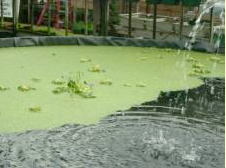
Growing Power uses aquaculture, or the "symbiotic cultivation of plants and aquatic animals in a re-circulating system." A fishery of Tilapia and Yellow Perch is used to fertilize a variety of crops in greenhouses at an urban farm in Milwaukee. In 2008, the Great Lakes Water Institute delivered 10,000 young (three-month old) yellow perch to Growing Power's urban farm in Milwaukee to test this indoor fish-farming system.


Using gravity for transport, water from the fish tank is drained into a gravel bed for filtration:

Here, beneficial bacteria break down the toxic ammonia in fish waste to Nitrite and then to Nitrogen, a key nutrient for plant development. On the gravel bed, we also use watercress as a secondary means of water filtration.

The filtered water is then pumped from the gravel bed to the crop growing beds. Then the water flows from the growing crop beds back to the fish tank. This is how it works:

Allen's Market Basket program provides weekly deliveries of produce to neighborhoods in Milwaukee, Madison and Chicago. Prices range from $9 to $28 for around 20-25 pounds of 12-15 varieties of produce that is designed to feed 2-4 people throughout the week.

There are so many additional benefits. Communities are brought together, old warehouses in cities are transformed into indoor fisheries and greenhouses, jobs are created and the perch population is restored. In the mid-1990s, the perch population in Lake Michigan collapsed partially due to an invasion of zebra mussels that hitchhiked on the hulls of ships.

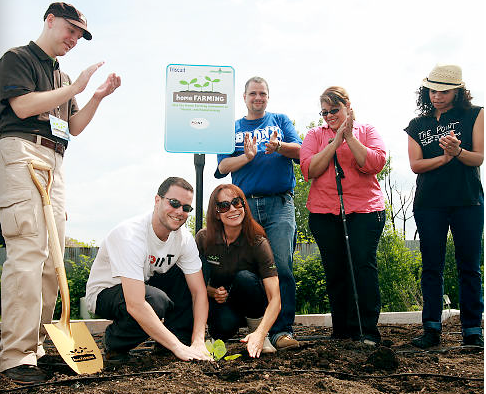
Another program called Urban Farming creates community-based farms nationwide and so far has "planted the equivalent of 1,000 garden plots -- 20 feet by 20 feet" that bring entire communities together from all generations as well as benefitting the environment with more green. A video at the link shows the community spirit of song and dance at the groundbreaking ceremonies.

Urban Farming allows poor communities and local food banks to obtain nutritious food:

This organization has turned almost 20 derelict properties in Detroit into urban farms. Through community support and partnerships with local business, these properties are now community gardens where needy residents can grow and pick their own fresh fruits and vegetables. Any leftover food from the gardens is donated to local food banks.

In 2005, the Detroit Urban Farming program provided one ton of food to food banks and community members. This is not the first time that urban farms sustained our nation:

Urban Farming wants to eradicate hunger in this generation's lifetime, Sevelle said. There is precedent; 20 million Americans grew victory gardens during World War II and grew 40 percent of the nation's produce supply.

A recent survey showed that "South Bronx suffers the highest hunger rate of any congressional district in the country. More than 36% of residents lack enough money for food." Now they have a new community farm on a 400-square-foot plot to feed themselves in a healthy, sustainable manner.
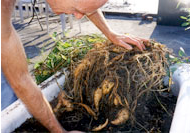
Gardening, on the other hand, means fresh air and exercise, and teaches kids about science, math, cooperation and patience, as well as yielding healthy foods, he said.

The broccoli, collard greens and tomatoes grown at the farm will be harvested for residents of the community, with any excess donated to food kitchens, said Ritz.

For neighborhoods that don't yet have access to urban farming programs, there is container gardening (resources and guide sheets provided at link) that uses a variety of sources, including old bathtubs to grow sweet potatoes.

Michelle Obama has been working hard to show that we have a food crisis in this nation of hunger, malnutrition and obesity. Local groups are also working hard to build the infrastructure to grow and distribute food. But America needs to realize that our food crisis is not limited to 40 million people receiving food stamps.

Friday, 4 June, 2010

New ecojournal: "Solutions"

Robert Costanza's Solutions journal is well-designed, scientifically reliable, and understandable by lay readers. Its editorial board includes David Orr, Paul Hawken, Elinor Ostrom, David Suzuki, Bill McKibben, Ray Anderson, Jacqueline McGlade, Wes Jackson, Richard Heinberg, and many more.

"It's exactly what we need! Careful and accurate accounts of the next steps that we need to take. We know the problems--now we need the answers." -- Bill McKibben

Its July/August issue on Appalachia showcases the writings of Wendell Berry, John Todd, Adam Lewis, Sarah Forbes, Eric Reese, and is dedicated to presenting innovative and alternative solutions for the challenges facing Appalachia. The September/October issue on Getting to 350ppm includes pieces on the smart grid, ecosystem services, democracy in China, open source information, geo-engineering, and much more. Authors include Bill McKibben, Gus Speth, Peter Fox-Penner, Joe Passacantado, Chuck Green, and the entire 350.org group.

Tuesday, 1 June, 2010

Soberanía Alimentaría y Ecofeminismo -- por Pilar Galindo

[Eso escrito ha parado en Ecocomunidades 31 de mayo 2010.]
La desigualdad de las mujeres respecto a los hombres, anterior al capitalismo, le es funcional. El mercado global es capitalista y masculino. El progreso económico se sustenta en la explotación de l@s trabajador@s y el trabajo invisible de las mujeres. La alianza entre el capitalismo y el patriarcado afianza el dominio sobre trabajador@s, mujeres, pueblos y naturaleza. Por eso la lucha de las mujeres por la igualdad no puede obviar la lucha contra las crisis económicas, los desastres ecológicos, la desnutrición y las enfermedades alimentarias o inmunológicas originadas por la economía global.

La inseguridad alimentaría afecta a media humanidad: más de mil millones de personas con subnutrición crónica y casi dos mil millones enfermas de obesidad, diabetes, estreñimiento, cardiopatías, etc. [1] . Millones de muertos anuales por desnutrición y carencia de agua potable, pero también por una alimentación enfermante (exceso de grasas, proteínas de origen animal, productos químicos, sal y azúcar refinada). [2]

La capacidad de una población para disponer de alimentos nutritivos en cantidad y calidad suficiente (seguridad alimentaría), es un derecho humano de primer orden y la condición para el desarrollo integral de las persona [3]. La economía de mercado no persigue la seguridad alimentaría sino obtener beneficios en el mercado mundial [4]. El hambre y la comida basura tienen su origen en la mercantil- ización, industrialización y globalización de los alimentos. [5]
El trabajo de cuidados realizado por las mujeres es la primera víctima de la inseguridad alimentaría. Somos las primeras en sufrir los daños de la desnutrición, las enfermedades alimentarias y el deterioro del medio ambiente sobre niñ@s y enfermos. La desigual condición de hombres y mujeres se agudiza en los países empobrecidos, las clases trabajadoras y los colectivos marginados.

La capacidad de los pueblos para producir, distribuir y consumir sus propios alimentos (soberanía alimentaría) es la condición para la seguridad alimentaría. [6] La mercantilización e industrialización de la agricultura y la alimentación para el mercado global es el principal enemigo de la soberanía alimentaría. [7] No hay soberanía alimentaría sin la autodeterminación de los pueblos y las mujeres para conseguir este derecho.

El capitalismo no ha inventado la separación de la esfera pública (mercado) y la privada (hogar), pero se beneficia de ella y la lleva hasta sus últimas consecuencias. Esta separación implica una dualidad de tareas y funciones hombre/mujer y la subordinación de las mujeres a los hombres, independientemente de su posición social.

La desigualdad de las mujeres respecto a los hombres, anterior al capitalismo, le es funcional. Los cuidados en el espacio domestico contribuyen a la producción de mercancías con un coste económico oculto. La economía externaliza ese coste que es asumido por las mujeres. Ninguna mujer puede reclamar a la sociedad el trabajo realizado en el ámbito doméstico. Tampoco puede abandonar esas tareas sin que caiga sobre ella la culpa, aunque la mayoría de los hombres lo hacen y no pasa nada.
en Chiapas
La economía de mercado considera improductivo el trabajo de cuidados. Pero no puede confundirse la conquista de la igualdad entre hombres y mujeres con la mera emergencia de los costes materiales de dicho trabajo.[8]

Si para liberar de estas tareas reproductivas a las mujeres se hace una estricta valoración económica (salarizar el trabajo doméstico), quedan fuera los aspectos inmateriales y no mercantilizables de esta actividad. Los cuidados implican experiencia, afectos, tiempos, no movilizados por un salario. La lucha de las mujeres para conquistar su independencia económica supone entrar en el mercado con la carga de los cuidados. Muchas mujeres entran en el mercado de trabajo global para cuidar a los hijos y mayores de otras mujeres, separándose de sus hijos. Mujeres asalariadas encadenan a sus madres para que cuiden a sus hij@s. La retribución del trabajo de cuidados no es nada sin el reparto del mismo entre hombres y mujeres. [9]

El mercado global es capitalista y masculino. El progreso económico se sustenta en la explotación de l@s trabajador@s y el trabajo invisible de las mujeres. La alianza entre el capitalismo y el patriarcado afianza el dominio sobre trabajador@s, mujeres, pueblos y naturaleza. Por eso la lucha de las mujeres por la igualdad no puede obviar la lucha contra las crisis económicas, los desastres ecológicos, la desnutrición y las enfermedades alimentarias o inmunológicas originadas por la economía global.

El "progreso" industrial disminuye el trabajo de cuidados mediante electrodomésticos que reducen el tiempo de cocinado y limpieza a costa de un gran consumo de materiales y energía. Supone un enorme negocio que daña nuestra salud por ondas electromagnéticas, químicos y emisiones de CO2, no generalizables a toda la población mundial. Los alimentos procesados y precocinados nos alimentan mal, nos enferman y son más caros. El ahorro de tiempo, lo pagamos en cuidados a l@s enferm@s.

Esta modernización se basa en el dominio del ser humano sobre la naturaleza y de los hombres sobre las mujeres. Ignorar la alianza entre capitalismo y machismo, supone una grave pérdida para la causa de las mujeres, reducida a un feminismo institucional y capitalista. Al igual que para el movimiento obrero supone perseguir un socialismo consumista, contaminante y machista.
La amenaza para la vida en el planeta nos interpela a las mujeres. La lucha por la supervivencia requiere enfrentarse a las multinacionales y sus políticos a sueldo. Pero también, impulsar acontecimientos económicos, asociativos y culturales en defensa de la vida, la naturaleza y la soberanía alimentaría.

Las mujeres de los países ricos, aunque subordinadas a los hombres, estamos del lado de los beneficiados por el capitalismo patriarcal. Con dobles jornadas, nuestras comodidades implican la explotación de la naturaleza y de otras mujeres. El capitalismo patriarcal y la civilización "moderna" desgarran la sociedad y manipulan la noción de bien común. No perseguimos una vida pacífica y segura para tod@s. Las personas beneficiadas lo son a expensas de las perjudicadas. El progreso depende de la subordinación de la naturaleza a la economía, de la mujer al hombre, del consumo básico al consumismo irracional, del trabajo al empleo y de la participación a la delegación.

El ecofeminismo plantea la necesidad de una nueva cosmología y una nueva antropología que nos coloque, como seres humanos, en el lugar que nos corresponde, dentro y no sobre la naturaleza y que potencie la cooperación, el cuidado mutuo, el amor, como formas de relación entre los hombres y mujeres, y entre los seres humanos y la naturaleza. [10] El ecofeminismo pone en cuestión la concepción ilustrada de que la libertad y felicidad del "Hombre" requieren de la emancipación de la naturaleza, mediante el dominio y control sobre ella para salir del reino de la necesidad en dirección al reino de la libertad. Esta concepción de emancipación implica el dominio sobre la naturaleza, incluida la naturaleza femenina. El ecologismo, con la denuncia de las catástrofes provocadas por la aplicación de esta concepción de "libertad humana", ha cuestionado las aplicaciones científicas y tecnológicas asociadas a estas teorías. El ecofeminismo, para ser ecológico y feminista, debe enfrentarse con la perversa emancipación derivada del progreso económico y tecnológico, sin olvidar que cualquier paso en la buena dirección implica, aquí y ahora, el reparto de trabajos y cuidados con los hombres. Esto significa remover las condiciones de vida de l@s beneficiari@s de la globalización interpelando a las clases medias de los países ricos, incluidos los sectores agrarios "modernos", el sindicalismo y algunas corrientes feministas cuando celebran, sin matices, la presencia de la tecnología en nuestra vida cotidiana y de las mujeres presidiendo multinacionales, ejércitos y estados agresores.

Debemos poner en primer plano las necesidades fundamentales: alimento, cuidados, afecto, salud, educación, vivienda, trabajo digno, cooperación, cultura y participación. Aprender de las mujeres campesinas una concepción de la supervivencia más austera en el consumo y más rica en las necesidades básicas económicas, sociales y afectivas. Atravesar la lucha feminista con la lucha por la seguridad y la soberanía alimentaría, la defensa de un consumo responsable agroecológico y el fin de la subordinación de las mujeres respecto a los hombres. Denunciar los abusos de las multinacionales y educarnos en una cultura alimentaría que nos defienda de la publicidad engañosa, mientras tomamos la seguridad alimentaría en nuestras propias manos.

Por Pilar Galindo, Colectivo Feminista Las Garbancitas.
Para adherirse a la campana: escribir un mensaje a gaksmadrid@nodo50.org o lagarbancitaecologica@nodo50.org

Notas:
[1] Informe de la FAO 2009 El estado de la inseguridad alimentaría en el mundo.
[2] Galindo, P. (coord.) Agroecología y Consumo Responsable. Teoría y práctica Ed. Kehaceres. Madrid, 2006 y 18o Entrega de la campaña contra la presidencia española de la UE Soberanía Alimentaría y Ecofeminismo.
[3] Ver apartado de Seguridad Alimentaría en "La seguridad alimentaría y sus condiciones de posibilidad", 1ª entrega de la Campaña 17 de abril, Día de las luchas Campesinas 2009.
[4] Ver "Distribución mundial y libre comercio de alimentos" 6ª entrega de la Campaña 17 de abril, Día de las luchas Campesinas, 2009.
[5] Ver "La industrialización de la agricultura", y "Mercantilización e industrialización de alimentos y naturaleza" 7ª y 5ª entregas, respectivamente, de la Campaña 17 de abril, Día de las luchas Campesinas, 2009.
[6] Ver apartado de Soberanía Alimentaría en "La seguridad alimentaría y sus condiciones de posibilidad", 1ª entrega de la Campaña 17 de abril, Día de las luchas Campesinas, 2009.
[7] Ver "La seguridad alimentaría y sus enemigos" 2ª entrega de la Campaña 17 de abril, Día de las luchas Campesinas, 2009.
[8] Sira del Río, "Globalización y feminismo". Pags.187-212. En El movimiento antiglobalización en su laberinto. Entre la nube de mosquitos y la izquierda parlamentaria. Ed. La Catarata-CAES. Madrid, 2003.
[9] Ver Sira del Río (2004) "La crisis de los cuidados: precariedad a flor de piel", alojado en la web de CAES.
[10] Shiva y Mies. Ecofeminismo. Teoría, crítica y perspectivas. Icaria, Barcelona. 1997.
[11] Ver "Frente a la inseguridad alimentaría, Agroecología y Consumo Responsable" 10ª entrega de la Campaña 17 de abril, Día de las luchas Campesinas, 2009.